News Daily


Men's Weekly

Australia

  • Written by The Conversation
How to never get a speeding fine again — and maybe save a child's life

What if our cars didn’t allow us to speed? Or, at least, strongly encouraged us not to speed?

We could help motorists avoid speeding — and therefore reduce emissions and fuel use, improve traffic flow, reduce crashes, lower insurance costs, make streets feel safer to walk and cycle – and totally avoid speeding fines.

Reducing speeding is crucial if we are to reduce the rising road toll. More than 1,200 people were killed on Australian roads in the past year.

It’s no wonder Australians want this technology – 81% believe “intelligent speed assist” technology is important for making roads safer.

Technology to stop speeding

“Intelligent speed assist” is the name of the low-cost technology that could save lives every year by reducing speeding.

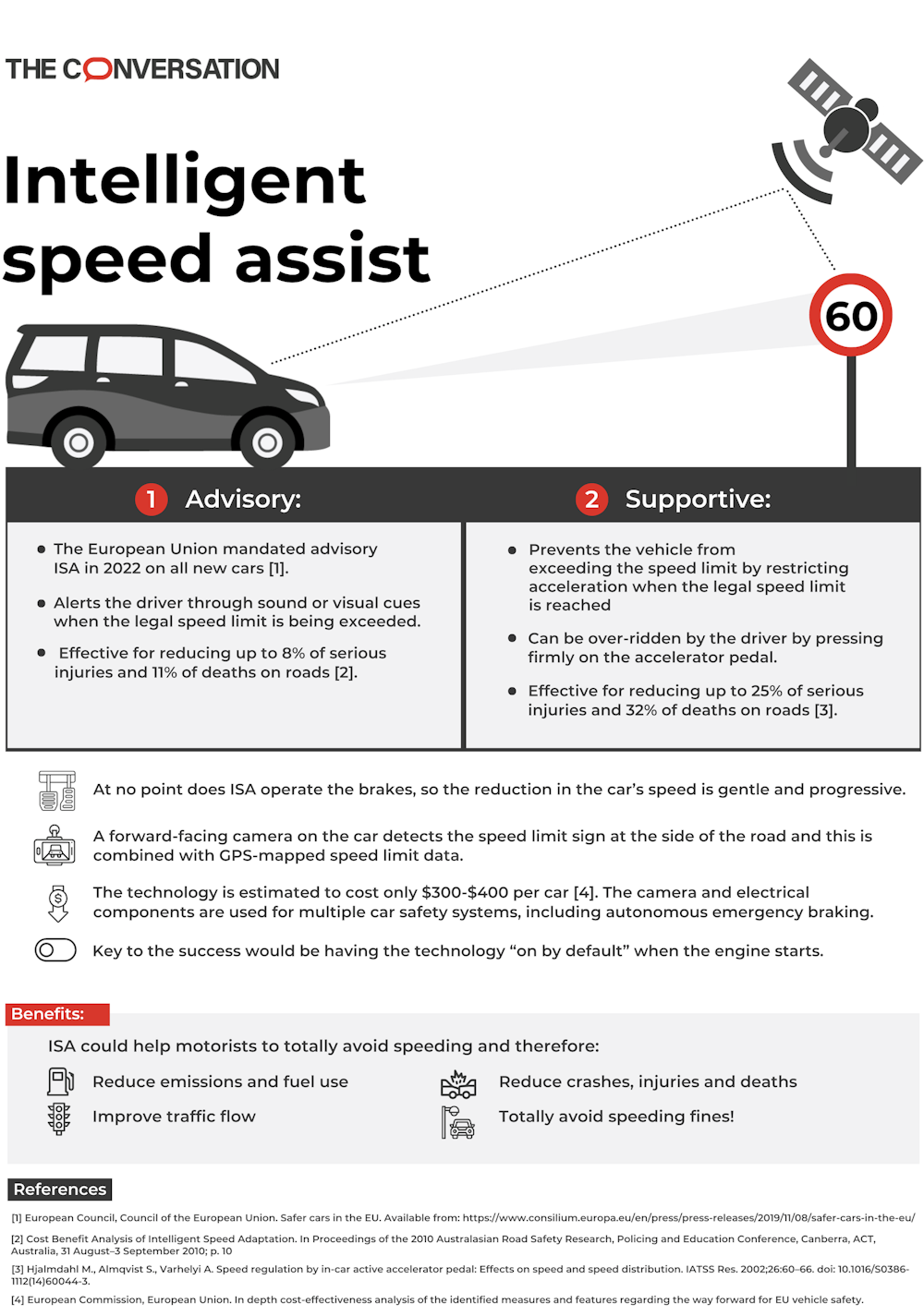
Graphic explaining what intelligent speed assist does, how it works and the benefits
CC BY The idea of helping drivers to avoid speeding is more than 100 years old. But early speed-limiting technologies proposed a top speed limit (similar to the way e-scooters are regulated in Australia), rather than allowing motorists the option to break the speed limit. If we don’t do intelligent speed assist, what’s the alternative? Currently, we must constantly monitor speed limits and adjust our speed accordingly to avoid speeding. That means looking often at our speedometers. There is some research to suggest continually taking our eyes off the road to review our speedometer could be dangerous. Given how often speed limits can change on a route, and that we all make mistakes, it’s no wonder speeding is so common. Will it work? Installing intelligent speed assist in all cars could prevent at least 8% and up to 19% of all crashes Australia-wide. This represents up to 200 lives saved per year. A NSW Centre for Road Safety trial found advisory intelligent speed systems reduced speeding in 89% of vehicles, across more than 1.9 million kilometres of testing. Intelligent speed assist is not yet a perfect system. Hurdles to overcome include: different speed sign coverage and designs from state to state maintaining an accurate map of speed limits across Australia for GPS potential over-reliance on the feature in varying driving conditions, such as wet weather, corners and so on. But shouldn’t we be doing everything we can to overcome these hurdles, to make such a life-saving, child-saving technology work as well as it can? What’s already been done? Legislation in 2022 has made intelligent speed assist technology mandatory for all new cars sold in the European Union. In Australia, if you drive a relatively new car, you may already have the option of intelligent speed assist. For example, if you drive a new Ford, you can activate its Intelligent Speed Limiter. Intelligent speed assist adds to a growing list of in-vehicle safety technologies, such auto emergency braking, lane keep assist and blind spot monitoring. We know older vehicles that lack such technologies are involved in more crashes. What about older vehicles? Cars have an average age of 10.4 years. So retrofitting older cars with intelligent speed assist technology has been trialled. Despite the European legislation, there’s no expectation of a wide-scale retro-fitting program. It is common, though, to retrofit fleet cars such as government and company vehicles with intelligent speed assist. This improves fleet safety and distributes new technologies when these vehicles are sold on the second-hand market. ‘But I only speed a little bit’ Research shows most people think they’re better-than-average drivers. More than one in four Australians think it’s ok to speed if driving “safely”. But you can’t speed and drive safely. For every 1km/h increase in speed, there is a 4% increase in fatal crashes. If everyone was to increase their speed by just 1km/h, we could expect an extra 48 deaths a year. Road deaths remain the number one killer of children in Australia and speed is the most common factor in a crash. Current measures to reduce speeding haven’t gone far enough. Despite two in three Australian drivers admitting to speeding every week, only one in ten got a speeding fine last year. If you are worried about the government losing out on revenue, don’t. Road traffic crashes cost the Australian economy A$27 billion a year. Speed camera fines generate just $1.5 billion a year. Read more: Despite lockdowns, 1,142 Australians, including 66 kids, died on our roads in the past year. Here's what we need to do 3 actions to get started Intelligent speed assist is not a silver bullet. But it is one of five crucial actions that can make zero road deaths possible. More than 200 cities around the world have already achieved this goal at least five times for a calendar year since 2009. Here are three actions to get started: install intelligent speed assist in all all public buses and government fleet cars – the NSW government fleet, for example, has 25,000 cars require intelligent speed assist for a 5-star ANCAP safety rating adopt the EU legislation in Australia to require intelligent speed assist in all new cars. We have an urgent problem, we have the technology, we have the evidence it works, so what’s stopping us using it to save lives on our roads? The authors have provided footage online of intelligent speed assist in action, for free reuse.

Read more https://theconversation.com/how-to-never-get-a-speeding-fine-again-and-maybe-save-a-childs-life-216347

Why Retail Cleaning Plays a Key Role in Customer Experience

In retail environments, cleanliness directly shapes how customers perceive a brand. Retail cleaning is not just about appearance but about creating a space where shoppers feel comfortable, confident, and welcome. From small boutiques to large shopping centres, a clean retail environment... Read more

Cleaner Floors, Healthier Homes: Lefant M3L Arrives as Australians Prioritise Pet-Friendly Hygiene

As pet ownership continues to rise, Australians are placing greater emphasis on maintaining a hygienic indoor environment for both family members and their animals. Issues such as dander, loose fur, and tracked-in dirt require consistent cleaning to support better home... Read more

How Home Removalists Save Time, Money, and Energy During Your Move

Moving to a new home is an exciting chapter in life, but the process of getting there can be overwhelming. From packing and organizing to transportation and unpacking, relocation involves a long list of tasks that can consume both your... Read more

Fulfilment Australia: Streamlining ECommerce Operations for Business Growth

As eCommerce continues to thrive, efficient order fulfilment has become one of the most critical components of customer satisfaction and business success. Companies across the nation are turning to professional fulfilment Australia providers to manage inventory, packaging, and shipping operations... Read more

Evaporative Cooling Cleaning Melbourne: Keeping Your System Fresh, Efficient, and Healthy

As Melbourne’s summers grow hotter, many homes rely on evaporative cooling systems to stay comfortable. While these systems are energy-efficient and environmentally friendly, they require regular maintenance to perform at their best. Professional Evaporative Cooling Cleaning Melbourne services are essential... Read more

4 Benefits of Exploring Australia in an Off Road Caravan

Australia’s vast landscapes offer a kind of freedom that can only be fully experienced on the open road. For travellers seeking caravans for sale, choosing one built for adventure can transform any journey into a memorable one. This article will... Read more