

COP28: Why China's clean energy boom matters for global climate action
- Written by The Conversation
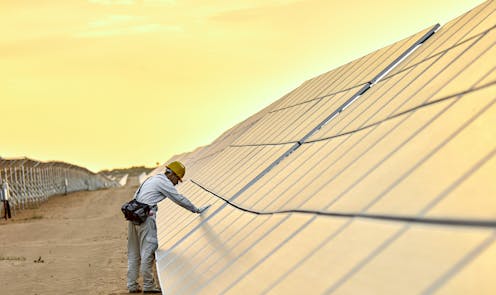
With an energy-hungry economy, an historic reliance on coal and vast manufacturing enterprises, China is the world’s single largest emitter, accounting for 27% of the world’s carbon dioxide and a third of all greenhouse gas emissions.
But China is also the world’s largest manufacturer of solar panels and wind turbines. Domestically, it is installing green power at a rate the world has never seen. This year alone, China built enough solar, wind, hydro and nuclear capacity to cover the entire electricity consumption of France. Next year, we may see something even more remarkable – the population giant’s first ever drop in emissions from the power sector.
The COP28 climate talks began well, buoyed by November’s Sunnyland Statement between China and the United States, the second largest emitter. At previous climate talks, US-China cooperation has been lacking. But this time, they’re largely on the same page.
The statement outlined joint support for global tripling of renewable energy by 2030, tackling methane and plastic pollution, and a transition away from fossil fuels.
The urgency of now
China has been looking for better coordination with the US on climate since US President Joe Biden took office. Climate is an area where these competing major powers can cooperate.
The COP28 talks in Dubai – meant to finish tomorrow – offer a window for joint action. Next year, the US could elect a different president with very different views on climate. China’s well-regarded veteran special climate envoy, Xie Zhenhua, is about to retire.
Read more: Why renewed China-US cooperation bodes well for climate action
In these talks, China – the world’s top oil importer – is looking for a compromise solution on the tense debate over fossil fuels. The world’s cartel of oil producing countries, OPEC, has called for focusing on emissions reduction rather than fossil-fuel phase out in the declaration. Xie and his team are trying to find a middle ground to ensure a final deal.
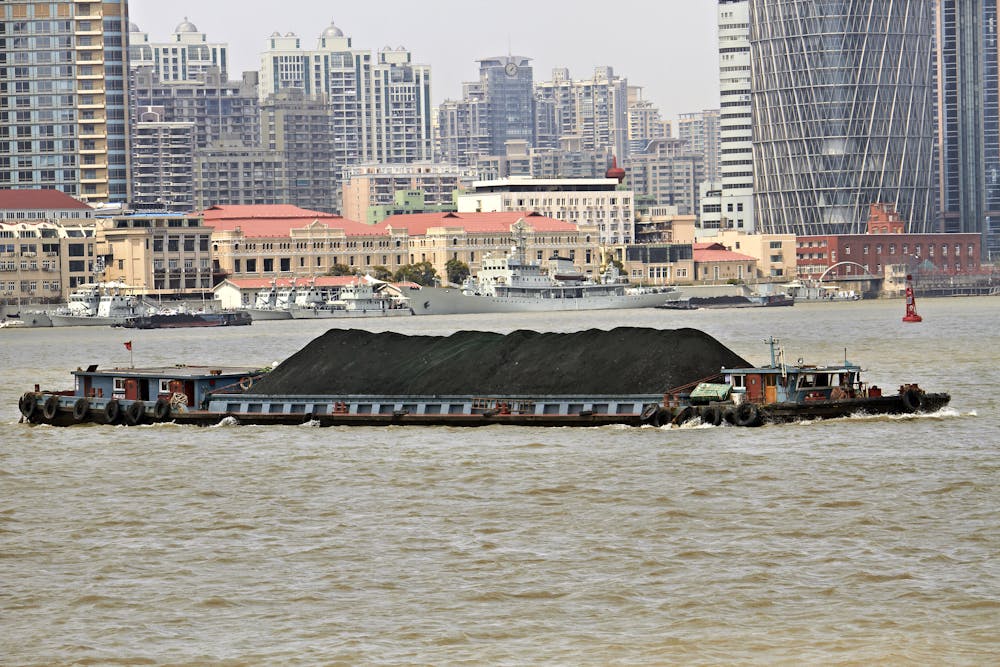
China has long been criticised for its continuing coal-fired power plant expansion. It has the world’s largest coal power fleet, and approved another 106 gigawatts worth of new coal plants just last year – the equivalent of two a week. But the five major state-owned power companies are already burdened by heavy financial losses.
Why build dirty and clean? It’s a longstanding national policy: build sufficient baseload supply first while expanding renewable capacities. But at COP28, Xie said something new:
[China will] strive to replace fossil fuels with renewable energy in a gradual manner.
A country of engineers
In developed countries, much clean energy work is driven by energy economists, who use incentives to change behaviour.
China is a country of engineers, who see these challenges as technical rather than economic.
In 2007, China released a national action plan on climate, calling for technological solutions to the climate problem. Private and state-owned companies responded strongly.
Fifteen years later, China is in the lead in every low-carbon category. Its total installed renewable capacity is staggering, accounting for a third of the world’s total, and it is leading in electric vehicle production and sales.
In the first three quarters of 2023, over 53% of China’s electricity came from low-carbon sources: hydro, wind, solar, bioenergy and nuclear.
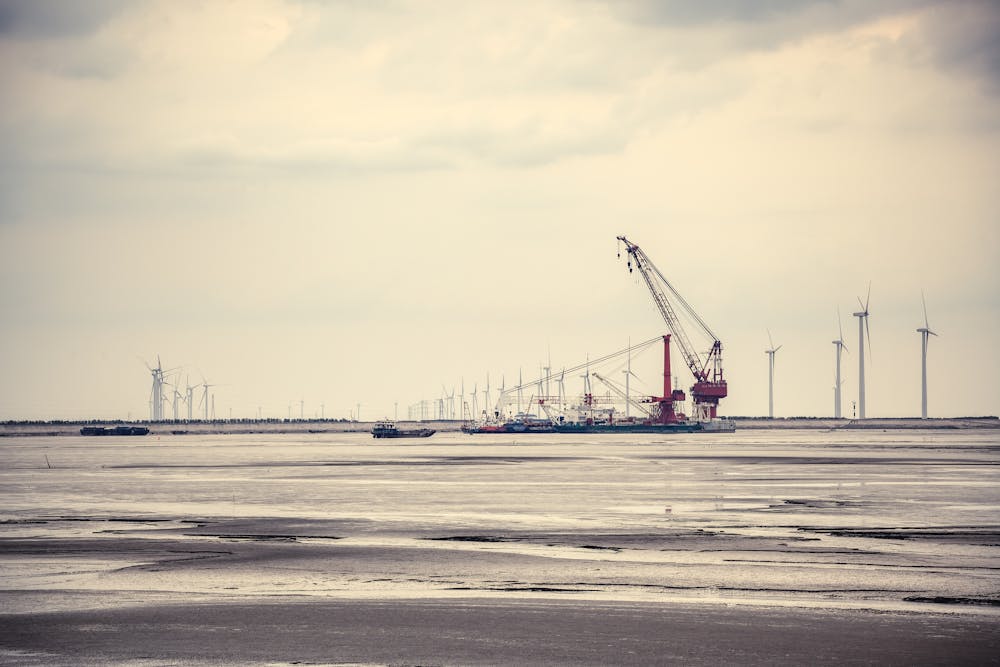 China has approached its record-breaking renewable roll-out methodically.
Shutterstock
China has approached its record-breaking renewable roll-out methodically.
Shutterstock
How did China boost clean energy so fast?
China’s huge domestic market and large-scale deployment of wind and solar contribute greatly to plummeting renewable costs. Steadily lowering costs means green energy becomes viable for developing countries.
In 2012, a large team from China Power Investment Corporation arrived in the high desert in Qinghai province and began building 15.7 GW worth of solar across 345 square kilometres.
It was here that China first figured out how to make intermittent power reliable. Excess power was sent to a hydropower station 40km away and used to pump water uphill. At night, the water would flow back down through the turbines. Technologies developed here are now being used in other large-scale hybrid projects, such as hydro-solar, wind-solar and wind-solar-hydro projects.
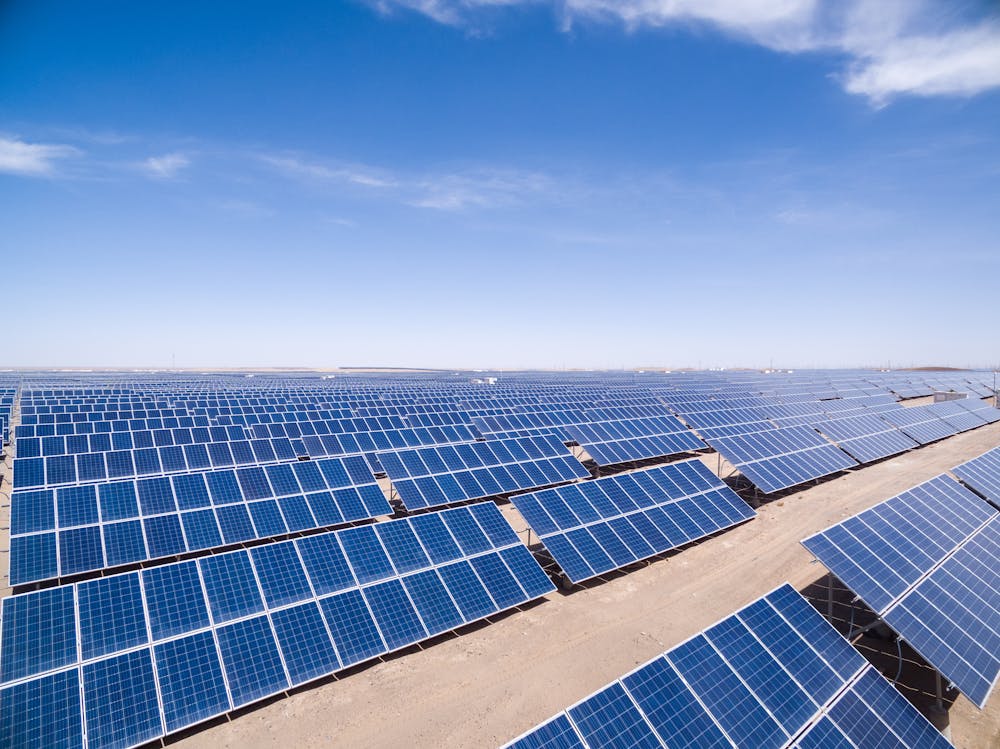 Huge solar farms carpet the desert in Qinghai – and new work opens the door to revegetating in the shade of the panels.
Shutterstock
Huge solar farms carpet the desert in Qinghai – and new work opens the door to revegetating in the shade of the panels.
Shutterstock
In 2022, the government announced plans to install 500 GW worth of solar, onshore and offshore wind projects in the Gobi Desert across Xinjiang, Inner Mongolia, and Gansu provinces.
These are intended to not only supercharge China’s clean energy supply, but to tackle desert expansion. Solar panels stabilise the movement of sand and absorb sunlight, reducing evaporation of scarce water and giving plants a better chance at survival. This knowledge, too, came from the Qinghai solar farms, where plants began growing in the shade.
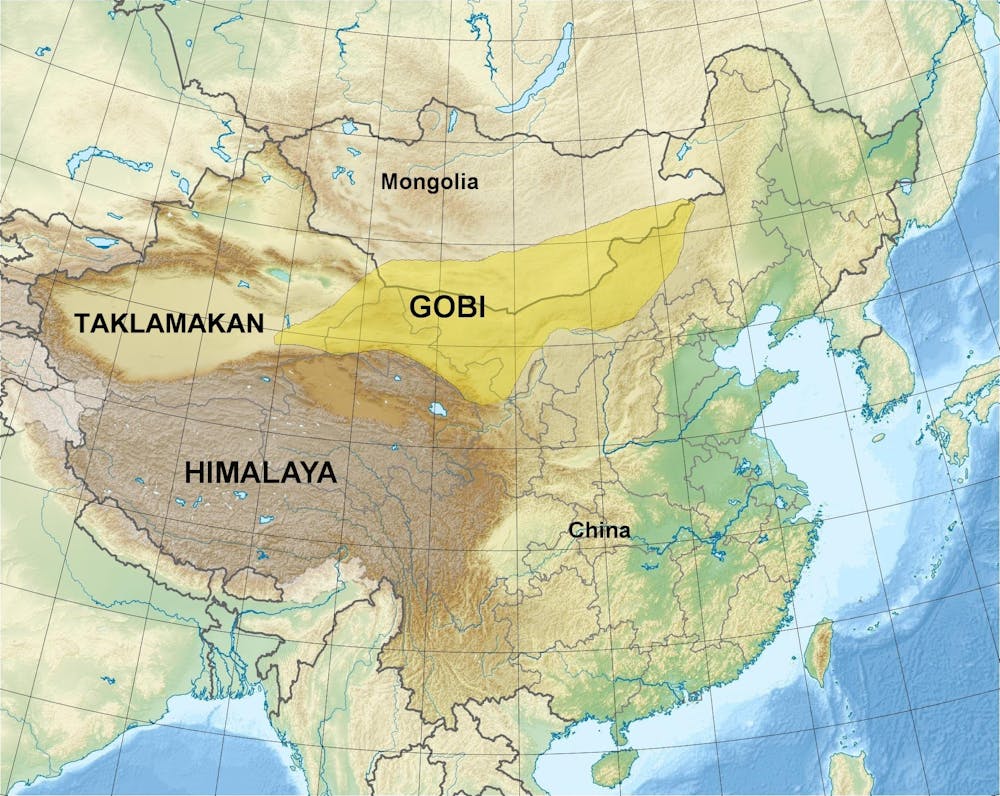 Plenty of room for solar: China’s two major deserts, the Gobi and Taklamakan, are home to more and more solar.
TheDrive/Wikimedia, CC BY-ND
Plenty of room for solar: China’s two major deserts, the Gobi and Taklamakan, are home to more and more solar.
TheDrive/Wikimedia, CC BY-ND
China’s focus on technology has given it combined solar and salt farms, floating solar power plants and energy storage ranging from batteries to compressed air to kinetic flywheels and hydrogen.
While the US and China cooperate at COP28, competition is not far away. China already dominates many clean energy technologies, but the US is trying to catch up through the massive green spend in last year’s Inflation Reduction Act.
According to the International Energy Agency, half of all emissions cuts needed to achieve net-zero by 2050 will come from technologies currently at demonstration or prototype phase. These include cheap green hydrogen, next generation nuclear, next generation solar and wind, and functioning carbon capture and storage for remaining fossil fuel use.
What has China achieved at COP28?
China is backing global calls to triple renewable capacity by 2030 and has agreed to tackle methane emissions, a particularly potent greenhouse gas.
China is far behind energy efficiency – it uses about 50% more per unit of GDP than in the US, and double that of Japan. It has not invested in energy efficiency as it has in other low-carbon areas.
This could change. US and China agreed in November to restart joint energy efficiency work on industry, buildings, transportation, and equipment, seen as harder areas to cut emissions.
At COP28, we will likely see states agree to double the rate of energy efficiency improvement from 2% to 4% a year by 2030. It remains to be seen whether China will join them.


