

Leah Purcell's Is That You, Ruthie? is a powerful look at 'dormitory girls' separated from Country and family
- Written by The Conversation
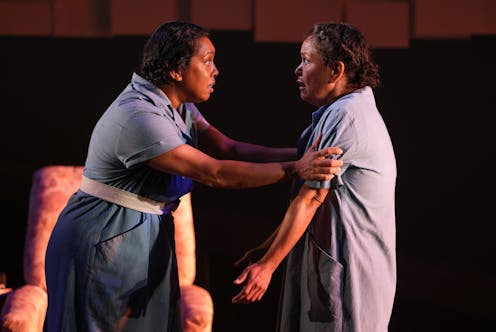
This article contains mentions of the Stolen Generations, and policies using outdated and potentially offensive terminology when referring to First Nations people.
Aunty Ruth Hegarty, or Ruthie, was four-and-a-half years old when she was forcibly removed from her mother, Ruby, under the auspices of Queensland’s Aboriginals Protection Act (1897).
The Act, as it was known, dispossessed thousands of Indigenous Australians of their heartlines and their homes by segregating them to government reserves that have been compared by past residents to concentration camps.
Is That You, Ruthie?, written and directed by Leah Purcell, one of Australia’s most important theatremakers, is an adaptation of Aunty Ruth’s memoir. It is a harrowing account of a mother and daughter’s attempt to repair their fractured relationship after being separated from their culture, their Country, and each other.
Read more: Indigenous Australia is deadly – and Leah Purcell shows it
Giving stage to the dormo girls
Purcell’s bold new play remembers the Stolen Generations of Indigenous women and children who were interned for more than 70 years at Barambah station, later known as Cherbourg, 250 kilometres northwest of Brisbane.
The story of the self-called dormitory girls, or “dormo girls”, is the story of the irreparable damage caused by the sanctioned removal and control of First Nations families and the dormitory system’s cruel legacy of the separation of children from their mothers.
The play opens in 1930, in the grip of the Great Depression, when a young Ruby (Chenoa Deemal) arrives with her six-month-old daughter Ruthie at the Barambah mission – “just for a little while” – on the advice of the local police sergeant, who is also the ironically titled “Protector of Aboriginals”.
When she is four-and-a-half, Ruthie (Melodie Reynolds-Diarra) is separated from Ruby, and they spend the next 30 years trapped in parallel lives.
Following their separation, mother and daughter are housed in separate dorms. They can see each other, but are forbidden to touch or talk.
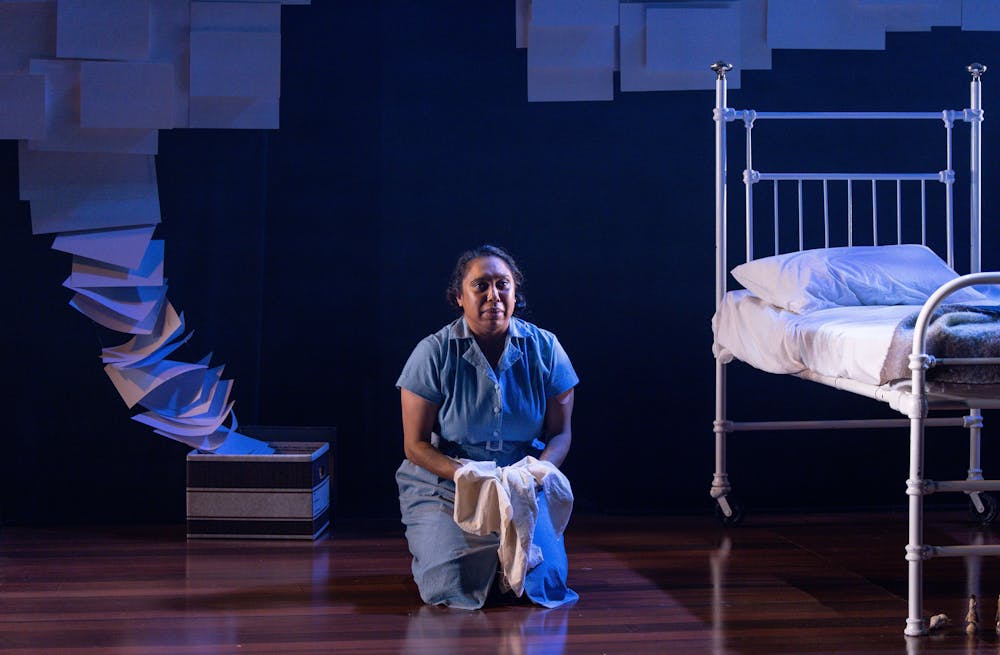
In a narrative spiral that moves back and forward in time, the pair oscillate in and out of each other’s lives as their relationship becomes increasingly estranged.
Separately, they are trained and later hired as domestic servants to aid the expanding white settlement.
After years of exploitation as “domestics”, both are denied access to their wages in a form of multi-generational financial abuse that is now recognised as the Stolen Wages.
When mother and daughter finally reunite, they are forced to face the painful realisation that they are strangers. Their relationship, irreversibly severed, is never the same.
In the play’s final scene the actors step forward out of character to remind us this story is not a work of fiction – a necessary and important moment when Australia’s history is still often met with defensive denial and resistance.
Two hearts breaking
Purcell, a self-described “truth-teller”, has perfected the art of adaptation. She is perhaps best known for her interpretation of The Drover’s Wife, which she has adapted three times to the page, stage and screen.
In Ruthie, over the course of 90 minutes, she strips down Hegarty’s memoir to its powerful core: the story of two hearts breaking. But Purcell’s play, like its origin material, is also a story about the enduring and ineffable connections that bond women who share profound trauma and grief.
Building on the tradition of Ningali Lawford-Wolf’s Ningali (1994), Wesley Enoch and Deborah Mailman’s The Seven Stages of Grieving (1996), and Jane Harrison’s Stolen (1998), Purcell interjects genuine moments of humour in a work that highlights the fraught nature of forgiveness and the cultural significance of both resistance and resilience.
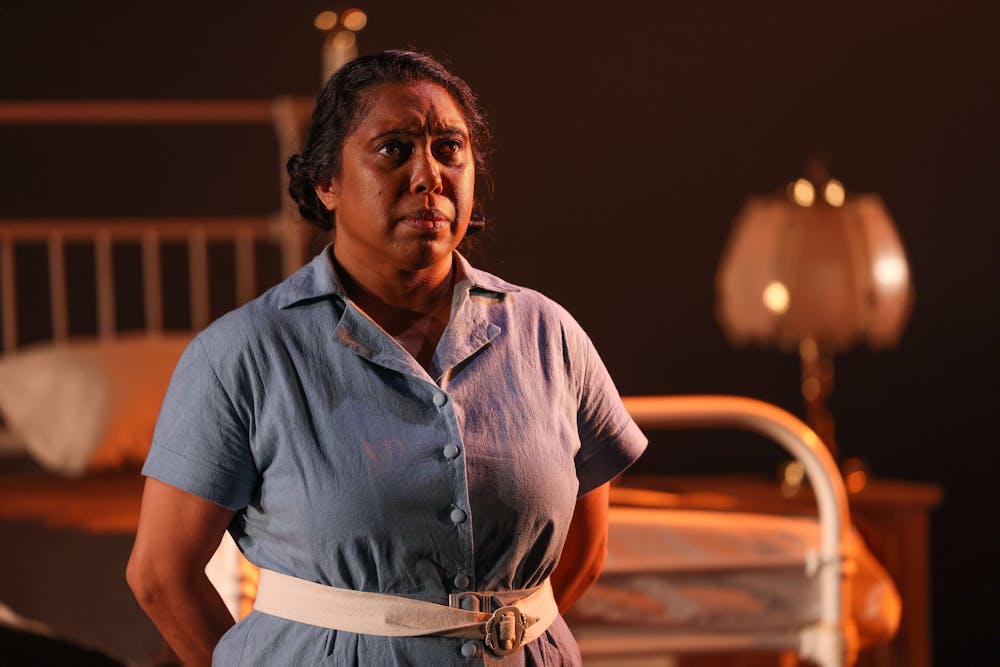 Purcell strips down Hegarty’s memoir to its powerful core.
Photo credit: Peter Wallis
Purcell strips down Hegarty’s memoir to its powerful core.
Photo credit: Peter Wallis
The work interweaves traditional song and dance in a testament to the courage and resilience of the young girls who lost their mothers and in turn became sisters who, in their own words, simply looked after each other.
As Aunty Ruth reflects in her memoir:
Our lives were governed by the same policies, and what happened to one, happened to all of us. We were treated identically, dressed identically, our hair cut identically. We were dormitory girls.
Purcell and Hegarty share the same creative agenda: both women blend the personal with the political through autobiographical storytelling and the power of witnessing.
A collaborative creation
Importantly, in her newest work, Purcell preserves the protocols of Indigenous storytelling by using collaborative theatre to combine oral history with documentary techniques. Aunty Ruth, now 94, collaborated on the script and contributed to the creative process.
The projection of archival material from Aunty Ruth’s government file – visitation requests, travel permits, letters from the Superintendent – bridge the theatrical and historical worlds of the play, and unite the emotion of the dramatic retelling with the authority and authenticity of the archive.
 Aunty Ruth Hegarty and Leah Purcell.
Photo credit: Lyndon Mechielsen
Aunty Ruth Hegarty and Leah Purcell.
Photo credit: Lyndon Mechielsen
At a post show discussion with Aunty Ruth, Purcell invoked the audience’s obligation to bear witness. “You cannot deny this woman her story,” she said, “because she’s sitting right here.”
In this way, the play’s title, Is That You, Ruthie?, is an important recognition of the past as much as it is a haunting inquisition that demands we listen.
Is That You, Ruthie? by Oombarra Productions played at QPAC, Brisbane. Season closed.


