

Australians love to talk about a ‘fair go’. Here’s what it meant before we became a nation
- Written by The Conversation
“Fair go” is an expression we hear a lot in Australia. Activists use it to demand social justice, companies use it to promise customers a good deal, and politicians invoke it to persuade us that they understand the plight of ordinary people.
Most political commentators and academics who write about the fair go associate the phrase with Australia’s famed egalitarian traditions, including equality of economic opportunity, universal political rights and the provision of a safety net via minimum wages and welfare programs.
Yet the fair go expression is sometimes used in ways that are distinctly inegalitarian. Former prime minister Scott Morrison repeatedly declared his belief in “a fair go for those who have a go”, suggesting the concept only applies to hardworking, “deserving” Australians. Morrison’s comments drew the ire of critics who argued he was subverting the original egalitarian meaning of the fair go phrase, along with the Australian culture of benevolence to the needy.
So who is right about what a fair go means to Australians? Are some uses more faithful to our “fair go traditions” than others?
Read more: In Australia, land of the 'fair go', not everyone gets an equal slice of the pie
Origins in the sports pages
In our research project, we went back to the earliest recorded mentions of the fair go phrase in colonial-era newspapers to understand the original uses and meanings of this phrase, focusing on the period between 1860 and 1901.
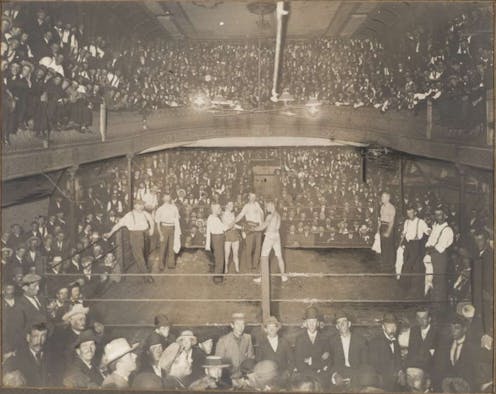
We found the most common uses of the fair go expression did not refer to equality, benevolence and social justice. Instead, the phrase was mainly used to describe spirited efforts in competitive sports such as horse racing, boxing and sprinting. We found this in an article published in New South Wales in 1889:
They were stripped of shoes and everything and had a fair go with the hurdles out about 18 yards.
In sport, a fair go could also mean trying your hardest, as opposed to “pulling” a race or “throwing” a match, such as in this piece from 1892:
With a dishonest jockey aboard […] an owner never knows whether he is to get ‘a fair go’ or not.
A fair go could also refer to a thrilling, close match that entertained spectators, or a lucky win for gamblers, as in the expression “having a fair go for their money”. The fair go phrase was also used in politics in the context of closely fought elections, such as in Western Australia in 1900:
[…] he can depend on a fair go for it, for it’s a dead certainty he won’t gain the seat unopposed.
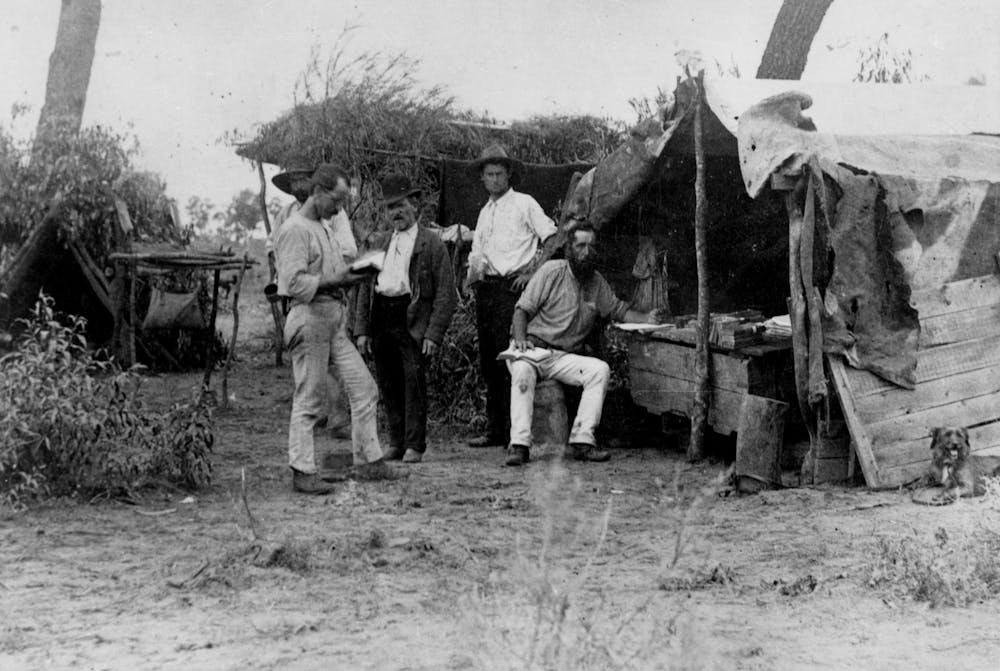
“Fair go” could also refer to violent power struggles. In an 1891 telegram sent during the Shearers Strike in Queensland, a union leader advocated achieving a fair go by force:
[…] if a little more devil was put into our actions the better it would be for us in the end. We have tried passive resistance and it appears to have failed. Let us try the other now, and have a fair go.
The expression was sometimes used to refer to fistfights in politics and beyond, such as this piece in 1897:
Fights between members of Parliament or city or municipal councillors are not of rare occurrence in Australia, but a fair “go” between lawyers with the “bare bones” is not often chronicled.
It was even used to describe violence in wartime, such as when an Australian soldier in the Boer war expressed a hope to a reporter that the enemy would “let him have a fair go […] with the bayonet”.
Different contexts, different meanings
While the dominant meanings of the fair go in the 19th century referred to competition and power struggles, we also found uses that resonate more with egalitarianism, social justice and procedural rights. In an 1891 article about politics, a fair go could mean the right to speak:
You are a liar and the father of a liar. Why don’t you let me speak? This is my maiden speech and you might let me have a fair go.
The fair go phrase was also used to advocate for the principle of one person, one vote, as well as ranked voting.
In sport, a fair go was said to require impartial umpires who didn’t favour one side over the other. In the legal system, a fair go required the right to due process, such as the provision of warrants for arrests and adequate defence in the courtroom.
While these ideas resonate with contemporary concerns about equal rights, non-discrimination, and proper process in government, they represented the minority of uses of the fair go phrase in the 19th century. Uses of “fair go” to refer to benevolence to the poor and the need for a safety net were virtually absent in the period we studied.
These findings highlight that the fair go originally meant different things to different people, and in different contexts. In our recent research, we show that 19th-century uses of the fair go can be organised into six distinct meanings. These reflect the fact that the words “fair” and “go” have multiple meanings associated with both “justice” and “strength”.
These different interpretations are alive and well today, and can be used to critically assess public policies on contentious issues such as housing affordability and immigration.
Who is right about the true historical and contemporary meaning of the fair go? Our research shows no political ideology or party has a monopoly on the fair go. How we talk about the fair go reveals the ideas that shaped us as a nation, and the values that influence our political debates.


