

Australia’s shot-hole borer beetle invasion has begun, but we don’t need to chop down every tree under attack
- Written by The Conversation
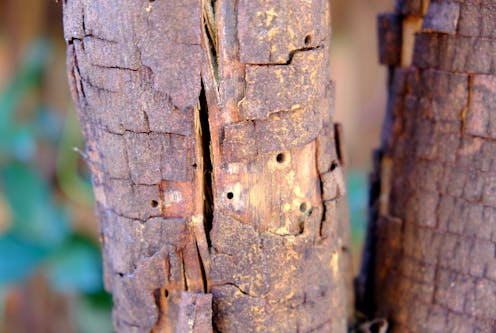
A new pest attacking Perth’s trees threatens to spread across Australia, damaging crops and native forests as well as our urban forest. To control its spread, the Western Australian government is chopping down hundreds of established trees. But these losses may be in vain.
Originally from southeast Asia, the polyphagous (meaning “many-eating”) shot-hole borer has invaded several countries. It attacks more than 400 tree species, including crops such as apple, avocado, macadamia and mango. Trees grown for timber, such as ash, elms and oaks are not safe either. And with every new country it invades, it threatens an increasingly large number of native trees.
Australia plans to eradicate this pest using one method: felling established trees. But the borer has been eradicated only once – in isolated tropical glasshouses in frosty Europe – demonstrating the difficulty of eradication from larger agricultural and natural ecosystems.
To achieve this worthy but difficult goal, everyone will need to work together. We need a wide range of experts to fully evaluate all available control methods, and consider the most appropriate time frame for eradication. Understanding the impacts of both the pest and its management will ensure we get the best possible outcomes in both the short and long term.
Read more: Trees in South Africa are under attack. Why it's proving hard to manage
The nature of the beast(s)
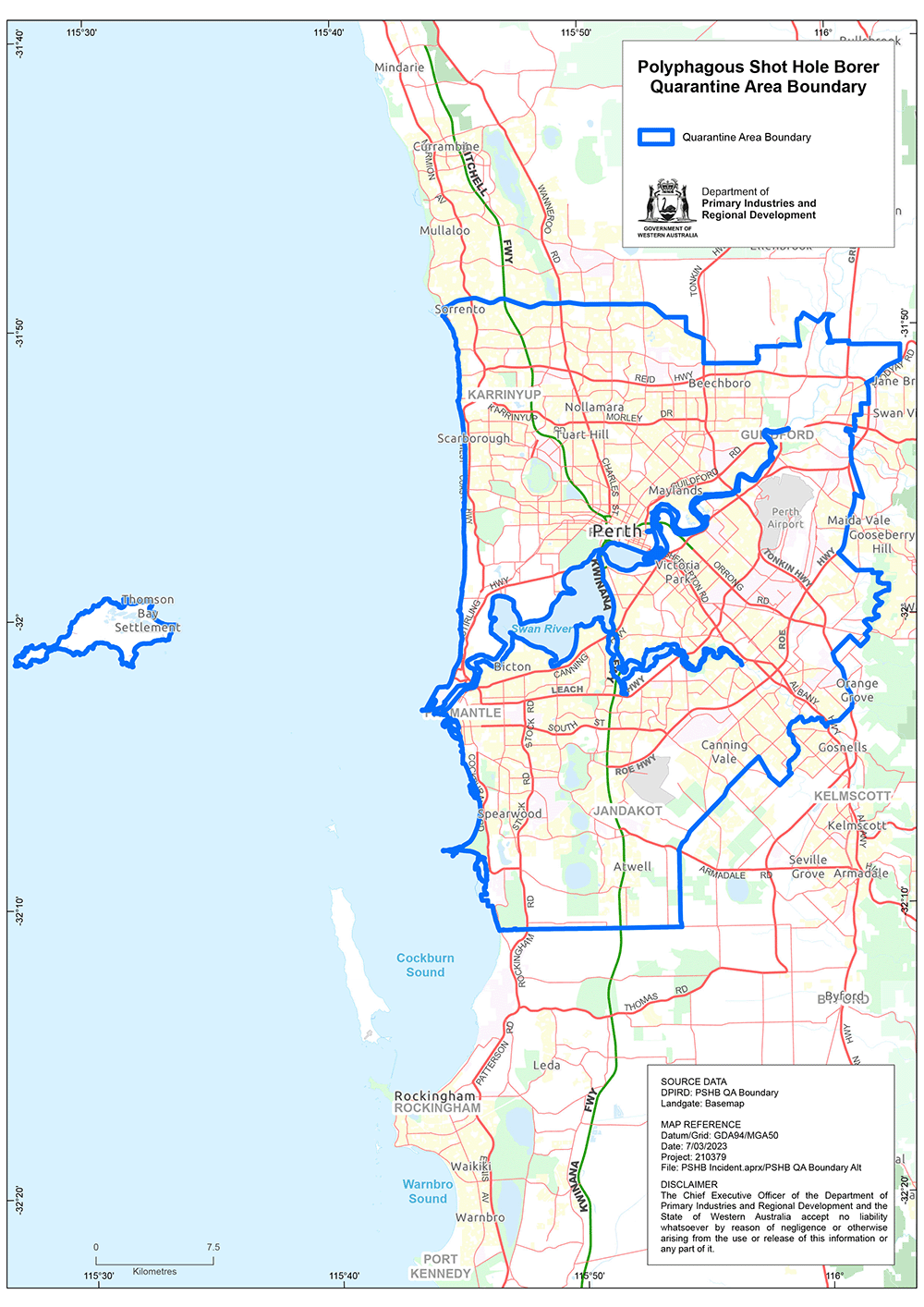
The borer probably arrived in Australia as a stowaway with untreated wood and remained undetected until August 2021, when a concerned resident of East Fremantle noticed unusual holes in her backyard maple trees. Now more than 80 suburbs in 25 councils are affected. Fortunately, the pest has not yet been detected outside the Perth metropolitan area.
The borer attacks so many tree species because it has an accomplice, in the form of a fungus. The two live in a mutually dependent “symbiotic” relationship.
The borer creates a Swiss cheese-like matrix of tunnels through the wood. The fungus feeds on the wood lining the tunnels as it grows, and the borer eats the fungus.
The tunnels weaken the structure of the wood, but tree death occurs when the fungus invades and blocks the flow of water and sap between roots and leaves.
The borer’s small size likely limits its natural rate of spread, however we don’t know how far it can fly. There is a risk of human-assisted spread over long distances as the borer can survive in small pieces of wood for weeks. To make matters worse, a single female borer can produce offspring without a mate.
 The life cycle of the polyphagous shot-hole borer, also known as the Asian ambrosia beetle (Euwallacea fornicatus)
Protasov AN, Shutterstock
The life cycle of the polyphagous shot-hole borer, also known as the Asian ambrosia beetle (Euwallacea fornicatus)
Protasov AN, Shutterstock
Responding to the threat in Australia
The threat to Australia can be estimated from the experience in other invaded locations. As in Perth, the invasion usually begins in cities, then spreads into the surrounding countryside, attacking horticulture and forests, including avocado production in Israel and California and stone fruit in South Africa. This overseas experience has informed models of potential impacts for WA.
But local effects are hard to predict. Figs and eucalypts not susceptible in California and Israel, yet figs are preferred and some eucalypts are susceptible in WA.
The national biosecurity response led by WA has allocated A$41 million to eradicate the borer. This funding was based on an assessment of what it should cost. But there is only a short window of opportunity to effectively deploy these resources to achieve eradication.
The response includes trapping and surveillance to determine the spread of the pest. More than 1.5 million trees on more than 50,000 properties have been inspected and some 3,000 traps laid.
These traps catch flying beetles, which fly just once in their lives, so there’s a low catch probability. This makes it hard to detect false negatives, when no beetles are trapped but there are beetles in the area. This can be improved with alternative trap designs and chemical lures.
When infested trees are found in WA, the response is “removing infested trees to save healthy trees”. This could mean hundreds of trees at popular public locations such as Perth Zoo, Lake Claremont, Kings Park and Hyde Park will be felled and chipped.
Continuing with the one control method, felling trees, will leave us with fewer trees, particularly if the eradication campaign runs for many years. Reduction of the urban tree canopy could be profound, and Perth already has the sparsest urban tree canopy in the nation.
The flow-on consequences could mean even higher urban temperatures and poorer human health.
Urban trees are also valued for their beauty, shade and habitat for animals. All these benefits can be assigned a significant monetary value, which would be even higher if intrinsic or cultural value could be included.
Waging war on the shot-hole borer
Although felling and chipping entire trees is necessary, there are other effective control methods. Alternatives may include removing and chipping infested branches only, which may be more cost-effective than felling entire trees, to injecting at-risk but uninfested trees, and slowing infestations in trees or spraying repellents onto uninfested trees. In California, traps were developed into an attract-and-kill strategy to tackle the borer in avocado orchards.
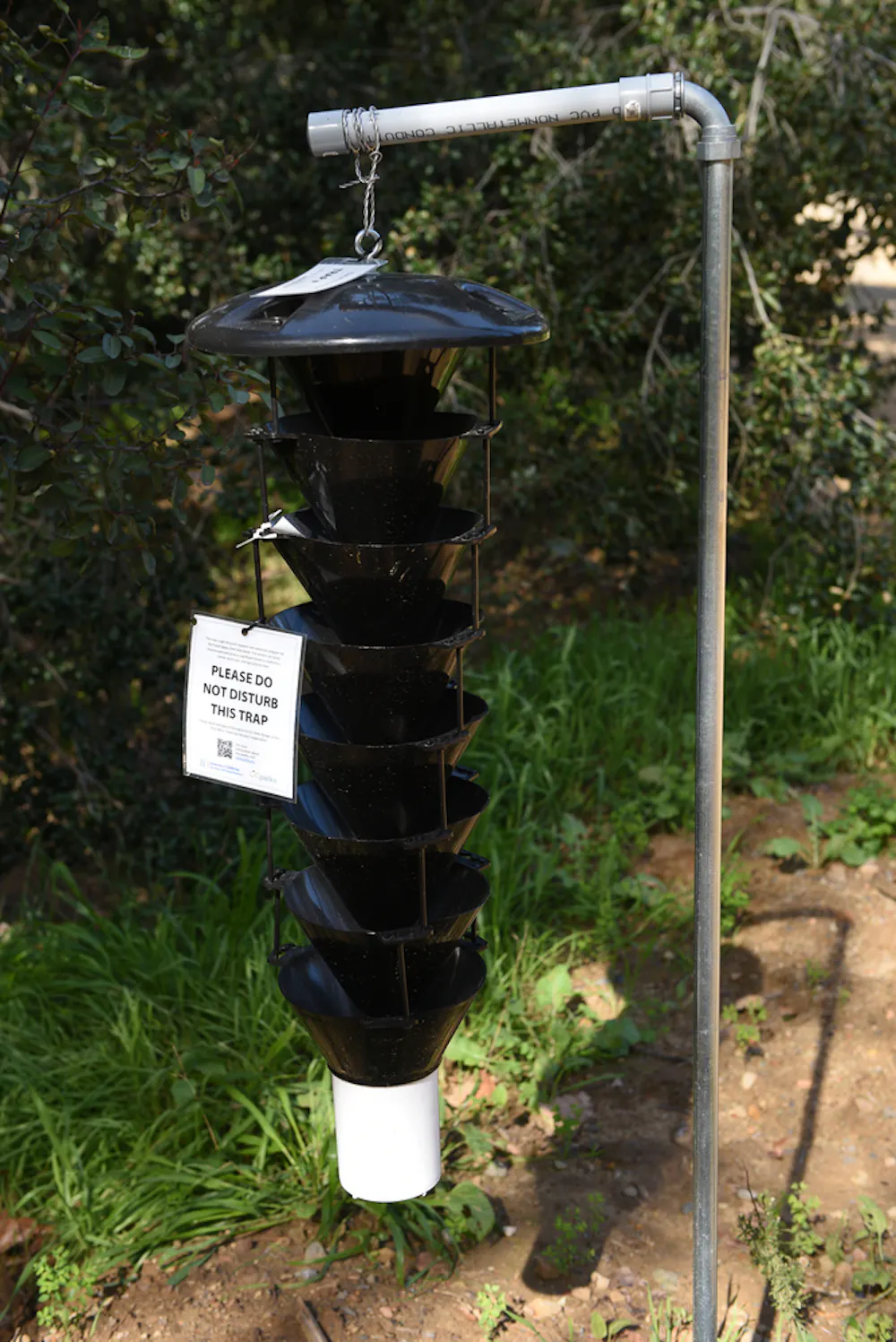 The best trap for the borer, developed in California, is not being used in Perth.
Steve Cukrov, Shutterstock
The best trap for the borer, developed in California, is not being used in Perth.
Steve Cukrov, Shutterstock
While a rapid response is crucial for eradication, we need to keep improving on this, using the most effective methods available. Relevant solutions from around the world suggest broader community engagement, beyond Perth, would be beneficial.
It is unclear what has been learned so far from efforts in WA. Is it still feasible to eradicate the pest completely? We need more experts to evaluate and advise on the response as it continues.
Making the right response choices will be crucial. Just consider other threatening invaders such as the red imported fire ant, the honey bee varroa mite, and myrtle rust.
As the borer has only been detected in Perth, the window of opportunity is open now. Let’s make sure we have the best plan of attack so we can achieve eradication.
Australians pride themselves on working together to get things done. If we can bring everyone together to rapidly tackle this insect invasion, the whole nation will benefit.


