

Australian passenger vehicle emission rates are 50% higher than the rest of the world – and it’s getting worse
- Written by The Conversation
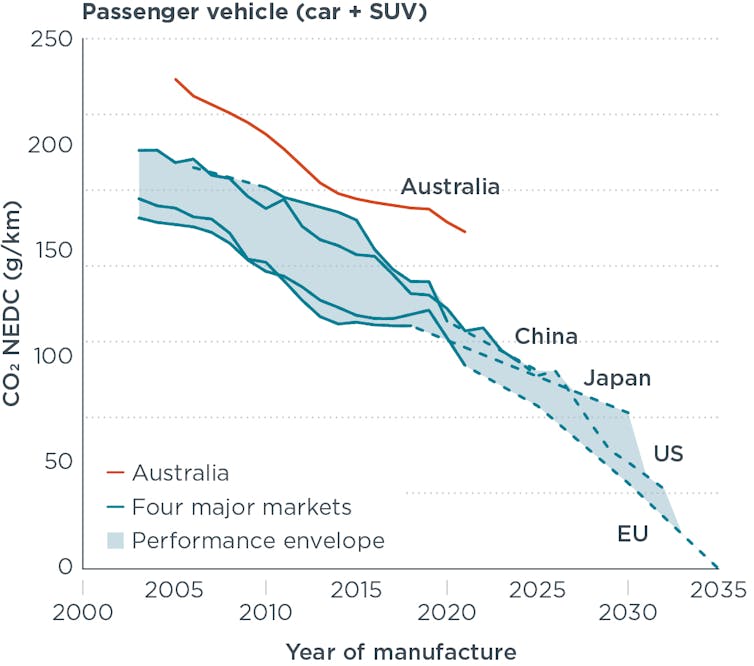
Australian passenger vehicles are emitting 50% more carbon dioxide (CO₂) than the average of the world’s major markets. And the real-world situation is even worse than official figures show. That’s the finding of a new study comparing the CO₂ emissions performance of cars, SUVs and light commercial vehicles in Australia and overseas.
The comparison suggests Australia will probably fall well short of the economy-wide 2050 net-zero emission target for road transport. To hit the target, policies to cut vehicle emissions have to be intensified and supported by a range of other policies.
This month, the Australian government announced options for a New Vehicle Efficiency Standard (NVES) – not to be confused with the National Electric Vehicle Strategy (NEVS). Each option would set a national limit on grams of CO₂ that can be emitted for each kilometre driven, averaged across all new cars sold.
Mandatory CO₂ emission or fuel-efficiency standards are internationally recognised as a fundamental building block to cut transport emissions. To provide further context and input to the development of an Australian standard, Australia-based Transport Energy/Emission Research (TER) and the International Council on Clean Transportation (ICCT) collaborated on a newly published briefing paper.
The independent analysis shows the urgent need for Australia to adopt a stringent, well-designed and mandatory fuel-efficiency standard. This standard and additional policies are essential to keep up with technological advances and decarbonisation in other developed countries.
How did we fall so far behind?
Both fuel efficiency and emission standards aim for roughly the same thing: cutting fuel consumption and greenhouse gas emissions. In doing so, they also cut fuel costs for consumers and improve energy security.
About 85% of the global light vehicle market has adopted these standards over time, in some cases decades ago. The United States, European Union, Canada, United Kingdom, Japan, China, South Korea, Brazil, Mexico, New Zealand, Chile and India all have them. Australia and Russia are the two exceptions in the developed world.
Australia has a long history of debate about making such standards mandatory for passenger and light commercial vehicles. The federal government has released six public consultation documents since 2008, without achieving mandatory standards. This is about to change.
Australia has had voluntary standards since 1978. These targets have not always been met due to lack of enforcement. They have been criticised for lacking both ambition and effectiveness in reducing real-world emissions.
It appears the government’s current proposal will be more ambitious. It potentially aims to converge with US targets in 2027 – though falling short of what is being done in Europe. The Australian standard’s effectiveness in achieving genuine emission reductions and net zero emissions in 2050 will still need to be examined once the design and details are clearer.
Read more: Why electric trucks are our best bet to cut road transport emissions
How does Australia compare using official figures?
The new study compared the officially reported CO₂ emissions performance of passenger and light commercial vehicles in Australia, China, the EU, Japan and the US. We found CO₂ emissions from the Australian passenger vehicles were 53% higher than the average of these major markets in 2021.
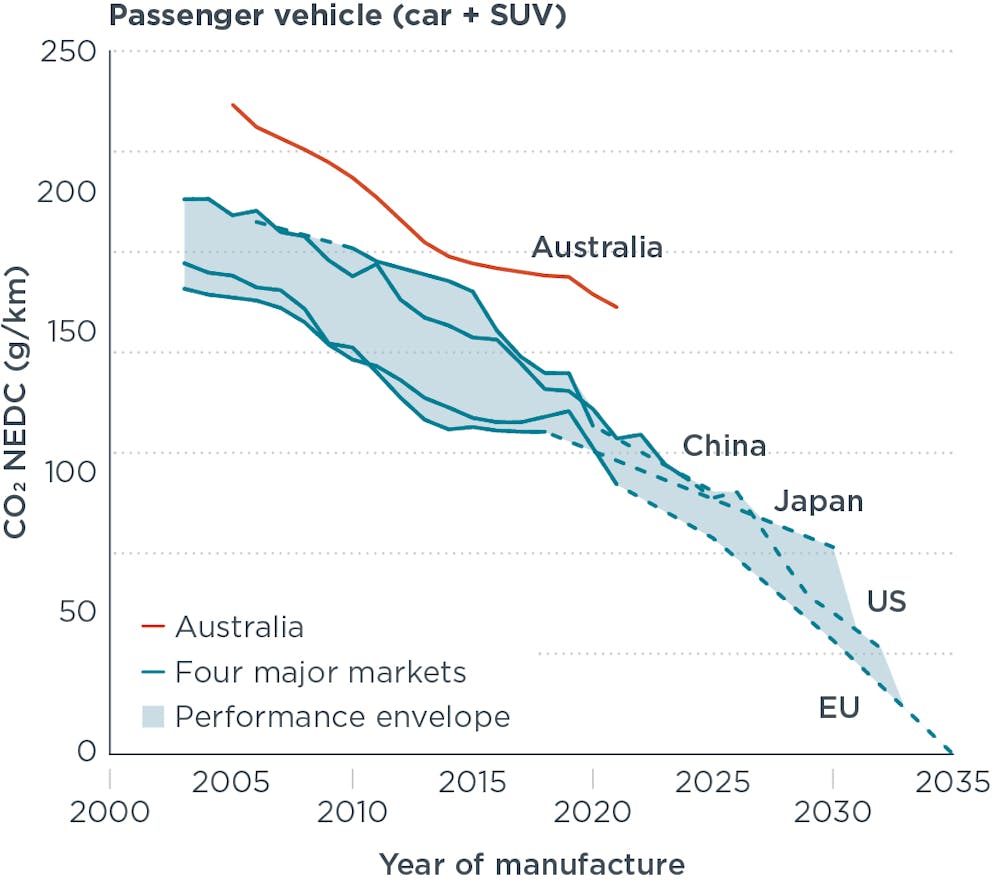
Importantly, without effective action, this performance gap is expected to grow in future years. That’s because these other markets are moving to aggressively adopt standards that drive the transition to a low-or-zero-emissions vehicle fleet.
Read more: Too big, too heavy and too slow to change: road transport is way off track for net zero
How does Australia compare in reality?
The official Australian figures are based on a test protocol called the New European Drive Cycle (NEDC). It was developed in the early 1970s.
The main problem is that the difference between NEDC test results and actual on-road emissions has steadily increased. Actual on-road emissions were estimated to be about 10% higher in 2007, growing to over 45% in 2021.
Indeed, the EU no longer uses the outdated NEDC protocol. It has adopted a more realistic test procedure, the Worldwide Harmonised Light-Vehicles Test Procedure (WLTP).
The briefing paper used previous research into Australian and international real-world emissions performance to create a more accurate comparison. Whereas the official figures suggest newly sold Australian passenger vehicles have relatively high emissions, at least they appear to have improved each year. The picture is very different when we look at on-road emissions.
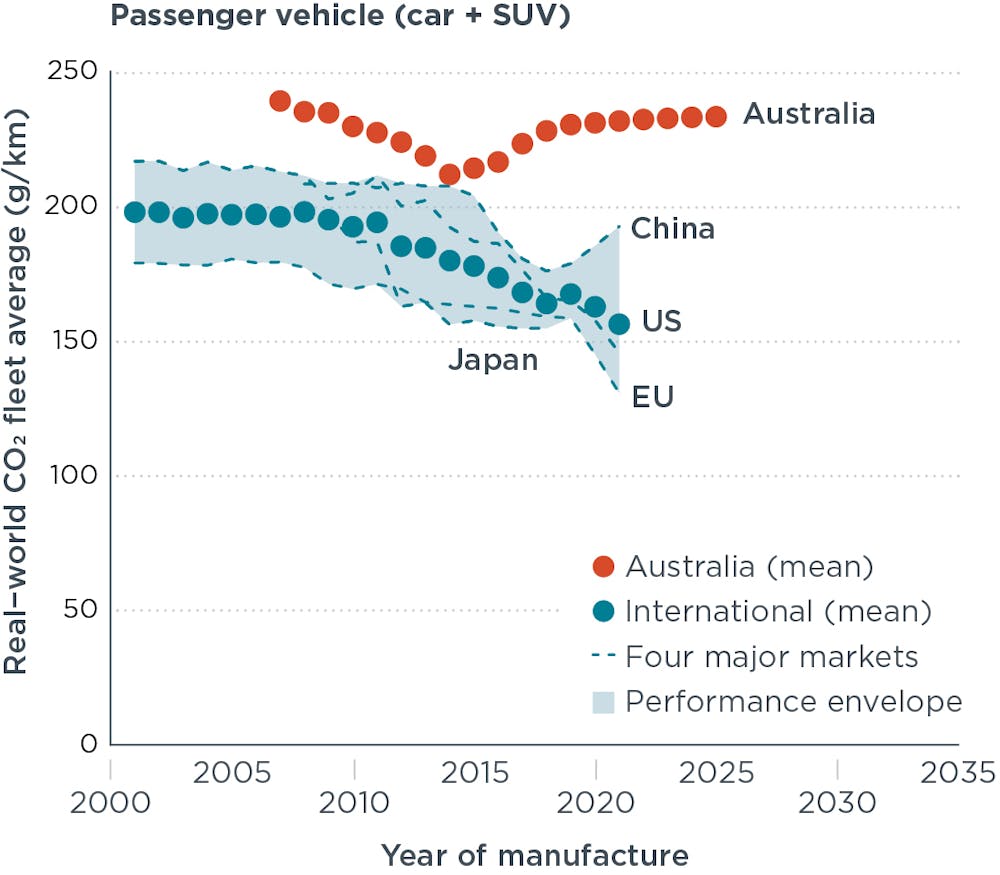 Estimated real-world fleet average emissions for new passenger vehicles, comparing Australia with four major markets.
TER and ICCT 2024
Estimated real-world fleet average emissions for new passenger vehicles, comparing Australia with four major markets.
TER and ICCT 2024
Our estimates suggest emissions from newly sold Australian passenger vehicles have actually been rising since 2015. This trend is a result of increasing vehicle size and weight, a shift towards more four-wheel-drive SUVs and large utes, and a lack of mandatory standards or targets.
The Australian real-world emissions performance is also much worse than in the four major markets. Before 2016 the average difference was around 20% higher on average. By 2021, Australian emissions were almost 50% higher for passenger vehicles.
Read more: The road to new fuel efficiency rules is filled with potholes. Here's how Australia can avoid them
What does this mean for policy?
Our analysis shows both officially reported and actual on-road CO₂ emissions from new Australian light-duty vehicles are much higher than in other developed nations. The available evidence suggests this poor performance will get worse without stringent mandatory standards in place.
The good news is that the government is acting on the lack of an effective standard. Mandatory standards will likely be adopted this year. The New Vehicle Efficiency Standard is due to take effect in 2025.
However, the standard must be carefully designed to achieve genuine emission reductions for new vehicles.
For instance, the official Australian test protocol (NEDC) is outdated and increasingly underestimates on-road emissions. It provides an unrealistic and skewed picture, undermining effective emission reduction. The government says it intends to adopt a more realistic test protocol.
The standards should also include on-board monitoring of fuel consumption – as the EU is now doing. It’s vital to measure real-world fuel efficiency and emissions of new vehicles and to make this information public to ensure standards are achieving their goals. But the latest government report didn’t mention it.
A mandatory fuel-efficiency standard is long overdue in Australia. It can help close the performance gap between Australia and the rest of the world. So we’d better make sure it works.


