

LATAM flight 800 ‘just dropped’ in mid-flight, injuring dozens. An expert explores what happened, and how to keep yourself safe
- Written by The Conversation
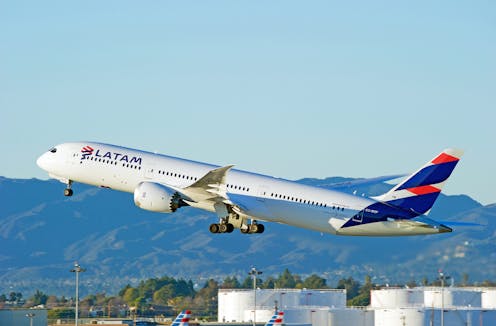
On Monday, LATAM Airlines flight 800 from Sydney to Auckland experienced what officials are describing as a “technical fault” that meant the Boeing 787-9 Dreamliner “just dropped” without any warning.
The aircraft pitched downward very quickly, causing some passengers and crew members who were not wearing seatbelts to hit the ceiling, and leaving at least 50 people injured. The flight landed without further incident and the injured passengers and crew were transferred to local hospitals.
So what happened? And should air passengers be concerned?
The short answer is there’s no need to worry – if anything, it seems the plane’s safety systems worked as intended. The real takeaway from the story is you should always wear your seatbelt while seated, just like the cabin crew have been telling you.
Keep perspective
When we plan a trip, we usually have adventure or work on our minds as we wing our way to our destination. We think about what types of activities we’ll do, like hiking or water sports, and where we can find great meals.
Most of us never think about what is happening up front in the cockpit as we watch a movie or enjoy the in-flight meal. We generally don’t feel the need to worry about the flights as we feel confident we’ll get to our destination without a problem. Airline incidents are rare when you consider how much travelling is taking place around the globe.
Read more: Could climate change have played a role in the AirAsia crash?
On peak travel days, there can be more than 16,000 planes in the air at any time. There are around 4 billion air travel passengers each year, and the number is expected to double by 2035 by some estimates.
The vast majority of these flights pass without incident. However, when an emergency does occur it receives a lot of attention – a lot more attention than the far more frequent crashes or other accidents that happen on our roads, for example.
So when you do hear about an incident on a plane, the first thing to do is keep it in perspective.
What happened on LATAM 800?
Authorities have not released a lot of detail on the cause of the incident, beyond saying it was a “technical fault”. As LATAM Flight 800 originated in Australia, the transportation investigation teams from Australia, New Zealand, Boeing and LATAM will scrutinise the incident to better understand what happened.
Modern airliners have redundant systems for flight-critical controls. If one fails, it can be transferred to the backup automatically or manually by the flight crew.
One passenger stated that one of the pilots said his instruments went blank, he lost control briefly, and the backup system returned the aircraft back to normal operations.
If the aircraft experienced a sudden loss of electrical power – from a generator failure, for example – it would cause the autopilot to fail as well. This could have caused the aircraft to abruptly change its flight configuration and descend rapidly.
Whatever happened in this case, it seems the redundant systems on the 787, which includes six backup generators, were able to rapidly return all systems to normal.
Wear your seatbelt
LATAM 800 is an example of why we should always wear seatbelts when we are seated on an airplane. While technical faults of this kind are rare, turbulence is a much more common occurrence that can lead to injuries for unsecured passengers.
The US Federal Aviation Administration has reported that, in the United States, 30 passengers and 116 crew members were hospitalised due to in-flight injuries caused by turbulence between 2009 and 2021.
Crew members are most susceptible due to the nature of their job. The Federal Aviation Administration states the annual cost to the global aviation industry due to turbulence injuries is US$100 million.
Climate change and turbulence
With climate change heating up our atmosphere every year, we can expect more turbulence. Wind speeds at the altitudes where most aircraft fly are increasing, causing more turbulence.
Read more: What is air turbulence?
This type of turbulence is known as “clear air turbulence” and is difficult to predict or see with current aircraft technologies. Researchers have found that severe clear air turbulence over the North Atlantic increased by 55% from 1979 to 2020.
For airlines, more turbulence will mean more wear and tear on aircraft. But for travellers, the bottom line is clear: always follow the safety instructions from the cabin crew, and keep your seatbelt fastened at all times when seated.


