

Australian ‘bush glass’ bears the fingerprints of a cosmic collision with an iron meteorite
- Written by The Conversation
How Earth and the other planets of the solar system formed and evolved over the aeons is a hot question for planetary scientists like me. One of the best ways to find out is by looking at rocks from space.
Getting the rocks is the hard part. Sending spacecraft to asteroids or other planets to gather samples and bring them home is possible, but extremely difficult and expensive.
Another option is to study space rocks that fall to Earth: meteorites. However, they are relatively rare, and the journey through our planet’s atmosphere followed by a high-speed collision with the ground often means they’re not in very good condition by the time we get a look at them.
That said, meteorites do leave fascinating traces. In a new study, my colleagues and I analysed lumps of glass found around a 5,000-year-old meteorite impact site in the Northern Territory and discovered it contains a surprisingly large amount of metal from the meteorite itself – proving the craters at the site were formed by a cosmic interloper and giving clues about the intruder’s composition.
Natural glasses
We’re all familiar with the human-made kind of glass found in windowpanes and kitchenware. But glass occurs in nature, too. Most of it is obsidian, the glass produced in volcanoes which has been known since ancient times.
A much smaller amount of natural glass is produced by lightning strikes and asteroid impacts. When we find glass in nature, it can take careful forensic work to pinpoint what created it. However, the forensic analysis can reveal a surprising amount of information about the origin of the glass.
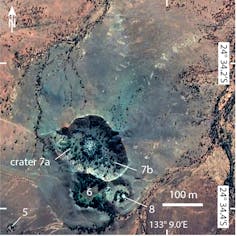
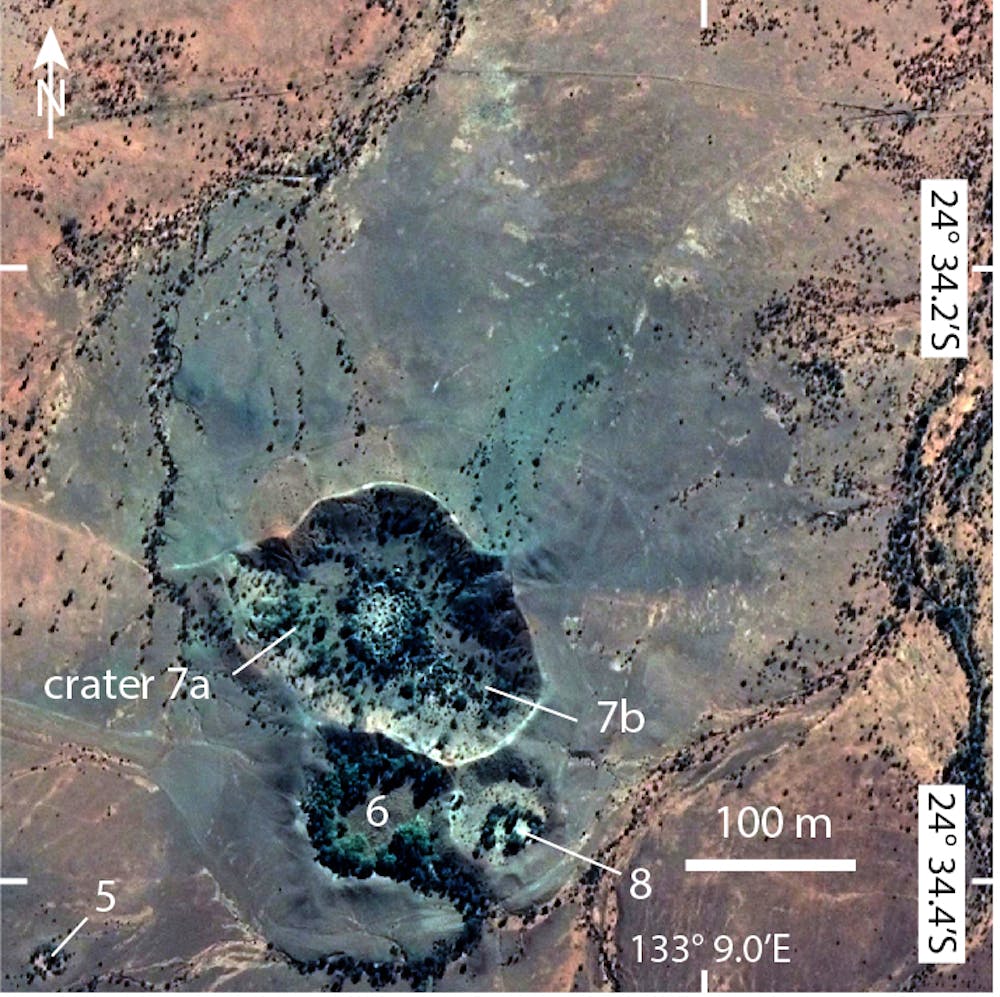
In our study, published in Geochimica et Cosmochimica Acta, we analysed glass from a site in the NT called the Henbury crater field.
Meteorite fragments have been recovered from the site, where there are at least 13 impact craters formed in an event around 5,000 years ago. The crater field is also called Tatyeye Kepmwere, and reports of it are found in Aboriginal oral traditions.
 The Henbury IIIAB iron meteorite.
Museums Victoria
The Henbury IIIAB iron meteorite.
Museums Victoria
The meteorites recovered from the Henbury field are a type called IIIAB irons. They are remnants of the metallic core of an ancient shattered world and were eventually delivered to Earth. They’re essentially lumps of metal, comprised mostly of iron, nickel and cobalt.
Heavy metal–classic rock fusion
When the space rock struck at Henbury, the heat of the impact melted the meteorite along with rock from the ground. Some of this fused material formed molten droplets which was thrown from the craters and cooled to form thumb-sized lumps that look a lot like volcanic glass.
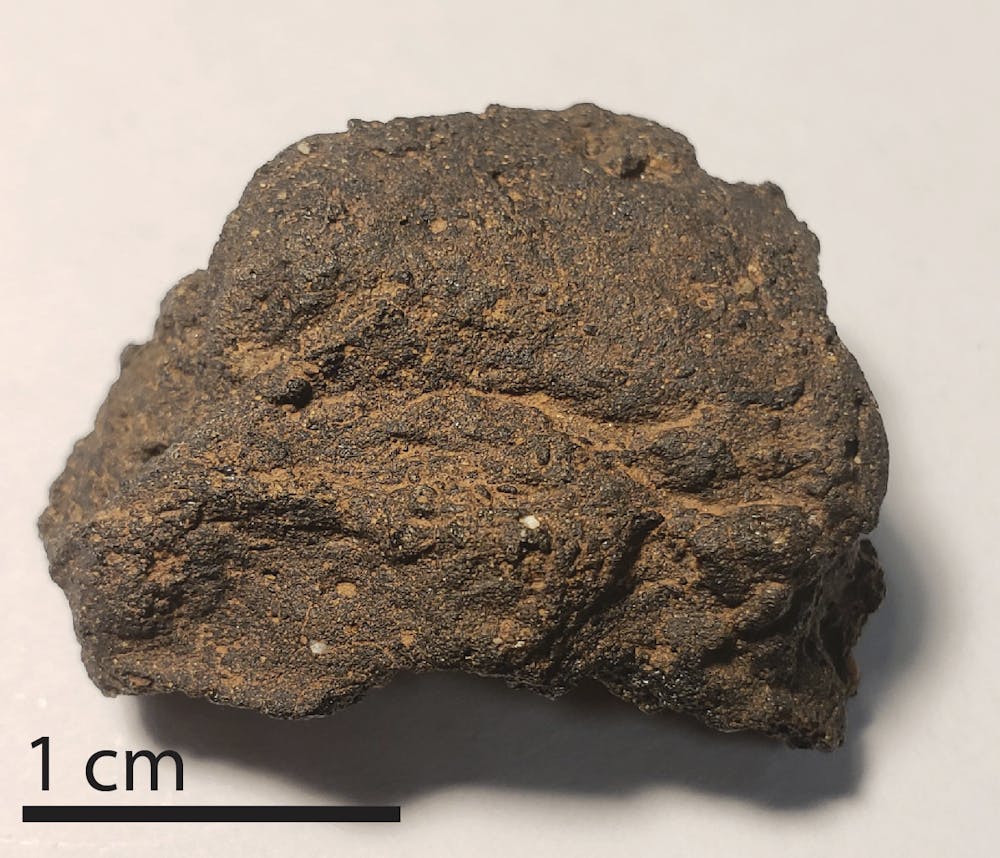 A piece of Henbury glass.
Cavosie et al.
A piece of Henbury glass.
Cavosie et al.
To find out more about this “bush glass”, we took samples to the laboratory and shot holes in them with a laser, heating the glass into a hot plasma we could study with a mass spectrometer, which can determine which elements are present.
This revealed the glass contained elements from the local sandstone as well as high levels of iron, nickel and cobalt – much more than we found in exposed rocks in the craters. These results suggest the glass is made of about 10% melted meteorite.
A 10% meteorite contribution might not seem like a lot, but it’s a relatively enormous amount. By comparison, melted rocks from Chicxulub, the giant asteroid strike in Mexico widely believed to have killed off the dinosaurs, are typically less than 0.1% meteorite.
The Henbury glass also contained elevated levels of chromium, iridium and other elements from the platinum group. All of these are vanishingly rare in most rocks on Earth’s surface. Their high abundance in Henbury glass is another hallmark of a cosmic origin.
Meteorite glass around the world
Such high levels of meteorite residue in glass have not been reported from other Australian craters.
Similar glass has been described at two other sites, both younger and smaller than the largest Henbury crater (145m across). One is the 45m Kamil crater in Egypt, and the other is the 110m Wabar crater in Saudi Arabia.
Around 200 meteorite impact structures have been documented on Earth, with 32 located in Australia.
Read more: How we solved the mystery of Libyan desert glass
We think meteorite-rich glass like we found at Henbury forms in all craters, regardless of size. However, it likely represents a very small volume of the melt formed at large craters, and is best preserved at young craters that haven’t been eroded.
Our main motivation to search for meteorite residue in natural glass is that it provides ground-truth evidence for an impact with a celestial object. Many circular, crater-like features occur on Earth’s surface, but few have a truly cosmic origin.
Discovery of meteoritic residue in glass is an unambiguous method to confirm that a suspect site was made by an asteroid strike.
More enigmatic glasses
There are many reports of enigmatic natural glasses, in places such as Argentina, Australia and elsewhere, whose origins are ambiguous. In many cases no crater is known in the vicinity, such as Libyan desert glass. Determining whether they have an impact origin requires careful detective work to look for the telltale signs.
OSIRIS-REx mission sampling the asteroid Bennu.NASA is currently weighing up spending US$11 billion or so to bring a few hundred grams of rock samples from Mars collected by the Perseverance rover. Missions to Itokawa, Ryugu and Bennu have returned samples of asteroids, and a flood of new missions to the Moon will hopefully return fresh samples of our planetary neighbour.
In the meantime, there are lots of interesting bush glasses that deserve a second look for clues of a cosmic heritage.


