

Money transporter Armaguard is in peril. Could cash be dead sooner than we think?
- Written by The Conversation
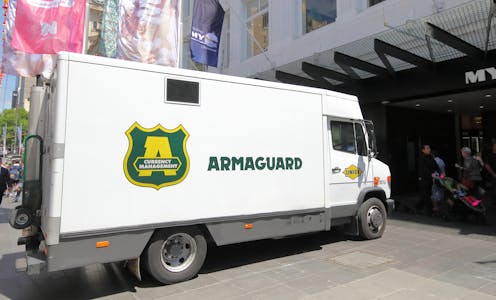
If you’ve ever taken money out at an Australian ATM, been handed $20 change at a supermarket or paid someone in cash, you’ve probably used the services of Armaguard.
Owned by Linfox Group, Armaguard is Australia’s largest currency transport business, servicing about 90% of the cash-in-transit market.
But the company is struggling. Use of cash as a means of payment has declined sharply in recent years, a trend that was only turbocharged by the pandemic. Last year, Armaguard said it would need a $190 million lifeline over the next three years in order to stay afloat.
Read more: The move to a cashless society isn't just a possibility, it's well underway
Last week, the company rejected a A$26 million rescue offer put together by some of Australia’s biggest banks and retailers, which would have required it to open its books. Instead, it opted for a smaller A$10 million package from its parent company Linfox that will see it through the next few weeks.
But the company’s future remains far from certain, worrying the Reserve Bank.
Why is “physical money” still important, and what could Australia learn from countries who’ve already gone cashless?
Cash-in-transit at a dead end?
Australian cash use has fallen off a cliff over the past decade. Consumers have moved overwhelmingly toward paying by card, now often facilitated by digital wallets on phones or watches.
As a result, there are now far fewer bank branches and ATMs operating in Australia. Between 2017 and 2023, bank branch numbers declined by 37% and the number of bank-owned ATMs fell from 13,814 to just 5,693.
According to the Australian Banking Association, cash is now only being used for about 13% of payments, a 57% decline since 2017.
Moving cash around was already expensive – the sheer size of the Australian continent means it has to be transported securely over huge distances. The fall in cash usage has further increased the unit cost of this process.
The Reserve Bank of Australia has outlined an alarming “cash-use cycle”, showing that if cash usage continues to fall, it could become uneconomic for banks and other ATM providers to offer cash services in some regional areas.
With permission from the ACCC, Armaguard acquired its main competitor Prosegur in June last year, arguing the merger would allow it to continue offering cash-in-transit services to all locations both companies had served.
But Armaguard has claimed it is still sustaining larger-than-expected losses, citing a structural reduction in demand for cash-in-transit services.
Having now accepted a A$10 million lifeline from its parent company, Armaguard will continue to operate all of its cash-in-transit services for the moment. But it remains to be seen what extra financial support it will be able leverage from the businesses it currently services.
Why do we need cash to survive?
The Reserve Bank of Australia (RBA) has a vested interest in maintaining cash as a store of wealth and means of payment for many people, particularly as a backup option when electronic payment systems are unavailable or offline.
As RBA governor Michelle Bullock explained in a recent speech:
For these reasons, the RBA places a high priority on the community continuing to have reasonable access to cash withdrawal and deposit services.
The Reserve Bank is keeping a close eye on the negotiations to keep Armaguard afloat, having previously floated the idea of an industry “cooperative model”.
This would see major cash users like banks form a cooperative entity to replace private sector suppliers like Armaguard.
Such models already exist in European countries. In the United Kingdom, the Link network connects almost all of the country’s ATMs and allows consumers to withdraw cash regardless of who they bank with.
Link is a not-for-profit organisation jointly owned by its members, who all issue cards used in its ATMs.
Read more: Cash may no longer be king, but the Optus debacle shows it is still necessary
Lessons from overseas
Much further down the road than Australia on this journey, Sweden has become one of the most cashless societies in the world. But this has prompted a degree of backlash in the country.
The governor of the Swedish Central Bank, the Riksbank, recently called for urgent legislation to protect both notes and coins as a payment option for Swedes:
Cash is needed to avoid people suffering digital and financial exclusion.
The Riksbank says the banks should be mandated to accept deposits of banknotes and coins and ensure their customers can withdraw cash from both branches and ATMs.
In a recent report, the Riksbank also pointed out there is currently only one private company in Sweden providing a cash-in-transit service, creating a potential point of vulnerability.
It called for collaboration between the Riksbank and Sweden’s commercial banks on ensuring that cash could still be transported if the current system ever broke down.
Importantly, Sweden offers an example of how the true death of cash will ultimately sound alarm bells. Faced with this, central banks and governments can bend to popular opinion and legislate for cash’s survival.


