

We found three new species of extinct giant kangaroo – and we don’t know why they died out when their cousins survived
- Written by The Conversation
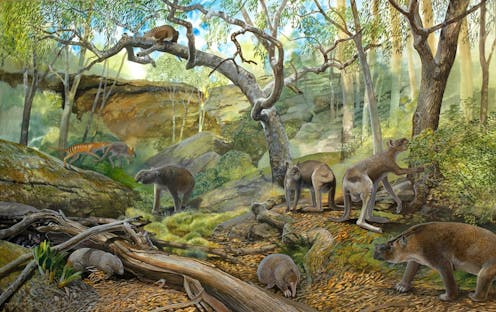
For millions of years, giant animals or megafauna roamed the lands that are now Australia and New Guinea. Many were like much larger versions of modern animals.
There was a four-metre goanna called Megalania (Varanus priscus), for example, which likely ambushed its prey. This beast disappeared by around 40,000 years ago along with almost all the other megafauna aside from remnants such as the red kangaroo and the saltwater crocodile.
Some of the now-vanished kangaroo species were quite massive. The short-faced kangaroo Procoptodon goliah grew as tall as three metres and may have weighed more than 250 kilograms.
There was another genus of extinct kangaroos, Protemnodon, which were more like the grey and red roos we know today, but little has been known about their lives. In a new study, my colleagues and I describe three new species of these vanished marsupials – and shed some light on where they lived and how they got around.
A 150-year puzzle
The first species of Protemnodon were described in 1874 by the British naturalist Richard Owen. As was standard at the time, Owen focused chiefly on fossil teeth. Seeing minor differences between teeth from different fragmentary specimens, he described six species of Protemnodon.
However, Owen’s species have not stood the test of time. Our study agrees with only one of his species — Protemnodon anak. The first specimen of P. anak to be described, called the holotype, still resides in the Natural History Museum in London.
Fossils of individual Protemnodon bones are not uncommon, but more complete skeletons are rare. This has hampered palaeontologists’ efforts to study the creatures.
The question of how many species there were, and how to tell them apart, has not been fully answered. This has made it hard to say how the species differed in their size, geographic range, movement and adaptations to their natural environments.
I set out to solve this problem in my PhD project. With fellow PhD student Jacob van Zoelen, I visited the collections of 14 museums in four countries to gather data.
We have now seen just about every piece of Protemnodon that exists above ground, photographing, scanning, measuring, comparing and describing more than 800 specimens collected from all over Australia and New Guinea.
Finding the key
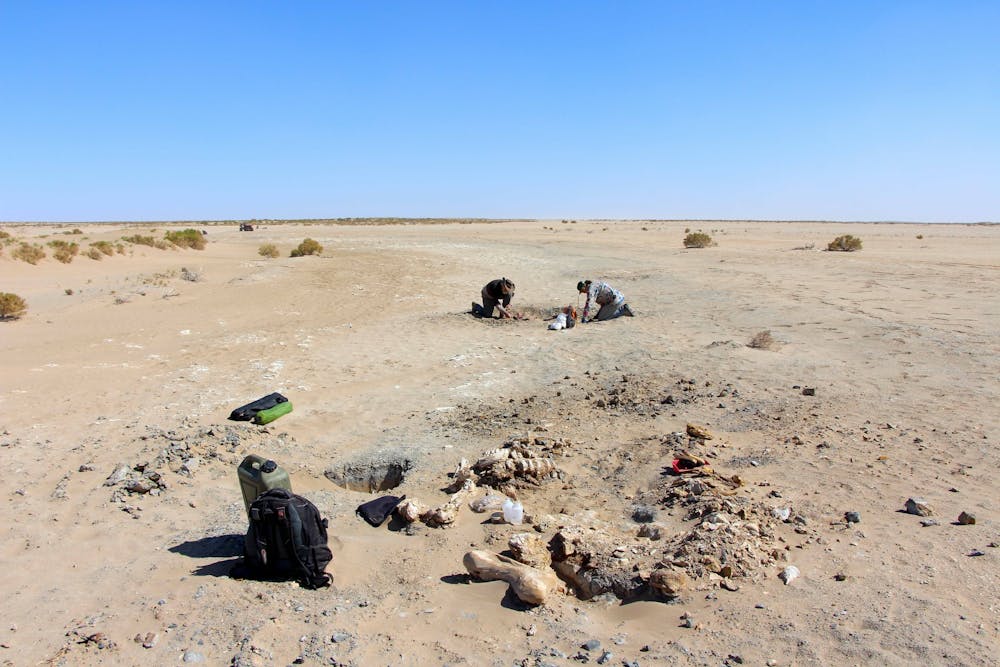
Among all this study, the key to the Protemnodon problem turned out to be buried in the dry bed of Lake Callabonna in northeastern South Australia. Three expeditions to Lake Callabonna from 2013 to 2019 found a megafaunal boneyard: complete skeletons of giant kangaroos, giant wombats, and Genyornis newtoni, a 250kg flightless bird, were scattered among the remains of hundreds of Diprotodon optatum, a rhino-sized marsupial herbivore. This lake likely preserves animals that died while searching for water during prolonged drought.
I accompanied the 2018 trip, which returned with all manner of amazing articulated fossils. These fossils allowed me, then a PhD student in my first year, to begin the process of picking apart the identities of the kangaroos.
Read more: Humans coexisted with three-tonne marsupials and lizards as long as cars in ancient Australia
Two of Richard Owen’s species, Protemnodon brehus and Protemnodon roechus, were only known from their teeth, which were extremely similar. We unearthed and compared several kangaroos with teeth that could have belonged to either of Owen’s species, but the skeletons didn’t match.
By the international rules of species naming, this meant we had to describe two new species. These are Protemnodon viator from central Australia and Protemnodon mamkurra from southern Australia.
Big kangaroos with big differences
Our study reviews all species of Protemnodon, finding surprising differences. We concluded that there are seven species in the genus, adapted to live in very different environments and even hopping in different ways. This level of variation is unusual within a single genus of kangaroo.
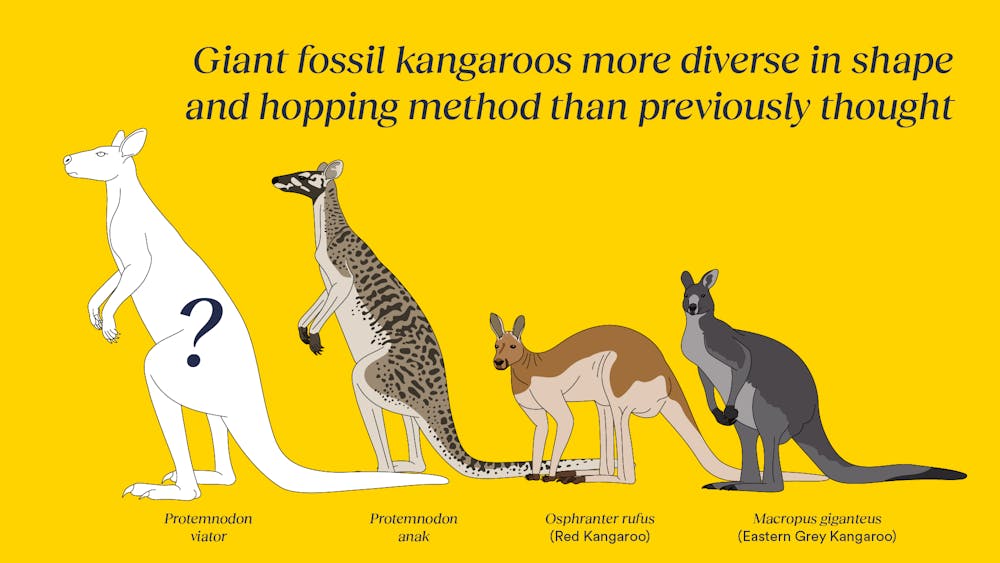 The newly described species Protemnodon viator was bigger than its relative P. anak, and much bigger than the red and Eastern grey kangaroos we know today.
Traci Klarenbeek
The newly described species Protemnodon viator was bigger than its relative P. anak, and much bigger than the red and Eastern grey kangaroos we know today.
Traci Klarenbeek
Protemnodon viator was a large, long-limbed kangaroo that could hop fairly quickly and efficiently. Its name, viator, is Latin for “traveller” or “wayfarer”. Its elongated hind limbs were muscular and narrow, perfect for supporting the kangaroo as it hopped long distances.
Protemnodon viator was well-adapted to its arid central Australian habitat, living in similar areas to the red kangaroos of today. Protemnodon viator was much bigger, however, weighing up to 170 kg, about twice as much as the largest male red kangaroos.
Our study suggests two or three species of Protemnodon may have been mostly quadrupedal, moving something like a quokka or potoroo – bounding on four legs at times, and hopping on two legs at others.
Read more: Did people or climate kill off the megafauna? Actually, it was both
The newly described Protemnodon mamkurra is likely one of these. A large but thick-boned and robust kangaroo, it was probably fairly slow-moving and inefficient. It may have hopped only rarely, perhaps just when startled.
The best fossils of this species come from southeastern South Australia, on the land of the Boandik people. The species name, mamkurra, was chosen by Boandik elders and language experts in the Burrandies Corporation. It means “great kangaroo” in Bunganditj language.
The third of our newly described species is Protemnodon dawsonae, a woodland-dwelling kangaroo from eastern Australia and the probable ancestor of P. viator and P. mamkurra. It is named for kangaroo palaeontologist Lyndall Dawson.
By about 40,000 years ago, despite their many differences, all Protemnodon were extinct on mainland Australia. We don’t yet know why they died out when similar animals such as wallaroos and grey kangaroos survived – but our study may open the door for further Protemnodon research that will find out more about how they lived and why they died.


