

Robert Adamson’s final book is a search for recognition and a poetic tribute to his love of nature
- Written by The Conversation
Robert Adamson, one of our greatest poets, died aged 79 on December 16, 2022. By that time, as recorded in the biographical note in his final book, Birds and Fish: Life on the Hawkesbury, he had published 21 volumes of poetry and had long been a renowned editor, critic and publisher. He made a significant and lasting contribution to Australian literature.
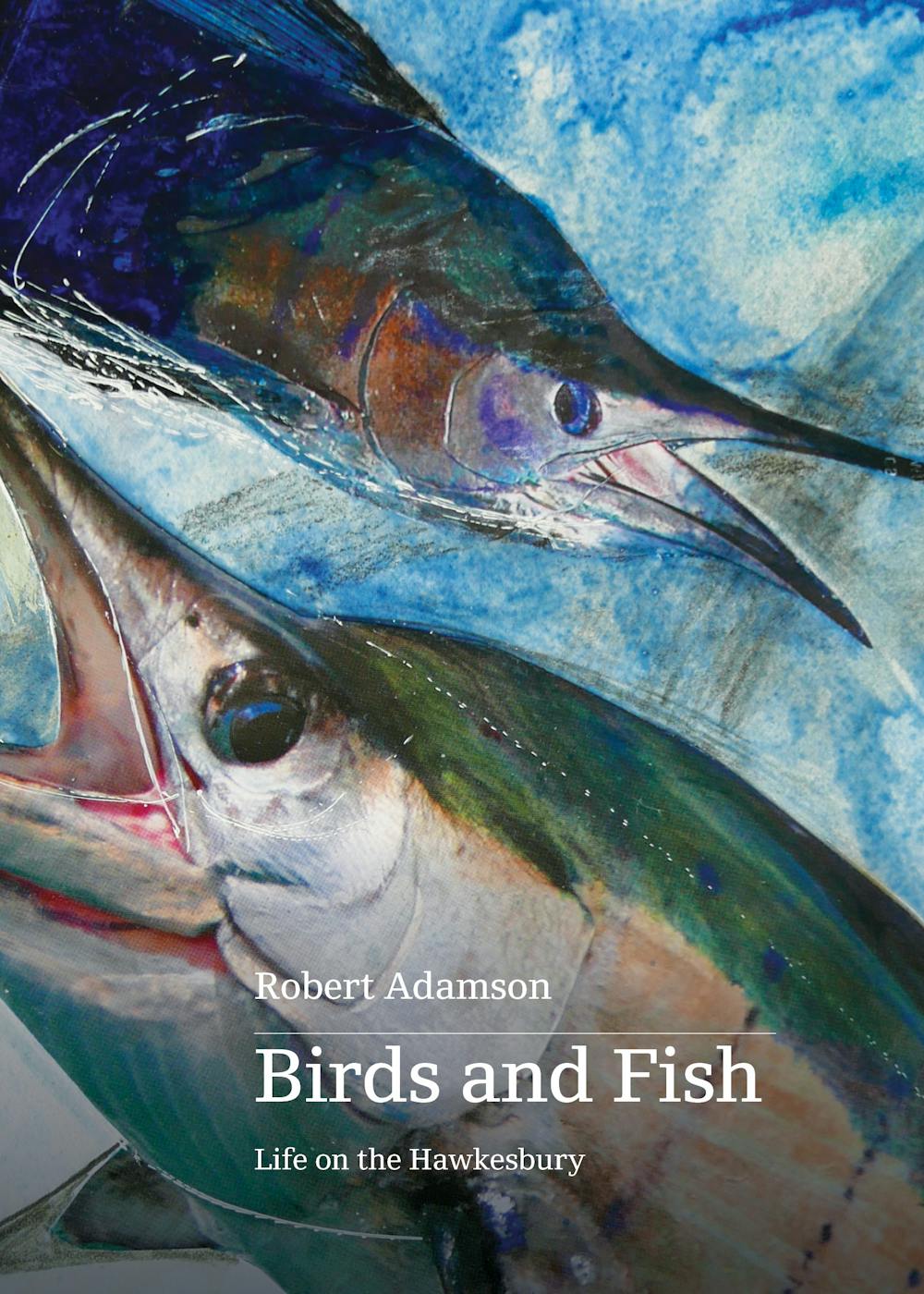
Birds and Fish: Life on the Hawkesbury – Robert Adamson (Upswell)
In 2004, Adamson published Inside Out: An Autobiography. Several long excerpts are included in Birds and Fish, a selection of his writings on the natural world. The first of these excerpts begins:
From as far back as I can remember, I was fascinated by animals and felt compelled to get close to them in whatever way I could – by hunting them, studying them, keeping them in cages or imitating their behaviour.
Adamson grew up in Neutral Bay on Sydney’s lower north shore, which afforded him ample opportunity to pursue his interest. He frequented Taronga Zoo, “sometimes through the front gates, but more often over the fence near [his] favourite part, the quarantine area at Athol Bay”.
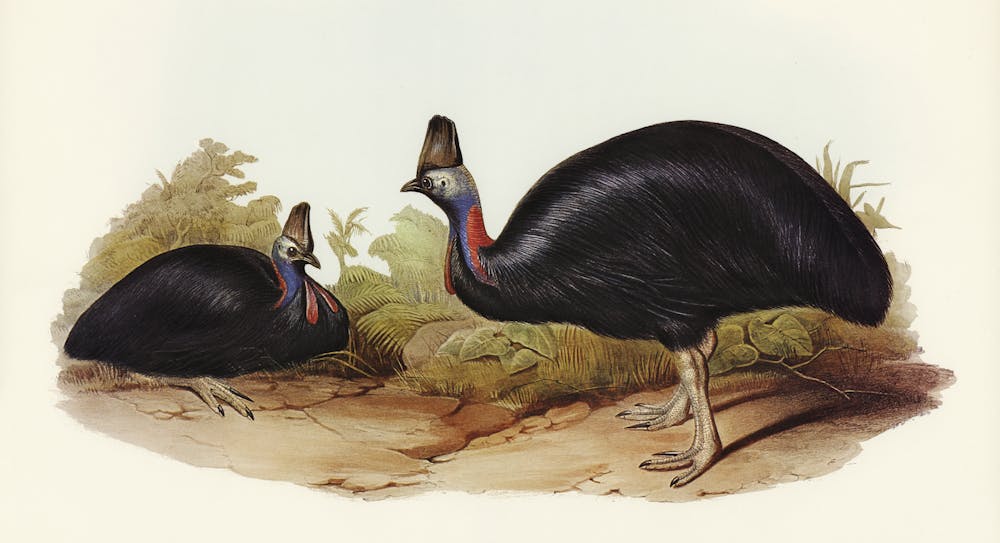
On one such occasion, aged “ten or eleven”, Adamson fell into an enclosure and found himself “face to face with an angry cassowary”. He stood “utterly still with the great black bird” circling around him, with its “deep, resonant, furious-sounding voice” and “horn of a head fringed with iridescent blue feathers shivering in the moonlight”.
It is a terrifying, beautiful scene, recounted not by the fallen boy, of course, but the poet he became.
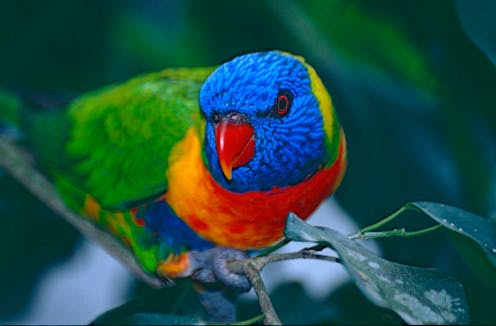
Adamson says of the injured rainbow lorikeets his younger self would take home to nurse that
I wanted to will myself inside the bird’s head – not to tame it exactly. What I think I was aiming for when I stared into each bird’s eyes was some flicker of recognition, some sign of connection between us. I wanted the bird to recognise and accept me. But as what?
Adamson is very often on philosophical ground. What does it mean for a person to want an animal “to recognise and accept” him? Do animals have such a capacity? Can an animal be a person?
Theories of recognition have a long history, which in the Western tradition date back at least as far as Hegel. To think on “recognition” raises questions of respect and understanding, friendship, love and empathy, and law.
To and from whom is recognition given, or withheld? As we know from history, and it seems always newly apparent, the answer to such a question can be a hinge point for calamity.
In the scene with the injured lorikeet, as earlier with the angry cassowary, the philosophy is implicit. We knew it would be, for the book’s epigraph is from Gerard Manley Hopkins: “What you look hard at seems to look hard at you.”
Mutual recognition, self-consciousness: it’s Hegel again.
Read more: Poetry goes nuclear: 3 recent books delve into present anxieties, finding beauty amid the terror
It wasn’t only non-human animals to whom the young Adamson looked for recognition:
The year I turned ten was my best year, when I was class captain for the final term. This was the year of Mr Roberts, the teacher who introduced me to poetry and what they called nature studies.
 Mr Roberts “would read poems to the class and go through them explaining what they meant and how poetry worked.”
The young Adamson seemed to find therein “a secret code”. He excelled at memorising poems, a talent which saw him selected to represent his school “on an ABC radio program that came on just before The Argonauts every Friday afternoon”.
It helped, too, that Mr Roberts “knew a bit about birds” and that he was encouraging about projects and assignments. The young Adamson lights up, a recognition undimmed, even when a new teacher tells him “to forget [his] ambition”.
He has a strong sense already that the natural world is “pure compared to the hypocrisies of humans”:
There was no third party, no good manners, no god involved – no reasoning or theology, let alone spelling and maths. Nature was blunt and honest.
For Adamson, the natural world offers a form of deliverance:
Fishing sustains the soul because it was once one of the most natural things a human being could do; that is why you can enter that state of grace, that lightness of being, while fishing. It is to do with the field of being; you can project yourself back to the original lores, rites and rituals.
All of which carries us from Hegel and recognition to the Spinoza Journal, which takes up the last 30 pages of the book. Adamson writes:
Spinoza’s given name [Baruch] means “Blessed” in Hebrew. Spinoza argued that God exists and is abstract and impersonal. His view of God can be described as Classical Pantheism, with infinite manifestations of divinity.
The Spinoza of Adamson’s journal is not the 17th century Dutch philosopher, but an unfledged bird that Adamson and his wife, the photographer Juno Gemes, find on the side of the road close to their house on the Hawkesbury River.
Adamson realises that the chick is only a few days old. He carries her “into the garage” and sets “her on the makeshift nest”. Every two hours, he feeds her a “mixture of rolled oats, crushed walnut and egg yolk”. A lifetime’s acquaintance with birds informs his actions:
When you find a baby bird, the thing to do is to place it near the tree it may have fallen from and wait for the parents to turn up. I did this and watched from a distance. It was a hot afternoon, so after about an hour, I decided that was long enough. I looked around for likely foster parents – currawongs, magpies and maybe kookaburras? No action at all. I took the baby bird back inside and put it into the cat carrier. To my relief, next morning the chick was still alive and squawking for food.
Adamson worries at the domestication of a channel-billed cuckoo, fearing “Spin the domestic companion would be like having Arthur Rimbaud as a pet”. He looks hard at the bird and the bird looks right back. There are regular feeding times and flying lessons, affording Adamson an occasion to write about Pliny the Elder and Charles Darwin, and to recall the “Cuckoo Song”, the “oldest secular lyric written in English, dating from 1250”.
There is some terrific writing and detailed observation. Then, some six weeks into the relationship:
I’m feeling embarrassed today: I finally realised Spin is not a channel-billed cuckoo. Spinoza is a satin bowerbird!
Spin has been misidentified, but not unrecognised:
Spin was in a lovely mood today in my study. I was working on the manuscript for my new book. As I look into Spin’s eye, when he turns his head to one side, I sense an empathy between us.
We should be thankful to Upswell Publishing and the editor of Birds and Fish, the American poet Devin Johnston, for ensuring the publication of this last of Adamson’s books.
The sort of recognition it suggests is a capacity of the imagination, or the moral imagination. It is imperfect, “blunt and honest”, and perhaps in a final sense, hopeful. Adamson deserves the last word:
Although I have loved birds all my life and love Spin deeply, it is Spin who has taught me that birds are nothing at all like humans. They are far removed from us, really, except that sometimes they let us project ourselves onto what we imagine them to be.


