

Ecosystems are deeply interconnected – environmental research, policy and management should be too
- Written by The Conversation
Why are we crossing ecological boundaries that affect Earth’s fundamental life-supporting capacity? Is it because we don’t have enough information about how ecosystems respond to change? Or are we unable, even unwilling, to use that information better?
We have a lot to learn still, but as we show in our research, using current ecological knowledge more effectively could deliver substantial environmental gains.
Our work focuses on improving links between research and ecosystem management to identify key trigger points for action in a framework that joins land, freshwater and sea ecosystems.
Specifically, we investigate solutions to environmental and societal problems that stem from the disparities between scientific research, policy and management responses to environmental issues.
We need managers and policy makers to consider ecological tipping points and how they can cascade though ecosystems from land into rivers and lakes and, ultimately, the ocean.
Our work’s standing among global research aimed at stopping ecosystem collapse has been recognised as one of 23 national champions in this year’s Frontiers Planet Prize.
Read more: Our oceans are in deep trouble – a 'mountains to sea' approach could make a real difference
More holistic solutions
This issue came into focus when New Zealand set up research collaborations known as national science challenges a decade ago to solve “wicked” social and ecological problems.
The challenges focused on environmental issues were deliberately created to concentrate on separate ecosystem and management domains (marine, freshwater and land). But all included research groups addressing ecological tipping points.
This was our inspirational spark. Our research highlights the consequences of managing land, freshwater and sea ecosystems in socially constructed bubbles. We focus on solutions where social and ecological connections are at the forefront of environmental management practices and decisions.
An example is the movement of pollutants such as microplastics from the land to the sea. Most of the microplastics found along coasts and in harbours are blown or washed off the land. While this pollution is a well recognised environmental threat to the marine environment, we have not yet focused on strategies to reduce the load.
Our work points to the ignored but critical issue that people’s impacts on land accumulate in the sea, but land management and consequent actions are not informed by these far-field effects.
This leads to lags in decision making which create undesirable environmental outcomes that are difficult to return from. But if we act on these connections, the environmental gains could be substantial.
Cyclones as a real-world example
As a result of massive soil erosion on the east coast of the North Island during Cyclone Bola in 1988, steep hillsides were retired from grazing and converted to pine plantations to help stabilise the land.
Fast forward three decades and a large proportion of the forest reached harvest at the same time. The exposed soil associated with clear felling was left draped in woody debris to protect it from rain.
However, Cyclone Gabrielle hit in February last year, with extreme rainfall washing both soil and woody debris into streams.
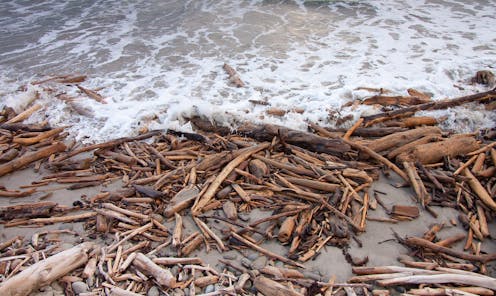
This destroyed habitats, transported vast amounts of silt and wrecked lowland farms, orchards and critical infrastructure. The debris also clogged harbours and coastal beaches, smothered seafloor habitats, destroyed fisheries and affected cultural and recreational values.
This real-world example demonstrates the severe consequences of lags in information flow and management responses. If land-use management decisions had considered the effects on other connected ecosystems and the potential for climate change to intensify those connections, the outcomes could have been different.
We could have implemented more diverse strategies in land use and put emphasis on restoring native forest and coastal wetlands.
Living with nature, not off it
Our vision is one where social and ecological connections across ecosystem domains are at the forefront of moving to a more sustainable future.
Living within planetary boundaries requires a paradigm shift in behaviours, including the way we link science and management to on-the-ground action. Crucially, we need to increase the speed at which new research is taken up and rapidly transition this into action that improves environmental outcomes at local scales.
This behavioural shift underpins the way to a more integrated, broad-scale ability to act and stay within planetary boundaries.
Our research shows we can, with trust and open minds, transcend the disciplinary silos to support new forms of research organisation. The challenge now is to extend holistic approaches into new practices.
This means identifying opportunities where connected research can alter behaviours across society, from individuals to global finance and governance. Central to this transition is recognising we are part of complex social and ecological systems and our actions have indirect effects and long-term consequences.
We need new research to provide this evidence. It will inevitably lead to new questions about fundamental ecological and integrated Earth processes.
We believe these holistic approaches will allow science to be more readily incorporated into decision making and ensure environmental perspectives are captured. This will lead to relevant, locally appropriate, integrated and robust environmental management actions.


