

Photos are everywhere. What makes a good one?
- Written by The Conversation
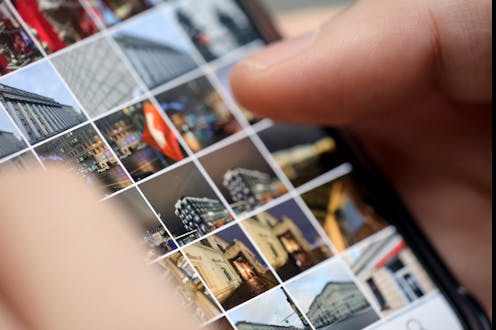
We upload some 3 billion images online each day. We make most of these photos on smartphones and use these devices to document everything from gym progress and our loved ones to a memorable meal.
But what makes a “quality” photo? Many people, even those who make images for work, struggle to answer. They often say something along the lines of “I know it when I see it”. But knowing some dimensions of a quality photograph can help make your images stand out and make you a more literate media maker and consumer.
Quality can be relative, but knowing the various dimensions at play can help you draw on those that are most relevant for your particular audience, context and purpose.
I identified six dimensions which will impact the quality of photographs. Here’s what I learnt – and what you can apply to your own photographs.
1. Production and presentation
Think of the factors in front of and behind the lens.
If you know you’re being recorded, this can affect your behaviour compared to a candid depiction.
You might be more or less comfortable posing for a friend or family member than for a stranger. This comfort, or its lack, can lead to more stiff and awkward poses, or ones that look more natural and confident.

Presentation circumstances, like the viewing size and context, also matter.
A group shot can make a nice statement piece above a fireplace, but it wouldn’t have the same effect as a profile photo. Be aware of how “busy” your image is, and whether the viewing conditions are well-suited for the nature of your photo.
Images with lots of elements, fine textures or other details need to be viewed large to be fully appreciated. Images with fewer, larger and simpler elements can usually be appreciated at smaller sizes.
2. Technical aspects
Technical aspects include proper exposure – meaning the image isn’t too dark or too bright – adequate focus, and appropriate camera settings.
Some of these camera settings, like shutter speed, affect whether motion is seen as frozen or blurred.
 A slow shutter speed can introduce motion blur and enliven an otherwise more static composition.
T.J. Thomson
A slow shutter speed can introduce motion blur and enliven an otherwise more static composition.
T.J. Thomson
If the image is too blurry, too pixelated, or too light or dark, these technical aspects will negatively impact the photograph’s quality. But some motion blur, as distinct from camera shake, can make more dynamic an otherwise static composition.
3. Who or what is shown
 Older people tend to be under-represented in public photography,
T.J. Thomson
Older people tend to be under-represented in public photography,
T.J. Thomson
Who or what is shown in the photographs we see is affected, in part, by access and novelty. That’s why we often make more photos during our holidays compared to documenting familiar settings.
Some people or locations can be under-represented and photographing them can lead to more visibility, and, depending on the context, a more empowering framing.
Consider in your photography if you’re including people who are typically under-represented, such as older individuals, people of colour, people living with disabilities and queer people. Also consider whether you’re representing them in stereotypical or disempowering ways.
As examples, when photographing older people, consider whether you’re showing them as lonely, isolated, passive, or in need of mobility aids.
4. Composition
 Use items in the built or natural environment as framing devices.
T.J. Thomson
Use items in the built or natural environment as framing devices.
T.J. Thomson
Composition includes positioning of elements in the frame, the balance between positive and negative space, and depth, among others.
Generally, images that centre the subject of interest aren’t as visually engaging as images that offset the subject of interest. This is what’s known as the rule-of-thirds approach.
Likewise, images that have no depth are generally not as interesting as images with a clear foreground, midground and background. “Seeing through things” with your compositions can help increase the visual depth of your photos alongside their visual appeal.
5. The psycho-physiological
The psycho-physiological concerns how the viewer reacts to what is shown.
 Images can spark an emotional reaction.
T.J. Thomson
Images can spark an emotional reaction.
T.J. Thomson
This includes the biological reaction we have to seeing certain colours, for example the way the colour red can increase our heart rate. It also can include the feeling we have when seeing a photo of someone we know.
The most powerful photos use colour and other elements of visual language strategically for a specific effect. Looking at these images might evoke a specific emotion, such as empathy or fear, and influence how the viewer responds.
6. Narrative
Narrative concerns the storytelling quality of the image.
Images can show something in a literal way (think a photograph from a real estate listing) or they can tell a bigger story about the content represented or about the human condition (think about some of the iconic photos that emerged during Australia’s black summer bushfire season).
 The narrative shapes a photograph, like this image after tropical cyclone Jasper.
AAP Image/Brian Casse
The narrative shapes a photograph, like this image after tropical cyclone Jasper.
AAP Image/Brian Casse
Literal photos help us see what something or someone looks like but they might not have as much of an impact as iconic photos. For example, the well-known photo of three-year-old Syrian boy Aylan Kurdi’s lifeless body on a beach in Turkey boosted fundraising for refugees 100-fold.
A more thoughtful process
Next time you pull out your smartphone to make an image, don’t just “spray and pray”. Try to pre-visualise the story you want to tell and wait for the elements to line up into place.
Being aware of aesthetic and ethical considerations alongisde technical ones and emotional resonance can all help engage viewers and lead to more standout imagery.
To challenge yourself further, consider taking your phone off full-auto mode and play with camera settings to see how they impact the resulting photos.
Read more https://theconversation.com/photos-are-everywhere-what-makes-a-good-one-229011


