

Heavy water: how melting ice sheets and pumped groundwater can lower local sea levels – and boost them elsewhere
- Written by The Conversation
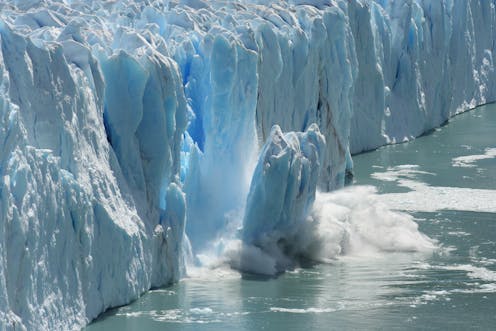
Imagine you’re standing near the edge of the Antarctic Ice Sheet, gazing out over the ocean, when the ice near you starts to melt very rapidly. A surge of meltwater flows into the ocean. Surprisingly, you watch the sea level fall – not rise.
But why? When we think of sea level rise, we picture oceans rising uniformly. But the sea is not like a bucket of water. It is bumpy and uneven. Gravity plays a vital role. Water is heavy. And unlike rocks, this enormous mass moves easily. Ice melts, snow and rain falls, rivers run, water evaporates and forms clouds. When ice melts, its weight shifts from land to sea and back again.
Our new research uses gravity-sensing satellites to track how changes in water storage on land can cause unexpected fluctuations in sea levels.
This century, rapid melting of ice sheets and mountain glaciers has raised overall global sea levels by around 1.5 millimetres a year. Melting ice has contributed 75% to the overall increase in ocean mass. The remaining 25% is due to changes in water storage on ice-free land areas. This includes changes in water captured in dams, water used by crops and vegetation as well as extraction of groundwater which then either evaporates or flows down rivers and eventually ends up in the oceans.
Changes to local sea level aren’t just due to melting glaciers or ice sheets. Any change in water mass on land can do the same thing. During large floods, the land gets heavier, boosting its gravity and triggering temporary local sea level rise. During droughts, the land loses mass, gravity drops and local sea levels fall.
These short-term effects are in addition to the long-term increases in sea level caused by the melting of Greenland and Antarctica and the thermal expansion as the oceans warm due to climate change.

How does water exchange influence sea level?
Why would local sea level fall near the coast of Antarctica if the ice sheet melts? It’s all because of gravity.
Think about the size of the Antarctic ice sheet, which covers the continent and the seas around it. It’s almost 5 kilometres high at its thickest point, and weighs a staggering 24 million billion tonnes. A mass this size exerts a gravitational pull on the ocean nearby, making sea levels higher than if it wasn’t there. But as the ice sheet melts, it loses mass, weakening the pull. As a result, the mass of the ocean is less attracted to the ice and nearby sea levels actually fall – while more distant sea levels rise.
Water is constantly being exchanged between land and sea. This exchange – through rainfall, rivers and groundwater – changes sea levels further away, affecting coastlines far beyond the point of entry or extraction. These fluctuations in water levels follow a predictable pattern as Earth rotates.
What this means is that sea level rise is different from place to place and time to time, even as ice steadily melts from global warming.
If there’s a sudden change to water or ice storage, it can profoundly influence water flows in the ocean, determining where sea levels rise or fall. For instance, as the Antarctic and Greenland ice sheets melt, the change to gravity actually leads to a fall in sea levels in the polar oceans, while sea level rises rapidly near the Equator.
Our research has shown the pumping of groundwater in ice-free regions – the continents where most of us live – can, in places such as Kuwait City, nearly mask the anticipated rise in sea levels from ice sheet melting. But in places such as New York, far away from intense groundwater extraction in Asia, sea level rise is accelerated.
Of water and land
In ice-free regions, the local sea level is influenced by what happens to water on land, whether by changes in lakes and rivers, soil moisture during drought and floods, or over-extraction of groundwater.
When La Niña arrives in eastern Australia or northern South America, this climate cycle often brings torrential rain, which can result in large-scale flooding, billions of dollars of damage, and loss of life. But La Niña can also tilt the gravitational balance towards the land.
In 2010 and 2011, consecutive La Niña events dropped so much rain on land that global sea level fell about 5mm. In the triple La Niña from 2020 to 2023, the rain dump significantly slowed the rate of global sea level rise.
This reduces, albeit temporarily, the climate-driven rise in global sea level.
What about groundwater? In most of the world, the drive for development and population growth have driven ever greater demands for water. Regions of China and India have been extracting groundwater at a combined rate of around 37 billion tonnes a year, far exceeding natural replenishment rates.
This over-extraction of groundwater has made a substantial contribution of ~1 mm per decade to overall sea level rise. But paradoxically, it has caused local sea levels to fall, as our industrious activities shift water mass from underground onto farms and then to the sea, via rivers.
As groundwater is depleted, the land loses mass and its gravitational pull falls. So far, this has had a far more pronounced effect on local sea level than the rise resulting from distant melting ice.
Of course, the water has to go somewhere. Unsustainable groundwater use ends up causing sea levels to rise elsewhere, and adds to the overall increase from ice sheet and mountain glacier melt.
 Groundwater extraction outstrips replenishment in many parts of the world.
Brian Inganga/AP
What does the future hold?
Our research points to one reason why some of us have not yet seen the full effects of global warming driving sea level rise – it’s been masked by groundwater extraction or climate cycles such as La Niña.
Groundwater overuse has slowed in China due to policy changes, leading to roughly 21 billion tonnes of increased water in these regions since the policy changes took effect.
Perversely, this will see local sea level rise accelerate, as groundwater extraction no longer offsets the increase from melting ice sheets. But on distant coastlines, reduced groundwater pumping will cause sea level rise to slow.
At present, in some places, groundwater use and other changes on land rivals the impact of ice-driven effects. The changes to water on our continents has been significantly affecting local sea levels.
But these changes are temporary and limited in magnitude relative to the big one: accelerating melting of the ice sheets covering Greenland and Antarctica.


