

Replanting trees can help prevent devastating landslides like the one in PNG – but it’s not a silver bullet
- Written by The Conversation
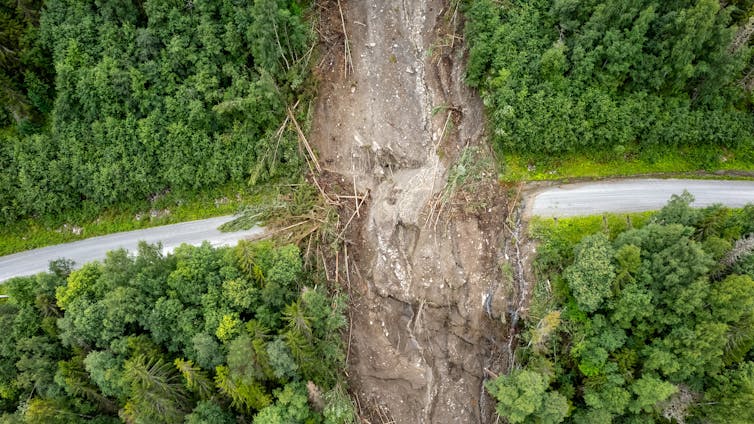
More than 2,000 people are now feared dead after a huge landslide buried a village in the highlands of Papua New Guinea, Australia’s nearest neighbour. Rescue efforts are being stymied by the fact the land is still sliding and moving. The disaster has cut the main road into the mountainous region.
PNG’s mountainous highlands are home to millions of people, living at least 1,500 metres above sea level. People here rely on food gardens, often cultivated on hillslopes. Landslides are common.
As Australia and other nations send aid to help the rescue effort and survivors, attention will turn to whether fatal landslides can be prevented.
Could deforestation be the cause? It’s possible. But there are many other potential causes. In 2018, for instance, a large earthquake triggered many landslides across the highlands.
Still, the example of Nepal gives some hope. Nepal was once heavily deforested, and suffered many lethal landslides. Mass reforestation has helped – but it must be coupled with other measures.

What makes land slide?
Mountains are not solid blocks of rock. They’re composed of a mix of clay, silt, sand, gravel and boulders of various sizes and shapes, all held together by resistive forces, especially friction.
Gravity is constantly pulling this mass downward, but resistive forces prevent it from collapsing, in a constant tug of war. When the resistive force becomes weaker than gravity, the hillside becomes unstable.
There are different ways the slope of a mountain can collapse, but landslides are one of the most common. Worldwide, these disasters cause significant loss of life and damage to homes, roads, bridges and other infrastructure.
What has to happen for gravity to win out over friction? Usually, it involves water.
When water sinks into the side of a hill or mountain, it acts as a lubricant. It can also build up pressure, which reduces friction. Earthquakes and volcanic activity can also cause landslides by shaking the slope, making a landslide more likely.
 Landslides are more common in mountainous nations with high rainfall.
Jakub Stanek/Shutterstock
Landslides are more common in mountainous nations with high rainfall.
Jakub Stanek/Shutterstock
Can our activities make landslides more common?
Landslides are common in mountainous regions with heavy rainfall and where earthquakes and volcanic activities are frequent. Taiwan, Japan, the Philippines, Nepal, PNG and Italy all frequently experience landslides.
Landslides are often triggered naturally. But our activities can make them more likely. The risk will rise in regions where climate change is driving substantial increases in rainfall.
When we cut into slopes to build roads or houses, we can make landslides more likely – especially if we don’t improve drainage to funnel infiltrating water away. Mining can also increase landslide risk.
To safely build infrastructure or mines in steep terrain means relying on structural measures such as a good drainage system, retaining walls, and other stabilising structures.
That’s in the ideal world. Structural measures are expensive. In poorer countries, development is often done without these safeguards, putting lives and livelihoods at risk.
 Deforested areas with bad drainage are more likely to suffer landslides.
The Conversation, CC BY-NC-ND
Deforested areas with bad drainage are more likely to suffer landslides.
The Conversation, CC BY-NC-ND
What about trees? When we cut down trees or irrigate hillsides, we can load the dice for more landslides.
Deforested areas are particularly vulnerable to landslides. When tree roots die, they leave behind soil pipes (macropores), small tunnels able to channel water from the surface deep into the ground. This significantly boosts the pressure groundwater is under, triggering more landslides.
Studies show landslides continue to increase for a few years after deforestation, indicating the decay of tree roots, decline and root strength and the formation of macropores.
Trees on more gentle slope help stabilise the soil, especially against shallow landslides. That’s because their roots go deep, anchoring movable surface soil to more stable substrates. Trees also cut how much water gets into the soil by drinking it.
But on steep slopes, trees can actually cause landslides, due to the added weight. And if a deep landslide is looming, tree roots won’t stop it.
What can we do?
The first step is to keep people away from high risk areas. Many countries have undertaken surveys of mountainous areas to assess where the highest landslide risk is.
It’s very hard and expensive to stabilise a slope after a landslide. It’s far better to avoid one.
For shallow landslides, the most feasible prevention is to keep forest cover widespread across the catchment.
Forests are important – but they’re not a silver bullet.
A study in Nepal found extensive deforestation peaked between 1985 and 1990. Landslides began increasing between 1995 to 2003, indicating a delayed impact. A different study from Nepal reported a reduction in the surface area affected by landslides following reforestation.
The effect is noticeable – but not huge. New Zealand research has found landslides are less common in forests than in pastures for areas with similar rainfall, and showed reforestation cut landslide sediment rates by at least 10% decrease within the first five years. Research on the Spanish Pyrenees found reforestation moderately reduced landslide occurrences.
So is it worth replanting trees on denuded slopes? On milder slopes, it will make a difference in cutting landslide risk. But this technique takes years until the roots grow big enough, it can’t be used on steeper slopes – and it won’t stop the really big landslides.


