

Hydration is really important for learning. How much do kids need to drink?
- Written by The Conversation
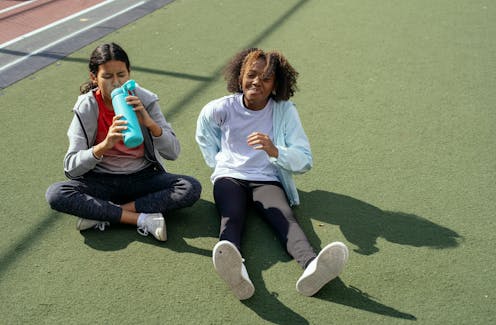
Last month, Ballarat Clarendon College began a trial to ban water bottles in the classroom for students in Years 5 to 9. According to the school, “early feedback” indicated it had reduced noise and bathroom breaks during class time.
Along with becoming a status symbol and fashion item, water bottles are now considered essential for school.
So how much water do children need in a day? And what impact does it have on their brains?
How much fluid do children and teenagers need?
The amount of fluid children need will depend on the weather and how much physical activity they do. But as a general guide:
children aged four to eight should have about 1.2 litres per day
boys nine to 13 should have 1.6 litres
girls nine to 13 should have 1.4 litres
boys over 14 should have 1.9 litres
girls over 14 should have 1.6 litres.
As the Australian Dietary Guidelines stress, it is preferable to meet most fluid needs by drinking plain water. If your child does not like drinking water you could consider adding a squeeze of juice.
Research suggests many school-aged children do not drink enough and arrive at school already dehydrated. A 2017 study involving 6,469 children (aged four to 17) from 13 countries (not including Australia) found 60% of children and 75% of adolescents did not consume enough water from fluids.
How often do they need to drink?
There is no specific advice about how often children and adolescents need to drink. But the main message from research is students need to start drinking from the time they get up.
Having a drink of water first thing in the morning regulates the body and brain to use water well, setting up mental performance for the rest of the day.
Research also tells us children need to keep drinking substantial amounts of water (about 250-300ml) throughout the day, rather than just taking little sips here and there to keep the brain in a hydrated state.
Why is water so important for our brains?
About 75% of all brain mass is water and our brains need water to keep working.
Among other functions, water helps brain cells and tissue to balance hormone levels, maintain proper blood flow and deliver vitamins, minerals and oxygen to your brain.
Even mild levels of dehydration can increase levels of the hormone cortisol, which can lead to feeling nervous, tense and irritable. This can muddle up the brain’s processing of information as well as our energy levels, emotions and behaviour.
So if students are adequately hydrated it sets up their brains to be in an optimal state to concentrate and pay attention at school.
How can water help learning?
Beyond helping our bodies to function, research also shows drinking water can help our brains to learn.
A 2020 study of German children in Year 5 and 6 showed those who had at least 50% of their daily water requirements (about 1 litre) over a four hour period in the morning had better memory performance overall.
The research showed children’s ability to pay attention to visual information was much better after drinking water, compared to no water.
A 2019 US study looked at the the impact of water on young people’s “cognitive flexibility”. This is the capacity to think about multiple concepts at the same time or quickly switch thinking between two concepts.
Over four days, children aged nine to eleven were given different amounts to drink. Those who drank up to 2.5 litres of water over 24 hours (even more than the recommended adequate amount) were better at switching between mental tasks compared to those who drank lesser amounts.
Water as part of children’s routines
Having other regular moments for drinking water can also help create steady routines for children and young people. Routines are an important way to manage attention, emotions and behaviour.
Water breaks don’t necessarily need to be during class time (particularly if schools are finding them disruptive). But they do need to be at predictable times during the day.
So, having a drink of water when kids wake up, at meal times, when kids get to school, at the start or end of classes and when they get home can all provide useful anchor points.


