

‘We cannot simply go, go, go.’ What is girl mossing, the wellness trend that rejects hustle culture?
- Written by The Conversation
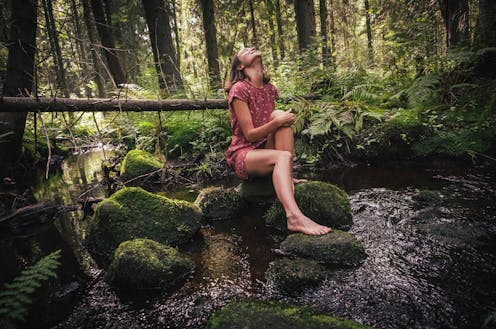
On TikTok and Instagram, people are “girl mossing”: lying on a forest floor, staring up at a leafy canopy or caressing moss. The United States National Forest Foundation even borrowed the term to kick off its 2024 Instagram account. Girl mossing recognises a need to step away from the pressures of modern, urban life, promoting spending time in nature as a restorative practice.
The fast pace and pressure of neoliberal capitalism take an enormous toll on wellbeing: not just personal, but social and planetary. These pressures are most acutely felt by women – whose labour remains, in large part, undervalued and underpaid – and by young people, who are often in precarious work, priced out of the housing market. Yet they’re still bombarded with images of unattainable success on social media. Not so the moss selfies.
There is a crossover between girl mossing as a byword for resting and relaxing in nature, and a worldwide trend for literally appreciating moss, similarly linked to finding relaxation in nature. In Japan, moss has long been a national craze, sparked partly by a 2011 runaway hit book, Mosses, My Dear Friends. The term “Moss girl(s)” in Japanese, #苔ガール or #苔ガールズ, has 4,036 posts on Instagram.
On Facebook, the Moss Appreciation Society has over 267.1k members. And there are whole Instagram accounts devoted to photos of moss, like Mossgirlny, with 14.9K followers.
 Mosses, My Dear Friends was a bestseller in Japan.
Moss does not move fast. It is soft and pillowy, ideal for nestling into, and plays a nurturing role in soil health, helping retain key nutrients, avoid erosion, and ward off disease. It also helps with decomposition, transforming decaying leaf matter into new life.
Retreats for “moss girls” in Japan are accompanied by moss discovery tours and special themed desserts. The moss obsession continues today, with Oprah Winfrey recently getting in on the trend, visiting the moss gardens in Saihoji Temple and “forest bathing”.
The girl moss phenomenon also provides evidence for the rise in popularity of what scholars have called Dark Green Religion, reverential naturalism or relational naturalism. A strong connection with nature and an awareness of our interdependence with it is becoming a prevalent worldview and a source of meaning for many. It can have spiritual dimensions, or be entirely materialist and scientific.
This connection with nature is frequently coupled with the desire for rest and repair, in contrast to (and representing recovery from) the speed of capitalist hustle culture.
Trends like girl mossing and girl rotting follow the recent trend of quiet quitting, rising interest in the Dutch concept of niksen (doing nothing), and Dzogchen Buddhism’s emphasis on resting in effortless ease.
In China, there’s a parallel rise in “tangping/lying flat” among Chinese young people who are “rejecting high-pressure jobs” in favour of a “low-pressure life”, and in “bai lan” (letting things rot), “a voluntary retreat” from pursuing goals that are now seen as “too difficult to achieve”.
Notably, these trends emerged as we reentered the productivity culture of contemporary working life after the lockdowns of the COVID-19 pandemic, when much of the world was forced to slow down. Perhaps we’ve learnt the wisdom of letting things moss and rot.
As Buddhist nun and bestselling author Pema Chödrön states, things “come together and they fall apart”, again and again. “It’s just like that.”
The Western, capitalist mindset – shaped by Protestant values – valorises “things coming together”. We typically strive for material rewards through hard work and achieve success through doing.
We celebrate the “wins”: the promotion, the new house, marriage, the birth of children. By contrast, we really struggle “when things fall apart”, as they inevitably do, particularly when we are confronted with old age, sickness, and death – basically, with human decomposition.
 mossgirlny/Instagram
Mossing and rotting trends are by no means the first spiritual or lifestyle movements out to subvert the prescribed capitalist life path.
In the 1960s, leading figure in the counterculture movement and psychedelics advocate Timothy Leary urged youth to “tune in, turn on, drop out”. But girl mossing and girl rotting are distinguished by being led by young women, and by their embrace of natural rhythms of decay.
They both resist the hustle of productivity culture through an awareness that humans are part of nature – and thus subject to natural cycles. This fundamentally includes decomposition.
There is overlap, here, with the women leading the natural death and home funeral movement, such as author Caitlin Doughty, who advocate for embracing decay and the “freedom found in decomposition, a body rendered messy, chaotic, and wild”. And for advocates of new methods of handling human remains, like composting, decomposition is a fundamentally generative act, productive of new life.
We cannot simply go, go, go and incessantly produce and consume. We also need to rest, and rot, to rejuvenate for our wellbeing – and at some point, to die well too.
This article is part of the Religion and Spirituality series, arising from the Australian Research Council funded Discovery Project on Australian Spirituality, led by scholars at Deakin University. The series considers the growing interest in spirituality in so-called Australia, and its relationship to wellbeing and risks.


