

Blade Runner soundtrack at 30: how Vangelis used electronic music to explore what it means to be human
- Written by The Conversation
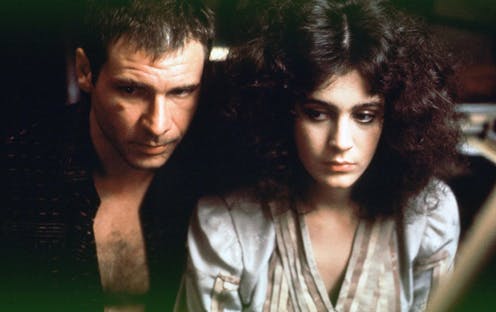
In June 1994 the late composer Evangelos Odysseas Papathanassiou – better known as Vangelis – released his soundtrack for the 1982 film Blade Runner. It would go on to become emblematic of his skills, with only a handful of soundtracks reaching a similar level of cult status.
Prior to this, sci-fi film scores tended to be characterised by orchestral sound palettes. For instance, John Williams’ 1991 Star Wars soundtrack leaned on the London Symphony Orchestra to communicate the vastness of a galaxy far, far away.
Vangelis, on the other hand, used an electronic approach to bring a subtlety and complexity that shifted the focus inwards. His ability to communicate deep emotion, alongside expansive philosophical concepts, was perhaps his greatest achievement with Blade Runner.
Missing pieces
Director Ridley Scott’s Blade Runner was adapted from Phillip K. Dick’s 1968 sci-fi novel Do Androids Dream of Electric Sheep? – which itself was a thoughtful examination of empathy and what it means to be human. The emotional gravitas of the original story, along with Vangelis’ accompanying timbral exploration, created an aural experience that was new to sci-fi films at the time.
Vangelis began work on the score in 1981. He received edited footage scene-by-scene on VHS tapes and created live takes in his studio with his synthesiser collection.
However, the first official soundtrack was delayed some 12 years after the film’s release, due to what was reportedly an ongoing disagreement with producers.
When it finally was released, purists viewed it as more of an album than a soundtrack. They criticised it for not having much of the music used in the original film, and for including pieces that never appeared in the film, such as Main Titles and Blush Response.
While the 2007 version (a 25th anniversary edition) included some unreleased material, parts of the original soundtrack remain unreleased even today.
A symmetry between newness and nostalgia
By emphasising longer drawn out notes, rather than thick instrumental combinations, Vangelis thoughtfully taps into the atmosphere of Scott’s visual world to create something truly unique.
Early sci-fi movies such as Forbidden Planet (1956) and The Day The Earth Stood Still (1951) often used electronic instruments developed in the early to mid-1900s, such as the theremin and the modular synthesiser. While these instruments helped augment concepts such as aliens, spaceships and robots, they did this somewhat simplistically.
A more sophisticated perspective pervades through Blade Runner, which combines film-noir instrumentation with classical, electronic, jazz and Middle Eastern music genres.
Specifically, Vangelis leverages the different sound qualities of synthesisers – such as bright and airy, thin and cold, or dark and thick – to at once capture emotion and highlight the complex ideas in the film’s narrative. In the final act, expansive synths dominate as the film reaches an intellectual and emotional climax.
While the synthesisers lend an artificial timbre to the score, the musicality simultaneously communicates life and feeling. In this way the foreign and familiar became enmeshed.
The film’s retro costuming and brutalist architecture also set up an expectation for the soundtrack. At times, the score will meaningfully go against this expectation by delving into a more nostalgic sound. The track Love Theme is a perfect example.
Innovative takes
Vangelis’ innovative use of dialogue in the soundtrack also helped to translate the complexities of the human condition. The tracks Main Titles, Blush Response, Wait for Me and Tears in Rain all feature dialogue in a way that makes them feel like a part of the film’s DNA.
The soundtrack’s arrangement was also uncommon for its time, as it mirrored the action narrative sequence. Tracks 1 through 4 are mixed as a single ongoing track. Tracks 5 through 7 are separated by silence, while tracks 8 through to 12 are also combined into a single piece. While this technique is common in electronic composition now, it was unique at the time.
The films dark, fraught and sad dystopian themes are further highlighted through collaborations with Welsh singer Mary Hopkins in Rachel’s Song, and Greek singer Demis Roussos in Tales of the Future.
Today, the Blade Runner soundtrack remains the most beloved of Vangelis’ works by his ardent fans – and it continues to commands its place in the 20th-century electronic music canon.


