

No costing, no clear timelines, no easy legal path: deep scepticism over Dutton’s nuclear plan is warranted
- Written by The Conversation
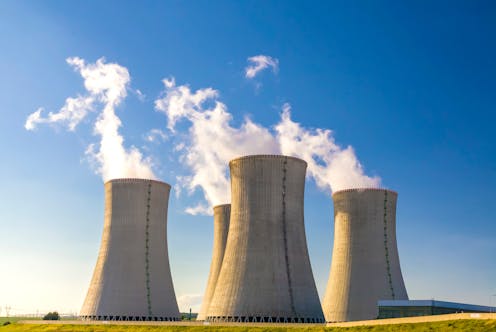
It is very difficult to take Opposition Leader Peter Dutton’s nuclear announcement seriously. His proposal for seven nuclear power stations is, at present, legally impossible, technically improbable, economically irrational and environmentally irresponsible.
Given the repeated community objections to much more modest nuclear proposals, such as storage of low-level radioactive waste, there is almost certainly no social licence for nuclear power stations.
Dutton promises that, if elected, he would make nuclear power a reality within a little over ten years. Given the enormous obstacles even to turn the first sod, this seems like a pipe dream.
Here’s why.
Legal status: seemingly impossible
Some 25 years ago, the Howard Coalition government legislated a ban on nuclear energy in its environment laws. Coalition governments have been in power federally for most of the time since, but have made no attempt to repeal the ban.
Even a sweeping victory in the forthcoming federal election would not give the Coalition the Senate majority necessary to change the ban in the next term of parliament. As is usually the case, only half the Senate will be elected, so simple arithmetic shows no prospect of a Coalition majority. The only possibility would be negotiating with the crossbench.
Of the seven nuclear power stations Dutton is proposing to build on the site of old coal stations, five would be in the eastern states: two in Queensland at Tarong and Callide, two in New South Wales at Mount Piper and Liddell, and one in Victoria at Loy Yang.
Each of these states have their own laws banning nuclear power. The eastern premiers have made clear they will not change their laws. Even Dutton’s Queensland Liberal National Party colleagues, who face a state election in October, do not support the plan.
So the proposal does not satisfy current laws and there is no realistic possibility of these changing in the timeframe Dutton would need to get the first reactors built (he says the first would be operating by the mid-2030s).
Dutton could try to bypass the states by building on Commonwealth land. But this would mean missing the supposed benefit of locating reactors next to existing transmission lines at old coal plant sites.

Cost: astronomical
Cost is a huge problem. Dutton has promised nuclear will deliver cheap power. But CSIRO’s latest GenCost study on the cost of different power generation technologies shows there is no economic case for nuclear power in Australia. Nuclear power would cost at least 50% more than power produced by renewables and firmed with storage.
This estimate is conservative – in reality nuclear would likely cost even more, as GenCost relies on the nuclear industry’s cost estimates. All recent projects have gone way over budget.
The three nuclear power stations being built in western Europe are all costing two to four times the original budget estimate.
It is true a renewables-dominated grid will require more storage, which means building more grid batteries and pumped hydro schemes. It is also true we’ll need to expand our existing 40,000 kilometres of transmission lines by 25% to get renewable electricity to consumers.
But even when we add these extra costs, and even when we accept industry figures, nuclear still cannot compete with solar farms or wind turbines. CSIRO costs nuclear at between A$8 and $17 billion for a large-scale reactor.
There are no private investors lining up to build nuclear. Overseas, nuclear has always been heavily bankrolled by the taxpayer. Dutton’s plan would either require a huge spend of public money or a major increase to power bills. In the United Kingdom, for example, the government has assured the developer of its Hinckley Point C reactor they will be able to recoup the cost by charging higher rates for the power.
While Dutton is promoting nuclear as a way to avoid building expensive and often unpopular new transmission lines, this is not true. Several proposed reactors would need their own lines built, as coal transmission capacity is rapidly being taken up by renewables, as South Australia’s energy minister Tom Koutsantonis has pointed out.
Time: we’re out of it
Building a nuclear reactor takes years or even decades. Dutton has promised Australia would have its first nuclear power station operational in a decade, assuming his party is elected and their scheme implemented without delay in 2025.
This claim is wholly without merit. In 2006, the Coalition government commissioned a study on whether nuclear power was viable in Australia, which found it would likely take 15 years to build a reactor here. The timeframe today would be similar, because we don’t have a workforce with experience of building large nuclear reactors. We also don’t have the regulatory framework needed to give the community confidence nuclear power stations could be built and operated safely.
Even in the United States, the UK and France – three countries with long experience with nuclear – no recent project has been completed within ten years.
It defies logic to suggest we could start with a blank sheet of paper and build complex systems faster than countries with long-established industries and regulatory regimes.
Nuclear backers often point to examples in China and the United Arab Emirates, which have both built reactors within about a decade. But these countries do not tolerate the community objections which would be inevitable. In Australia, consultation, legal challenges and protests often delay far less controversial projects.
Why does this matter? Dutton’s push for nuclear isn’t happening in a vacuum. This is the crucial decade for action on climate change. As Australian climate scientist Joëlle Gergis has written, we are now paying the cost of long inaction on climate change in damage from more severe bushfires, floods and drought.
Let’s say the Coalition is elected and sets about making this plan a reality. In practice, this would commit us to decades more of coal and gas, while we wait for nuclear to arrive. We would break our Paris Agreement undertaking to make deep cuts to emissions, and keep making climate change worse.


