

Nuclear energy creates the most dangerous form of radioactive waste. Where does Peter Dutton plan to put it?
- Written by The Conversation
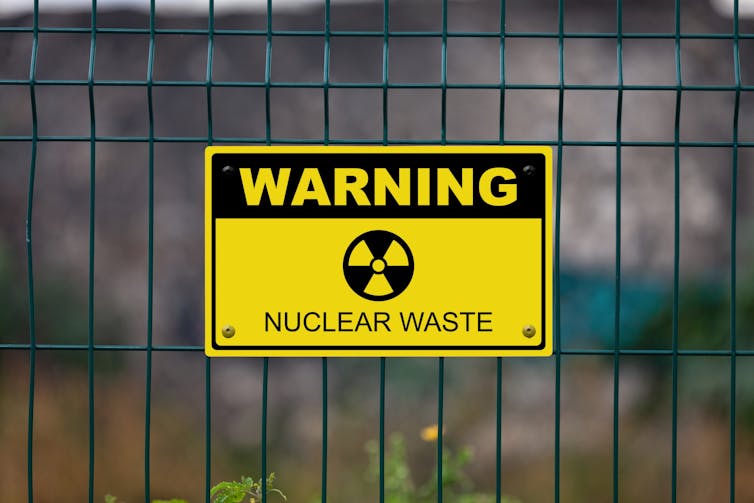
Opposition Leader Peter Dutton’s pledge to build seven nuclear energy plants, if elected, has triggered heated political debate – mostly about the costs and timetable of the plan. But the concept of nuclear energy in Australia must overcome an arguably even bigger hurdle: how to dispose of high-level nuclear waste.
Nuclear power is only a viable alternative to fossil fuel burning if there is somewhere to store the waste – and only if this can be done safely, without exorbitant cost and with community support.
A CSIRO analysis last month showed there is no economic argument for nuclear energy in Australia, even without considering the substantial cost of waste disposal and storage. Include waste in the maths, and the Coalition’s proposal looks a whole lot worse.
What’s more, nuclear power stations produce high-level radioactive waste. It is dangerous for hundreds of thousands of years — and so far, the world has failed to deliver a safe, permanent storage method. Is this a problem Australia really wants to take on?
What is high-level nuclear waste?
Nuclear reactors work by using fission, or the splitting of uranium atoms, to produce energy. Once the uranium has been used to produce energy it is considered “spent”. Spent fuel can either be disposed of or reprocessed to recover and reuse some of its contents, such as plutonium. Both spent and reprocessed nuclear fuel must eventually be disposed of.
Nuclear waste is classed according to how much radiation it emits – either low, intermediate or high. Nuclear power plants produce high-level waste, which is radioactive for a very long time.
Negative health effects in humans from exposure to high-level radiation include birth defects, impaired tissue and organ functioning, and increased risk of cancer.
Nuclear waste only becomes safe after it decays. For high-level waste, this can take hundreds of thousands of years. That means the waste must be disposed of and stored for a very, very long time.
How is high-level nuclear waste currently stored?
No permanent and safe storage for high-level nuclear waste is yet in operation.
The current temporary options are either “wet” or “dry” storage. Wet storage entails putting the waste in a pond and covering it with several metres of water to keep it cool. Dry storage involves putting the waste in containers made of concrete and steel.
These options are not a long-term solution. They are vulnerable to corrosion as well as natural disasters such as cyclones, tsunamis, earthquakes, fires and floods.
There are also risks from human-induced hazards such as war, terrorist attack, arson and accidents. For example, Russia’s invasion of Ukraine has threatened the safety of Ukrainian nuclear facilities such as the Zaporizhzhya plant, where spent nuclear fuel rods are reportedly kept in metal casks inside concrete containers in an open-air yard.
Can we put it underground?
Each reactor – even the small ones – will produce several tonnes of high-level waste each year – far more than the Coke can-sized amount of waste Dutton claims. The Coalition says it would find a permanent solution for storing nuclear waste from the plants. This is easier said than done.
The only permanent storage solution on the cards around the world is to place it in a “deep geological repository”. This involves encasing the waste and lowering it into a chamber drilled far underground. There are many challenges associated with this storage method. They include:
cost: the construction, decommissioning, closure and monitoring of such a facility in South Australia has been estimated at A$41 billion
siting: the location must be geologically stable, to prevent waste from escaping over many thousands of years
transport: the further waste has to be moved, the greater the safety risks. This is relevant to the Coalition’s plan, under which seven nuclear sites would be distributed around Australia
preventing corrosion and leakage: the waste container must be sufficiently robust to corrosion and the invasion of microbes. The shaft to the underground storage also needs to be sealed
social acceptance: in a democratic country such as Australia, communities must agree to host a nuclear waste site and be satisfied it is safe. This includes securing “free, prior and informed consent” from Traditional Owners.
Finland is the country closest to realising this storage method. It has selected a site for a deep geological repository 500 metres underground, and begun construction. But the project has taken decades and suffered numerous technical problems.
Scientists have also raised safety concerns, such as how the project will perform over the very long term, including during freezing of rocks in the next ice age.
Neither the United Kingdom nor the United States has moved beyond temporary storage of high-level nuclear waste.
The Coalition must come clean
Other nations have struggled to find long-term solutions for nuclear waste storage. There is every reason to expect Australia would face the same problems.
Importantly, Australia has for decades failed to find a suitable place for the long-term storage of small quantities of low- and intermediate-level nuclear waste from medical isotopes and the Lucas Heights research reactor. Even though these wastes are comparatively benign, every proposal has faced strong local opposition.
Ahead of the next federal election, the Coalition must explain to Australians how and where it intends to store radioactive waste from its nuclear plants. Without that detail, voters cannot fairly assess the plan.


