

Still fab after 60 years: how The Beatles’ A Hard Day’s Night made pop cinema history
- Written by The Conversation
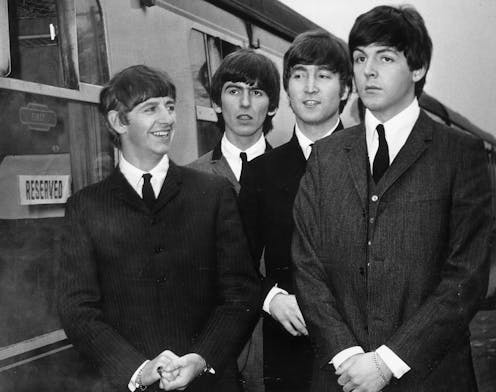
I first saw A Hard Day’s Night at a film festival over 20 years ago, at the insistence of my mum. By then, it was already decades old, but I remember being enthralled by its high-spirited energy.
A Beatles fan, mum had introduced me to the band’s records in my childhood. At home, we listened to Please Please Me, the band’s 1963 single, and the Rubber Soul album from 1965, which I loved.
Television regularly showed old black-and-white scenes of Beatlemania that, to a ten-year-old in the neon-lit 1980s, seemed like ancient history. But then, I’d never seen a full-length Beatles film. I had no idea what I was in for.
When the lights went down at Dunedin’s Regent Theatre, the opening chord of the film’s title song announced its intentions: an explosion of youthful vitality, rhythmic visuals, comical high jinks and the electrifying thrill of Beatlemania in 1964.
This time, it didn’t seem ancient at all.
Since that first viewing, I’ve returned to A Hard Day’s Night again and again. I now show it to my students as a historically significant example of pop music film making – visually inventive cinema, emblematic of a fresh era in youth culture, popular music and fandom.
Beatlemania on celluloid
A musical comedy depicting a chaotic 36 hours in the life of the Beatles, A Hard Day’s Night has now reached its 60th anniversary.
Directed by Richard Lester, the film premiered in London on July 6 1964, with its first public screening a day later (incidentally, also Ringo Starr’s birthday), and the album of the same name released on July 10.
The band’s popularity was by then reaching dizzying heights of hysteria, all reflected in the film. The Beatles are chased by hordes of fans, take a train trip, appear on TV, run from the police in a Keystone Cops-style sequence, and play a televised concert in front of screaming real-life Beatles fans.
Side one of the album provides the soundtrack, and the film inspired pop music film and video from then on, from the Monkees TV series (1966–68) to the Spice Girls’ Spice World (1997) and music videos as we know them today.
The original music video
Postwar teen culture and consumerism had been on the rise since the 1950s. In 1960s Britain, youth music TV programmes, notably Ready Steady Go! (1963–66), meant pop music now had a developing visual culture.
The youthful zest and vitality of ‘60s London was reflected in the pop-cultural sensibility, modern satirical humour and crisp visual impact of A Hard Day’s Night.
Influenced by French New Wave film making, and particularly the early 1960s work of Jean-Luc Godard, A Hard Day’s Night employs cinéma vérité-style hand-held cinematography, brisk jump cuts, unusual framing and dynamic angles, high-spirited action, and a self-referential nonchalance.
The film also breaks the “fourth wall”, with characters directly addressing the audience in closeup, and reveals the apparatus of the visual performance of music: cameras and TV monitors are all part of the frame.
Cutting the shots to the beat of the music – as in the Can’t Buy Me Love sequence – lends a visual rhythm that would later become the norm in music video editing. Lester developed this technique further in the second Beatles film, Help! (1965).
The closing sequence of A Hard Day’s Night is possibly the film’s most dynamic: photographic images of the band edited to the beat in the style of stop-motion animation. Sixty years on, it still feels fresh, especially as so much contemporary film making remains hidebound by formulaic Hollywood rules.
Slapstick and class awareness
As with much popular culture from the past, the humour in A Hard Day’s Night doesn’t always doesn’t land the way it would have in 1964. And yet, there are moments that seem surprisingly modern in their razor-sharp irony.
In particular, the band’s Liverpudlian working-class-lad jibes and chaotic energy contrast brilliantly with the film’s upper-class characters. Actor Victor Spinetti’s comically over-anxious TV director, constantly hand-wringing over the boys’ rebelliousness, underscores the era-defining change the Beatles represented.
Corporate pop-culture consumerism is also satirised. John Lennon “snorts” from a Coca-Cola bottle, a moment so knowingly silly it registers as more contemporary than it really is. George Harrison deflects a journalist’s banal questions with scathingly witty answers, and cuts a fashion company down to size by describing their shirt designs as “grotesque”.
And there is Paul McCartney’s running joke that his grandfather – played by Wilfred Brambell from groundbreaking sitcom Steptoe and Son (1962–74) – is “very clean”.
Even the film’s old-fashioned visual slapstick still holds up in 2024. Showing the film to this year’s students, I didn’t expect quite as much laughter when Ringo’s attempts to be chivalrous result in a fall-down-a-hole mishap.
In 2022, the Criterion Collection released a high-resolution restoration of the film, so today A Hard Day’s Night can be seen in all its fresh, black-and-white, youthful vigour.
Happy 60th, A Hard Day’s Night. And happy 84th, Ringo. Both still as lively and energetic as ever.


