

Critics are calling MONA ‘childish’, but history shows us how much the public love an art forger
- Written by The Conversation
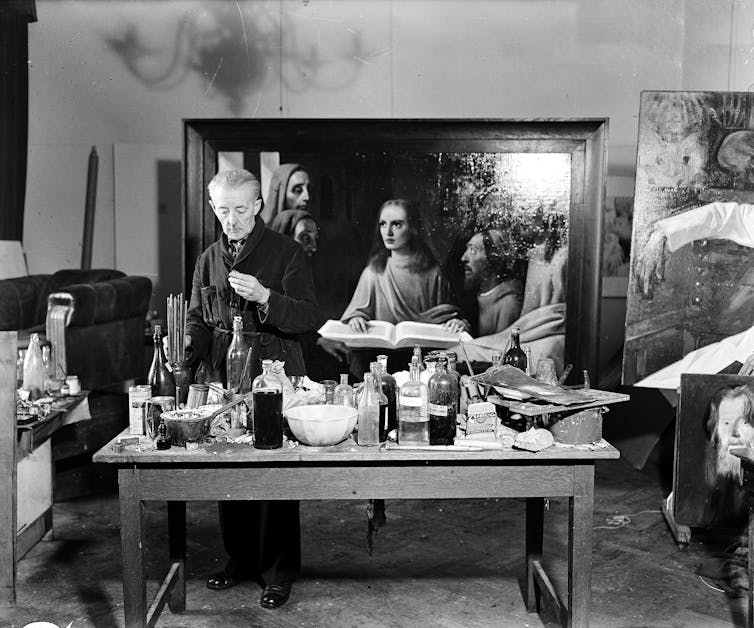
Art forgery is a devilish attempt to deceive its audience.
Experts’ negative reaction to Kirsha Kaechele’s admission she forged the three Picasso paintings that hung in the Ladies Lounge at Tasmania’s Museum of Old and New Art (MONA) is therefore no surprise.
As reported in Guardian Australia, experts such as Nine’s art critic John McDonald and Inside the Art Market’s Christopher Heathcote have dismissed Kaechele’s works as a “childish” prank, and highlighted the harm they imagine the fakes will inflict on the museum.
McDonald believes MONA has damaged its own reputation for integrity, and visitors to the museum will feel cheated by the fakes.
Heathcote thinks the forgeries will negatively impact Tasmania’s tourism industry. “You don’t travel from overseas or interstate only to be shown fake Picassos,” he says.
Except people do – and will – travel to see forged works of art, because the public loves the art forger, and is fascinated by their illicit practice.
The art forger and his fans
The art forger has a cheeky, mischievous quality that makes them a lovable rogue, less a gangster and more a prankster. Though their practice is illegal, in the wide spectrum of criminal activity the art forger is relatively benign.
They have none of the connections to organised crime or terrorism that characterises other art criminals, such as those who loot antiquities. Their fake works damage only wealthy collectors and institutions which the public thinks are elitist and pretentious.

In this way the art forger is a Robin Hood-type of criminal the public can admire and support as they pull the establishment’s pants down.
This public support is demonstrated by the number of art forgers whose works have been revealed to be fakes and who go on to enjoy fame and fortune.
English artist and infamous art forger Tom Keating (1917–84) was an arch-criminal who forged over 2,000 works between the 1950s and 1970s and looked like Santa Claus.
Though he was arrested for fraud, Keating escaped conviction, and was given his own TV show on Channel 4 in which he showed his captivated audience how he faked the masters.
British artist and convicted forger Shaun Greenhalgh (1961–) used his elderly parents (dubbed “The Artful Codgers” by the tabloid press) to sell over one million pounds worth of art works he had forged between 1989 and 2006.
After being arrested and serving over four years in prison, Greenhalgh has carved a lucrative career selling copies of famous works.
With the criminal mastermind John Drewe (1948–) British art forger John Myatt (1945–) was involved in a forgery scheme so diabolical in nature it is believed to have altered art history. Myatt produced forged works on which Drewe lavished a fake legitimacy by defiling the archives at the Tate Gallery and the Victoria and Albert Museum.
Myatt is now one of Britain’s most successful artists.
Art, without pretension
While the public celebrates the art forger, they are fascinated by their furtive art practice.
This interest can be detected in the popularity of the exhibition of forged works at the Courtauld Gallery in London in 2023, where fakes donated to the gallery for education purposes were displayed alongside forgeries once considered by experts to be original works.
Myatt thinks the public’s fascination with art forgery lies in the fake’s sense of authenticity that emanates from its lack of pretension.
He argues an original work embodies the capitalism and elitism and exorbitant value that renders such works remote from everyday experience. In contrast, the fake – without the price tag and the cultural baggage – can be considered in practical terms, as a painting with aesthetic properties that may have to complement the curtains.
Myatt’s ideas chime with the production of Kaechele’s fake Picassos, which she painted green to go with the colour scheme in the Ladies Lounge in which they are hung.
The experts who criticise the fake Picassos and argue MONA’s reputation is damaged fail to recognise how the rebellious nature of art forgery so perfectly aligns with the museum’s reputation for shaking up the art industry.
Past exhibitions at MONA have created controversy and drawn protest from animal rights campaigners and enraged Christians.
One of the museum’s most popular works is a device that mimics the human digestive system and converts food into excrement, which is dispensed daily. The forged Picassos and the establishment’s snooty reaction actually encapsulates and emboldens the museum’s public image.
 A faked Picasso painting as it was displayed in the women’s bathroom at MONA.
Eden Meure/MONA via AP
A faked Picasso painting as it was displayed in the women’s bathroom at MONA.
Eden Meure/MONA via AP
In time, the controversy will be seen as a positive story for MONA, and not the bonfire of integrity imagined by its critics.
The experts who warn of damage to Tasmania’s tourism industry have not stopped to appreciate the significance of a woman producing the fakes hung in the museum’s Ladies Lounge. Art forgery is exclusively a male activity.
Experts in this field such as Noah Charney and Thierry Lenain haven’t identified a single female art forger.
There may be hundreds of women producing art forgeries. They and their works are unknown because their paintings have not yet been revealed as fakes.
Until they are unmasked, Kirsha Kaechele can be recognised as the world’s most famous female art forger – an accolade that is certain to attract new visitors to the museum.


