

In Ancient Rome, the Vestal Virgins achieved power most women were denied – but at great cost
- Written by The Conversation
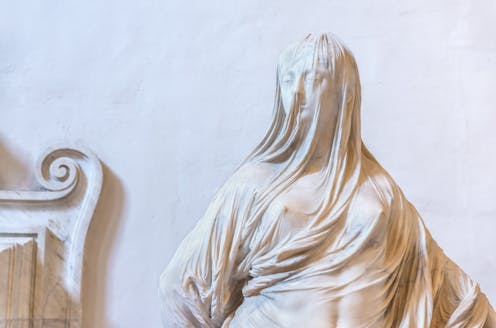
You might have heard of a group of women in Ancient Rome known as the “Vestal Virgins”. These female virginal guardians of the sacred flame of Rome could be buried alive for breaking their vows of chastity. Sure, this is a terrible way to go. But! They had power, prestige, privilege, popularity! So, who were these women, and how did they get such cachet?
Known to the ancient Romans as the virgines Vestales, the Vestal Virgins were a religious collegium (priesthood) made up at any one time of six females. These women took vows of virginity for 30 years in order to serve in the cult of Vesta, ancient goddess of the hearth. Following their 30 years of service, they were allowed to leave the priesthood and marry, although most would remain.
Living in the vast complex of the atrium Vestae located in the prime real estate of the Roman Forum, these priestesses guarded and systematically tended the sacred fire of Vesta in the adjoining temple.
The Romans believed the Vestals guaranteed the wellbeing of the state through their preservation of the eternal flame, understood in early Rome as an embodiment of the goddess Vesta and symbolic of the hearth of the Roman home.
Early beginnings
Tradition proclaims the cult and college of Vesta were established in the eighth century BCE by Numa Pompilius (the second king of Rome).
Numa is said to have done this as an act of deference to his predecessor Romulus (the founder of Rome) and Romulus’ mother Rhea Silvia who was raped by the god Mars.
Archaeological evidence attests the first permanent structures connected to the worship of Vesta existed as early as the sixth century BCE.
This collegium existed until it was abolished in 394 CE by Roman emperor Theodosius I.

What did they do and how were they selected?
Vigilant piety defined the tenure of the Vestal Virgins.
They participated in important rituals such as making mola salsa, a salt cake used in ritual sacrifices at ceremonies observed by the Vestals.
They attended agricultural festivals throughout the year, the continuity of these traditions marking the unfaltering fortune of Rome that paralleled the sacred flame kept alight in perpetuity.
It was not just in their dedication to Vesta and the Roman people that the Vestals performed their dutifulness. Their ultimate devotion was personified in their sexual status as virgins.
To ensure the castitas (chastity) of a new Vestal, candidates were chosen between the ages of six to ten.
A girl had to meet a series of stringent requirements codified in Roman law.
She had to be free of any “bodily defect”, both physical or mental, the possibility of which could render her tainted and impure.
Prospective candidates were selected by the senate and the Pontifex Maximus (the chief priest of Rome) from among the upper echelons of Roman society, the privilege of this guaranteeing that both the girl and her parents were honourable.
Once selected, the virginal girl went through the performance of the captio, a ceremonial initiation in which she was ritually “taken” by the Pontifex from her home and forevermore removed from all legal ties to her family and male guardianship.
As girls, the lack of privilege they were born into was now transcended by the privileges afforded to them as Vestals.
A Vestal secured a life of longevity and luxury, attaining rights normally only available to elite males.
They had a guaranteed income from a regular pension, the rite to accumulate their own personal estates, and could give testimony in legal cases. They could pardon condemned prisoners, and safeguarded the wills of influential political figures such as Marc Antony and Julius Caesar.
A Vestal was inviolate and not to be touched by the impure masses. To further protect them, a Vestal had a lictor (bodyguard) to guard them in public, and would ride in a carpentum (carriage), which carried them through the streets.
 A Vestal Virgin secured a life of longevity and luxury, but this came with downsides.
Bill Perry/Shutterstock
Precarious power
As a woman, a Vestal held a unique position of power, yet this was precarious.
The inviolability of Vestals was predicated on their virginity. It was this sexual status that entirely defined their social powers. The control of their sexuality was synonymous with the welfare and politics of the state.
If Rome was in turmoil, the chastity of the Vestals was the first to cop the blame.
A major scandal in 91 CE saw chief Vestal Cornelia tried in absentia and convicted of incestum (sexual impurity) by the deceitful Emperor Domitian.
While her alleged lovers were beaten to death, Cornelia was carried alive through the streets in a sombre procession to a small underground chamber. It held a few provisions such as bread, milk and a small bed, and with that she was left to die.
Roman law prohibited burial of the dead within the walls of the city. In order to circumvent this law, the Romans believed a Vestal was not technically entombed but rather died a “voluntary”, bloodless death.
The Vestals were icons of chastity, women revered and celebrated. But just as quickly as they were venerated, they could be brought back to Earth. Or in this case, buried in it.


