

The greater stick-nest rat almost went extinct. Now it’s found an unlikely ally: one of Australia’s worst weeds
- Written by The Conversation
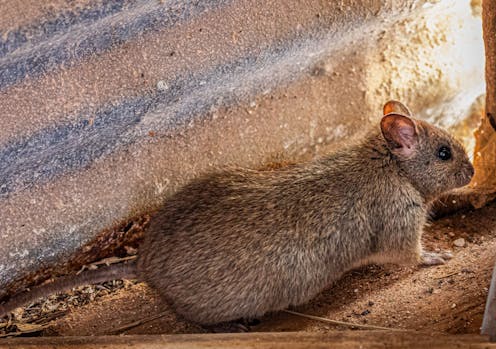
Greater stick-nest rats (or “stickies” as they are affectionately named) are one of Australia’s most adorable small native mammals.
These guinea-pig sized rodents build large communal nests which can be a metre high and 1.5 metres wide, using their sticky urine to glue sticks and leaves together. Remnants of their nests from thousands of years ago have been found in caves, with plant fragments protected by the urine. They live in arid, almost waterless parts of Australia, and live on fruit and succulents.
The greater stick-nest rat once roamed across the Nullarbor, from northern Victoria through to Exmouth in Western Australia. But their nests weren’t enough to protect them from feral cats and foxes. By the 1930s, they had been driven to extinction on the Australian mainland. A tiny population of 1,000 survived only on the Franklin Islands, offshore from Ceduna in South Australia. A related species, the lesser stick-nest rat, has likely gone forever.
Our new research on surviving stick-nest rats has found something unusual – these rodents are chowing down on one of Australia’s worst invasive plants, African boxthorn.
For the stick-nest rats, though, this plant spells opportunity.

Of island refuges and thorny bushes
To look at, the Franklin Islands don’t seem like prime wildlife territory. But these low-lying, shrub covered islands in the Nuyts Archipelago suit the greater stick-nest rat just fine. Conservationists used these survivors to seed new populations on two other South Australian islands, Reevesby and Saint Peter Islands, as well as a feral-proof fenced reserve in Western Australia.
Their total numbers have now grown to about 3,000, enough for its status on the international Red List of threatened species to be moved from endangered to vulnerable.
 The greater stick-nest rat is a social nest building rodent, able to survive arid conditions – but not feral predators.
Wayne Lawler/Australian Wildlife Conservancy, Author provided (no reuse)
The greater stick-nest rat is a social nest building rodent, able to survive arid conditions – but not feral predators.
Wayne Lawler/Australian Wildlife Conservancy, Author provided (no reuse)
But is this sustainable? Can offshore islands and onshore fenced reserves free of foxes and cats keep stick-nest rats safe indefinitely?
To find out, we investigated what food the animals prefer in one of their newer homes, Reevesby Island in South Australia’s Spencer Gulf.
To our surprise, we found these rats seemed most at home amongst African boxthorn, an invasive weed of national significance. Even more unexpectedly, they were turning up their noses at the native vegetation around them in favour of this noxious weed.
Why was this surprising? Of all the weeds in Australia, African boxthorn is one of the worst. Native to South Africa, this shrub defends itself against giraffes and other herbivores with spines up to 15 centimetres long.
In Australia, birds and small mammals feed on its berries and transport its seeds to new areas. Mature plants can grow up to 5 metres tall, forming impenetrable thickets armoured with large thorns. On farms, it disrupts livestock movements, blocks access to water sources and takes over land. In natural areas, it can offer a safe haven for rabbits.
But none of this fazes the greater stick-nest rat. On Reevesby, we found stick-nests deep inside the boxthorn, well-manicured entrances to other nests in thickets too dense to see into, and large amounts of poo pellets showing the native rodents were feeding in the area.
 On Reevesby Island, the evidence of greater stick-nest rats is everywhere.
Annie Kraehe, Author provided (no reuse)
On Reevesby Island, the evidence of greater stick-nest rats is everywhere.
Annie Kraehe, Author provided (no reuse)
The boxthorn bed and breakfast?
So, were the animals just living in the boxthorn, or did they use it as a food source as well? To find out, Annie Grace Kraehe spent a week surveying vegetation and collecting poo samples from around their nests. She then spent months sifting through the samples and identifying plant fragments under a microscope.
The work was worth it because it gave us a clear answer: African boxthorn makes up just over half of the stick-nest rat’s diet on the island, despite making up only a tenth of the available vegetation. They were also using the thorny branches in their nests.
 In stick-nest rat droppings, we found many digested boxthorn flowers and leaves.
Annie Kraehe, Author provided (no reuse)
In stick-nest rat droppings, we found many digested boxthorn flowers and leaves.
Annie Kraehe, Author provided (no reuse)
What does this mean for conservation?
The difference between hero and villain is often a matter of perspective. The same can be said for boxthorn.
Stick-nest rats appear to love boxthorn for the same reasons we hate it. Its famous thorns and dense growth offer excellent cover for a small furry mammal. Prey animals such as rodents don’t like to venture far for a meal if they can avoid it, so they make like Hansel and Gretel and eat the house.
It’s not unknown for invasive weeds to benefit some native species, especially when the ecosystem is already disturbed.
Research on little penguin colonies in Tasmania has found the birds seem to benefit from the dense growth and fearsome thorns of African boxthorn, which provides better protection against predators compared to native vegetation.
Similarly, invasive blackberry and lantana are often hated due to the way they form impenetrable thickets which push out native plants. But lantana and blackberry have been found to provide critical habitat and food sources for bandicoots, blue wrens, antechinuses and bush rats.
In fact, these food-providing protective thickets have made it possible for these species to thrive in severely disturbed ecosystems, such as the suburbs of Adelaide and Melbourne.
Costs and benefits
Does this mean we should avoid eradicating boxthorn if small endangered mammals survive nearby? We can’t say either way for now.
We need to do more research to see if the greater stick-nest rat truly benefits from African boxthorn, and weigh any benefit against the damage boxthorn does to ecosystems. If, for instance, the boxthorn keeps growing on Reevesby Island, it could push out native plants and trigger an ecosystem collapse. In that scenario, boxthorn might go from benefit to threat.
What our research does show is how adaptable these social rodents are. That gives us hope for their re-establishment elsewhere – as long as feral predators are controlled or absent.
Read more: Trees can be weeds too – here's why that's a problem


