

As News Corp goes 'rogue' on election coverage, what price will Australian democracy pay?
- Written by The Conversation
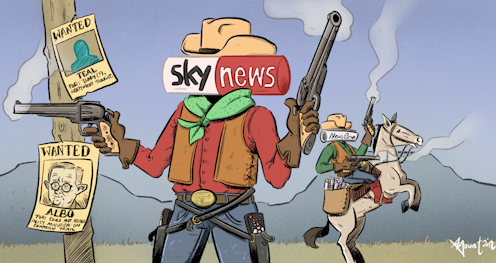
What does a democracy do when a dominant news media organisation goes rogue during an election campaign?
In 2022, News Corporation is confronting Australia with this question once again, as it did in 2019, 2016 and 2013, and as it did in the United States in 2016 and 2020.
“Going rogue” here means abandoning any attempt at fulfilling one of the media’s primary obligations to a democratic society — the provision of truthful news coverage — and instead becoming a truth-distorting propagandist for one side.
The evidence that News Corp has gone rogue during the current federal election is plentiful. It can be seen every morning in its newspapers across the country, and every evening on Sky News after dark.
A sample of its election coverage over the period April 27 to May 2 makes the case.
On May 2, the Daily Telegraph in Sydney devoted its front page to a publicity puff for Katherine Deves, the Liberal candidate for Tony Abbott’s old seat of Warringah.
Deves is campaigning to have transgender women banned from sport, but has had to apologise twice as statements by her have emerged claiming “half of all males with trans identities are sex offenders”, and likening her view on the issue to standing up to Nazis.
The Telegraph splashed the headline “They are all with me”, alongside a photo of a smiling Deves, pushing the argument that “the silent majority” supported her position. Rowan Dean on Sky went so far as to say this could win the election for the government.
On May 1, the Herald Sun in Melbourne turned its front page into a campaign poster for Josh Frydenberg. According to the headline, Frydenberg was in the “fight of his life” to retain Robert Menzies’ old seat of Kooyong against a “teal” independent, Monique Ryan.
Inside, the paper produced a double-page spread promoting Frydenberg with the banner headline, “Why you need to vote for me”, reportedly lifted straight from a Liberal campaign advertisement.
Pictures of his wife and children featured prominently in this piece of rank propaganda.
Meanwhile, on Sky after dark, the big guns Andrew Bolt, Peta Credlin and Paul Murray kept up a relentless barrage of pro-Liberal, anti-Labor and anti-teal propaganda.
Bolt picked up on a Scott Morrison jibe about Labor’s policy on the Solomon Islands, saying it involved sending the ABC to head off China in the south Pacific.
Over the week it was part of an eclectic contribution from Bolt, touching on Hong Kong, border protection, male birth control and a new twist on the concept of climate denialism. On Bolt’s planet, increasing power prices are the result of “being in denial” by thinking coal-fired power stations can be replaced by wind and solar energy.
Credlin also spent a lot of time on climate but had a quite different take. Having re-run a Liberal attack ad saying Labor is proposing a carbon tax, she went on to say the Coalition is divided more fundamentally than Labor on climate.
To her obvious chagrin, the Liberal Party had allowed itself to be distracted by this and by identity wars, a clear reference to the Deves problem, and she conceded the government was “a little bit shop-soiled”.
But Credlin’s main targets were the teal independents – women candidates standing on a platform of climate action, integrity and gender equality against Liberal incumbents in seats such as Goldstein and Kooyong in Melbourne, and Wentworth and North Sydney in Sydney.
Their sheer impertinence made her cross.
It meant, she said, the “hard heads” at Liberal campaign headquarters were having to spend time and money defending Liberal seats that “by right” they should not have to defend. In other words, the Liberal Party was entitled to occupy these seats without serious challenge.
Then there was Murray, presenting himself as “the last line of defence for common sense”.
In this role he was running a countdown: by the evening of May 2, there were only 19 days left to “save the country from the mad left”.
When a Labor figure, Nicholas Reece, tried to argue the cost of Labor’s election promises was dwarfed by the debt run up by the present government, Murray shouted him down, saying, “I’m not interested.”
Murray also asserted, without a shred of evidence, that Labor and the Greens had struck a power-sharing deal, so in the event of a hung parliament Labor would govern with the Greens’ support. This added up to the fact that “Labor and the Greens are the same thing”.
The lesser lights on Sky, such as Chris Smith, Chris Kenny and others, made their own toxic contributions, using words such as “fraud”, “sewer” and “spewing” in crude attacks on the teal independents.
And so it went for the whole week: propaganda, distortions, crudity and pro-Liberal apologia.
This abandonment of a fundamental news media obligation to truth-telling is by definition harmful to a democratic society. Not only does it rob the population of a bedrock of reliable news, it debases the entire discourse. It is also a fraud on the people by misrepresenting propaganda as news.
The dilemma facing a democracy is that measures needed to counter these harms would violate free-speech principles to a degree that would harm democracy in a different way.
Any abridgement of free speech must be proportional to the harm that is sought to be avoided. How that balance might be struck in a case like this is highly contestable on political as well as ethical grounds.
Yet existing measures are clearly ineffectual. The broadcast industry’s codes of practice for television and radio require news programs to be accurate and fair – but give no guidance on what this consists of. Current affairs programs are exempt even from this requirement.
The broadcast regulator, the Australian Communication and Media Authority, is a “co-regulator” that has shown itself to be utterly captured by the industry it is meant to hold to account.
Read more: 10 years after Finkelstein, media accountability has gone backwards
Newspapers are accountable to the Australian Press Council, but it has proved just as ineffectual as the ACMA. In any case, it is fatally compromised by being reliant on funding from the newspaper companies, among which the largest contributor is News Corporation.
All efforts to establish an effective independent media accountability body have foundered on the rock of implacable opposition from the commercial media organisations.
Yet, even if one were to be established, the dilemma would remain: what standards would strike the right balance, and how would they be enforced during an election campaign in ways that did not unreasonably burden free speech?
In the end, democracies are thrown back on conventions, which provide the boundaries within which politics operates in ways conducive to the public good.
The conventions depend on people in power, including those running media organisations, living up to the responsibilities that their role in a democracy imposes on them.
By convention, those responsibilities include prioritising the public interest over the private interests of media organisations and their owners, and providing news content calculated to inform, not repel, the voting public.
News Corporation fails on both counts.
It prioritises the understood financial and ideological interests of one man, Rupert Murdoch, over the public interest, and its toxic news content is calculated to reinforce the worldview of its target audiences.
If News Corp were merely an online echo chamber, this would be bad enough, but it is not.
The ready availability of its newspapers to the population as a whole, and the spread of its Sky after dark content beyond the confines of pay television into regional free-to-air services, make it a far more damaging influence than any online filter bubble.
WIN and Southern Cross Austereo, the companies that carry the Sky content on free-to-air TV into regional Australia, are complicit in inflicting this damage on the Australian polity. They too have abandoned their conventional responsibilities.
In an age where communications businesses are enjoined to “move fast and break things”, breaking these conventions risks breaking democracy itself. Events in the United States since 2016 provide a stark example of what this looks like when it happens.


