

When is a good time for a child to start music lessons?
- Written by The Conversation
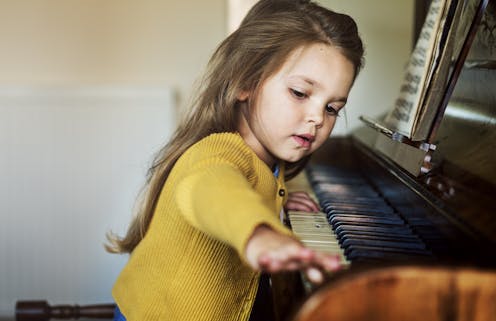
There are many reasons a child should learn a musical instrument. Not only does it give them the opportunity to make music, a significant body of research points to benefits for cognitive and academic achievement.
This is why a current New South Wales parliamentary inquiry has emphasised the importance of all children having the opportunity to learn music in primary school.
When it comes to starting lessons, research says “the sooner the better”. But pinpointing a precise age to start and particular learning approach depends on a range of factors.
How old is too old?
It is never too late to learn music. Recent research highlights the positive impacts of music lessons for people in residential aged care.
For children though, starting music lessons before nine offers a specific benefit parents should keep in mind. At around nine years of age musical aptitude or “talent” becomes a fixed trait. Before this age it is malleable and engaging in structured musical activity expands the possibilities of what a child can ultimately achieve through music.
Should my child call the shots?
There is debate among parents and teachers about whether parents should wait for their child to express interest in music lessons before starting.
Some children request lessons, particularly where they observe siblings and friends participating in music. Though asking is a good indication a child is ready, it is not necessary. Time is again a factor here.
A 1996 UK survey revealed enthusiasm for learning an instrument peaked at ages five to six. For children not already learning an instrument, the level of enthusiasm halved by age seven.
Which instrument?
Instruments including the piano, keyboard, violin, flute and recorder are ideal for an early start. The Suzuki Method (which believes musical ability can be developed) allows children to begin learning some of these at three. It’s common for teachers of any method to teach children these instruments from five and up.
String instruments are tailored to a child’s development with different sizes available. A child under five may begin learning with an instrument 1/32 the size of an adult instrument.
The ukulele has also become an increasingly popular “primer” instrument for children as young as four.
Brass and reed instruments (such as the trumpet or clarinet) require greater strength and losing baby teeth can make forming the right mouth shape or embouchure difficult. While children can start learning these instruments from the age of seven, it is not unusual for children to start brass and reed instruments in high school.
It’s common for a child to start on one instrument and change to another. This happens as a natural progression where a child begins on an inexpensive instrument such as recorder or ukulele and progresses onto the saxophone or guitar. Or a child might enjoy music, but dislike or become frustrated by their current instrument.
Which teacher?
In Australia, anyone can call themselves a music teacher, provided they have a working with children check and an ABN.
So parents need to exercise due diligence when selecting a teacher. Good teaching – particularly for younger children – requires more than simply the ability to play. Teachers should have a qualification, experience and ideally some kind of professional affiliation.
There are multiple evidence-based methods for teaching music. This includes Kodaly (which is based on singing and children’s stages of development) and Orff Schulwerk (which includes an emphasis on musical invention and improvisation).
Whatever their method, a good teacher will be able to articulate an age-appropriate learning method and explain how their approach changes as a child matures.
A good teacher will also be able to outline realistic strategies to help a child develop a sustainable practice routine. The amount of practice required depends on the instrument and the age of the child, but there should be clear expectations around practice.
There should also be clear expectations around the degree of parental involvement and intended learning milestones.
What if lessons aren’t an option?
Music lessons can be expensive and they can take up time in busy schedules. And we know many schools are under-resourced and cannot offer music education in classrooms.
Research suggests online lessons, streaming video tutorials and music learning apps, may be useful ways to expose children to music if they can’t learn in person.
Read more https://theconversation.com/when-is-a-good-time-for-a-child-to-start-music-lessons-237225


