

New measurements reveal the enormous halos that shroud all galaxies in the universe
- Written by The Conversation
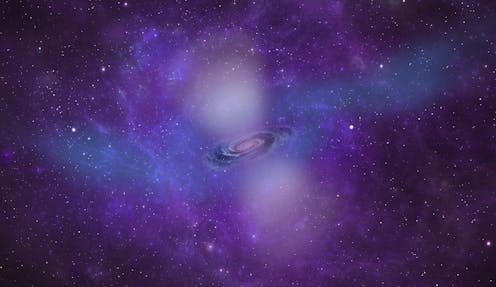
Have you ever wanted to make a $150,000 gamble? If you’re right, you open a new window to the universe. But if you’re wrong, you’ve just wasted a lot of money and time.
That is exactly what my team did when we pointed the Keck telescope at Mauna Kea Observatory in Hawai'i at what looked like empty space, hoping to reveal the hidden gas that shrouds all galaxies in the universe. There were cheers in the control room when we realised our gamble had paid off.
In a study published today in Nature Astronomy, we reveal the first detailed picture of the gas shroud around a galaxy, extending 100,000 light years out into “empty” space. If our own Milky Way has a similar halo, it is likely already interacting with the halo of our nearest galactic neighbour, Andromeda.
Most of the universe is not the bright stars
Most of the matter in the universe is not in the bright stars that make up the spectacular images of galaxies we see. For one thing, galaxies are surrounded by dark matter – which astronomers believe is some kind of exotic invisible particle.
But even most of the normal matter is not in stars. Instead, it is in gigantic clouds of gas that surround galaxies.
We believe these halos around galaxies contain as much as 70–90% of the universe’s normal matter (mostly consisting of hydrogen, helium, carbon, nitrogen and oxygen gas).
Understanding this diffuse gas – which is where all the stars and planets we see had their beginnings – helps us understand more about our own story, on the grandest scales.
However, this halo of gas is spread out over huge areas of space, which makes it extremely faint. In fact, it is 10,000 to 100,000 times fainter than the bright parts of galaxies.
We have known about these gas halos since the 1950s, when astronomers discovered they were absorbing certain frequencies of light that passed through them.
However, these measurements reduce gigantic regions of space stretching hundreds of thousands of light years into a single point – so we knew very little about the exact size or shape of the halos, or the way gas flows between them and their host galaxies.
How to see a galactic halo
For a long time, it was believed to be impossible to capture an image of the halos. However, that changed with the development of a new kind of spectrograph – a device for viewing the spectrum of different wavelengths of light in an image – called an “image slicer”.
The image slicer lets us take spectroscopic images of regions of the night sky to much fainter levels than previous generation instruments.
A team led by Chris Martin at Caltech (one of our collaborators on this project) built an ultra-faint spectrograph called the Keck Cosmic Web Imager and put it on the Keck telescope. The Keck is one of the largest optical telescopes in the world, and its location atop the Mauna Kea volcano in Hawai'i is one of the best astronomical sites in the world.
With the new device in place, we are able to see extremely faint things in the sky.
We used this instrument to stare for an entire night at the apparently empty space around a galaxy. This was followed by intense work analysing the data, as we were working at the limits of what the telescope could do.
Credit here goes to Nikki Nielsen, now a professor at Oklahoma University, who led the data analysis and the writing of the paper when she was working in our team at Swinburne University. To our excitement the gamble paid off, and returned data that allowed us to generate an image of the halo of gas around one galaxy.
What does the shroud of gas around galaxies look like?
Our team took images of the glow of hydrogen and oxygen gas over a region ten times larger than what would normally be called a “galaxy”.
This was exciting! Firstly, because it confirmed the idea that most of the universe’s ordinary matter is in these diffuse halos of gas.
We also found that the galaxy does not smoothly “fade out” into the surrounding halo. There is an abrupt break from one to the other.
In the past, a lot of debate surrounded the nature of this transition. In our data, it is easy to see an abrupt change near the edge of where the vast majority of stars are located.

Why can we see the halo at all?
There is still a mystery as to why we can see the gas at all. It is glowing, but we don’t know why.
We often see the glow of hydrogen gas inside a galaxy, but there we know it is glowing because it has been heated up by strong radiation from nearby stars. Outside a galaxy, however, there are not enough nearby stars to heat up the gas enough to explain the glow we see.
One possibility is that the halo is made of streams of gas moving in different directions. When the streams collide at high speed, the shock makes them glow.
Another possibility is that some very heavy stars and certain black holes (both inside galaxies) produce very large amounts of ultraviolet light. Some of this light can escape the galaxy, and might provide a kind of ambient background UV lighting for the cosmos.
Combined with fast-moving streams of gas, the ultraviolet background might be enough to produce the glow we have seen – but it will take more observations to know for sure.


