

The Queen’s Nanny: an entertaining, timely and informative play about Elizabeth II’s governess
- Written by The Conversation
Born in East Ayrshire in 1909, the Scottish educator and governess Marion Crawford, who trained as a child psychologist, is best remembered – if she is remembered at all – as an employee of the British royal family.
Melanie Tait’s entertaining, timely (just weeks ahead of the first visit by a reigning British royal to Australian shores since 2011) and historically informative play, The Queen’s Nanny, brings her story to the stage with a blend of wit and pathos.
A royal nanny
During a break in her psychology studies, Crawford accepted a temporary summer job working as the governess for Lord Elgin’s children.
This role opened doors for Crawford, leading to her introduction to the Duke and Duchess of York (later King George VI and Queen Elizabeth). Suitably impressed, the Duke and Duchess hired her to serve as the governess for their two daughters, Princess Elizabeth (later Queen Elizabeth II) and Princess Margaret.
This position placed Crawford at the heart of the royal household for over 16 years, during which time she became a trusted figure in the lives of the future Queen (referred to in the play by her family nickname, Lilibet) and her sister. She was also close to the Queen Mother and affectionately referred to as “Crawfie” by the royal household.

Crawford remained in service and did not retire until Princess Elizabeth’s wedding in November 1947, two months after Crawford’s marriage to the Scottish bank manager, George Buthlay.
Not long after Elizabeth’s marriage, Bruce and Beatrice Gould, editors of the major American magazine Ladies’ Home Journal, approached Buckingham Palace and the British Foreign and Commonwealth Office with a proposal to publish stories about royal life.
While the government was eager to cooperate, the royal family was decidedly less enthusiastic, and ultimately rejected the offer.
Undeterred, the government suggested the Goulds inquire whether the recently retired Crawford might be interested in contributing. Crawford agreed, although her motives for doing so remain somewhat unclear. Her account of life as a royal governess, which initially appeared in serialised form, generated substantial public interest.
This, in turn, led to a lucrative book contract worth US$85,000 (the equivalent of around A$3 million today).
 The Little Princesses was first published in 1950.
GoodReads
The Little Princesses was first published in 1950.
GoodReads
Published in 1950, The Little Princesses, was the first of a kind, groundbreaking in its candid – albeit extremely flattering – portrayal of the private lives of the young royals and their parents. Its unprecedented nature ignited a firestorm of controversy, and irrevocably damaged Crawford’s standing with her former employers.
The Queen Mother was, by all accounts, totally horrified by the book’s disclosures. She immediately severed all ties and forms communication with Crawford, who never again spoke to the royal family.
Crawford died, bereft and depressed, in Aberdeen in 1988.
Just ‘harmless stories’?
In her foreword to the 2012 reprint of The Little Princesses, former BBC royal correspondent Jennie Bond underscores the fact that Crawford’s recollections, which seem impossibly tame and unremarkable when viewed from our historical vantage point, are
harmless in the extreme: among the most ‘explosive’ revelations is the fact that in the schoolroom the two Princesses behaved like entirely normal and healthy little girls.
Needless to say, this is a far cry from the sensational content of contemporary royal exposes like Prince Harry’s self-sabotaging and divisive Spare. So why all the fuss?
Tait offers a possible explanation in the latter stages of The Queen’s Nanny.
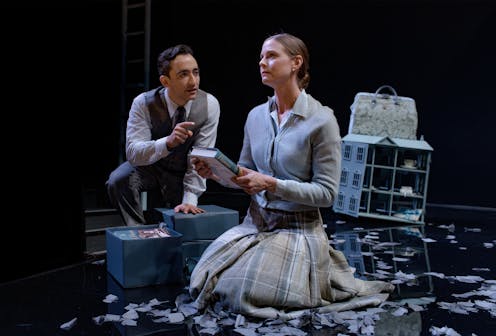
In a pivotal scene set in 1987 on the royal estate of Balmoral, Lilibet (Matthew Backer, who plays the Queen among other characters) receives distressing news about Crawford (Elizabeth Blackmore), who, we learn, has attempted to take her own life.
 Elizabeth Blackmore, Marion Crawford, is joined by Emma Palmer and Matthew Backer.
Phil Erbacher/Ensemble Theatre
Elizabeth Blackmore, Marion Crawford, is joined by Emma Palmer and Matthew Backer.
Phil Erbacher/Ensemble Theatre
Visibly upset, Lilibet shares this with her mother (Emma Palmer), whose cold, enduring anger toward over Crawford’s perceived betrayal shows no sign of softening.
Confused by her mother’s reaction, Lilibet says the memoir, full of “harmless stories about children”, was “hardly going to dismantle an entire monarchical system”. The Queen Mother’s response is telling:
I didn’t know that!
You haven’t seen what I’ve seen!
You don’t know how quickly things can change for people like us, and you don’t know what it is that will tip it all over.
Delivered with palpable intensity, this response exposes the Queen Mother’s deep-seated fear of change, instability and the fragility of the monarchy in an era of increased public and media scrutiny.
It also hints at the unspoken anxieties that, as Tait’s play suggests, may have shaped the Queen Mother’s actions, revealing how even seemingly trivial breaches of privacy are perceived as existential threats to the royal institution.
In her writer’s note, Tait says she “started working on this play around the time the Albanese Labor Government was voted in”.
She describes feeling hopeful, and confident
when the play got to the stage, we’d have lived through a successful Australian Indigenous Voice Referendum and, in an election year, movement would be ramping up about a new Republic Referendum. I wanted this play to be part of that conversation.
Sadly, neither of these things have happened. Nonetheless, Tait’s play succeeds in contributing to ongoing conversations about national identity and modes of governance, and inviting us to reflect on the interplay between personal narratives and larger historical and political tides.
The Queen’s Nanny is at Ensemble Theatre, Sydney, until October 12.


