

Can we find hidden graves of murder victims with soil imaging? New Australian study gives it a try
- Written by The Conversation
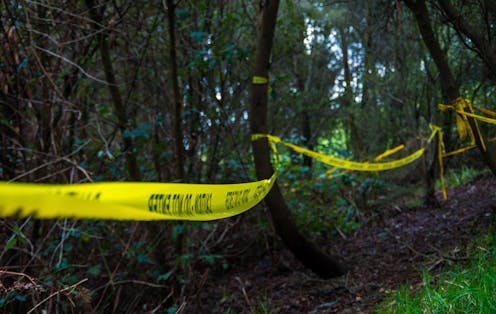
To avoid being caught, murderers often attempt to hide bodies using various methods. This can include shallow or deep burials, submersion in water, encasing in concrete or even disposing of remains in rubbish bins and suitcases.
Finding the body is a key part of any murder investigation, as it helps to identify, prosecute and charge the killer. Unfortunately, the task can be immensely difficult.
To help tackle the problem of locating hidden graves, we have trialled two innovative techniques for searching underground: ground-penetrating radar and electrical resistivity tomography, or ERT. Our results are now published in the journal Remote Sensing.
Borrowing tools from geology
The tools we used are known as geophysical methods because they measure the physical properties of materials in the soil under the surface.
The use of geophysical techniques for peering under Earth’s surface is not new – engineers, geologists and archaeologists have used the tools we tested for decades.
But geophysical techniques are not typically used for forensic investigations because directly finding a body with these methods is very difficult.
However, both of the tools we tested can help to locate a grave indirectly – by looking at the differences between the disturbed soil of the grave and the undisturbed soil around it. When the techniques encounter disturbed soil and/or the presence of body fluids, the resulting data will show as an anomaly – something different to the areas surrounding it.
To figure out whether the identified anomaly is a grave, researchers can then consider the size, shape and depth of the anomaly to make sure it correlates with a human body.

Pigs at the ‘body farm’
At the Australian Facility for Taphonomic Experimental Research (AFTER), Australia’s only “body farm” – a facility that uses donated bodies for forensic research – we buried five pigs in various configurations to mimic clandestine graves.
This included two single graves (a “shallow” grave of just half a metre, and a “deep” grave of almost two metres) and a mass grave with three pigs at one metre deep. We used pigs as they are a good body analogue in terms of size and mass to humans.
We surveyed the graves with ground-penetrating radar and ERT before and directly after burial, and then one, eight, 14, and 20 months later.
 In forensic research, pig cadavers are a suitable proxy for human bodies, as they have a similar size and mass.
Author provided
Our findings revealed that geophysical imaging of hidden graves can work, but with varying results. This depended on the size, depth and age of the burial, and the amount of rainfall before the survey.
The grave containing the three pig cadavers was the easiest to observe due to its larger size and volume. This indicates geophysical techniques may be particularly useful in humanitarian investigations that involve searching for mass graves.
A shallow single grave was the next most observable. This is also an encouraging finding because most graves of hidden victims are only around half a metre deep. For both techniques, the two-metre-deep single grave was the most difficult to image.
Although both tools could detect some graves on some occasions, neither located all of the graves during the entire length of our survey. This was likely due to a combination of factors, including the soil type at the site and unprecedented weather conditions during the research period – La Niña flooded the research site multiple times.
We did, however, confirm that pig cadaver graves are good proxies to human donor graves when investigating geophysical techniques for finding them.
To do this, we compared the ground-penetrating radar and the ERT responses of the pig burials to those of human burials (all part of existing research projects at AFTER). We found no obvious differences between the two.
This is a very important result, because it means we can further test these tools in Australia and worldwide without being constrained by highly limited access to human donors.
More work needed
Similar studies have been done in the United Kingdom, the United States and South America. However, ours is the first systematic, multi-technique, geophysical survey of covert graves in an Australian environment. The only other similar Australian study was in 2004, however, it only used ground-penetrating radar and didn’t check back on the graves at multiple time points.
Our results clearly demonstrate that geophysical methods can be effective for locating unmarked graves under some circumstances, but don’t always work. To try and work out why, we will continue our research using the latest geophysical instruments and monitoring the moisture conditions inside the graves.
Ultimately, we believe using these tools can increase the chances of locating missing and murdered victims. Then, we can finally provide answers to their families and loved ones, and increase the chances of prosecuting their killers.
The team would like to thank Justin Ellis, Gabriel C Rau, Dilan Seckiner, and Isabella Crebert for their contributions to this research. Additionally, we would like to thank AFTER for the space to conduct the research and to Soren Blau and Jon Sterenberg for allowing us to scan your graves.


