

From cheeky thrill to grande dame – the Moulin Rouge celebrates 135 years of scandal and success
- Written by The Conversation
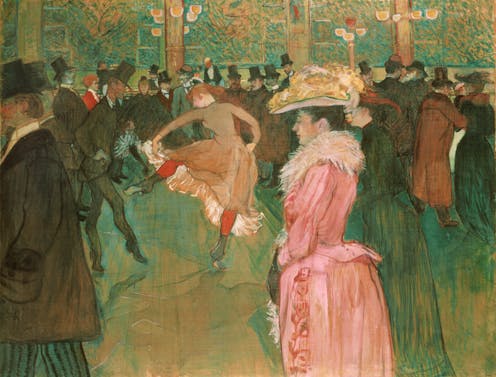
When the Moulin Rouge first opened on October 6 1889, it drew audiences from across classes and countries.
The Moulin offered an array of fin-de-siècle (end-of-the-century) entertainments to Paris locals and visitors. Located in Montmartre, its name, the “red windmill”, alluded to Montmartre’s history as a rural idyll. The neighbourhood was also associated with artistic bohemia, crime, and revolutionary spirit. This setting added a certain thrill for bourgeois audiences.
From irreverent newcomer to a French institution, the Moulin Rouge has survived scandal, an inferno and found new ways to connect with audiences.
Read more: How the Eiffel Tower became silent cinema's icon
Red and electric
In 1889, the Moulin Rouge was not the only red landmark to open in Paris. The Eiffel Tower, built as part of the Universal Exhibition and originally painted red, had opened earlier that same year. What set them apart, however, was their popularity.
The Moulin Rouge was an instant hit, capitalising on the global popularity of a dance called the cancan. Dancers like Moulin Rouge headliner La Goulue (“The Glutton”, real name Louise Weber) were seen as more appropriate emblems for the city than the Tower, which many considered an eyesore.
In an illustration from Le Courrier Français newspaper, a dancer modelled on a photograph of La Goulue holds her leg aloft, flashing her underwear with the caption “Greetings to the provinces and abroad!”.
Every aspect of the Moulin spoke to the zeitgeist, from its design to the performances, the use of electric lights that adorned its façade, and its advertising.
Its managers, the impresario team of Joseph Oller and Charles Harold Zidler, had a string of successful venues and businesses to their names. They recognised the importance of modern marketing, using print media, publicity photographs, and posters to spark public interest.
Among the most iconic images of the Moulin is Henri de Toulouse-Lautrec’s 1891 poster. At its centre is La Goulue, kicking her legs amid swirling petticoats.

She certainly can cancan
Found primarily in working-class dance halls from as early as the 1820s, the cancan became a staple of popular entertainment the world over.
Part of the dance’s thrill lay in the dancers’ freedom of movement and titillation of spectators, as well as its anti-establishment energy. Women used the cancan to thumb their nose at authority via steps like the coup de cul (“arse flash”) or coup du chapeau (removing men’s hats with a high kick).
The cancan was not the only attraction at the Moulin. There were themed spaces, sideshows, and variety performances ranging from belly dancers and conjoined twins to Le Pétomane (“The Fartomaniac”) who was a flatulist and the highest-paid performer. People watching was equally popular.
 Famous farter, Le Pétomane (Joseph Pujol).
Wikimedia Commons
Scandals, riots, and royalty
Over the years, the Moulin has been no stranger to controversy.
In its early years, it cultivated an air of misbehaviour and featured in pleasure guides for visiting sex tourists.
In 1893 it hosted the Bal des Quat’z’Arts (Four-Arts Ball) held by students from local studios. Accusations of public indecency were made against the models and dancers in attendance, and violent protests followed after the women were arrested.
In 1907 the writer Colette appeared onstage at the Moulin in an Egyptian-inspired pantomime with her then-lover, Missy, the Marquise de Belbeuf. When the act culminated in a passionate kiss, a riot broke out.
Historical footage shows the Moulin Rouge as it was.Kicking on and on
Over time, the Moulin Rouge shows changed their format to keep pace with public taste, though the cancan remained. The venue hosted revues and operettas, and various stars including Edith Piaf, Ella Fitzgerald, Frank Sinatra and Liza Minnelli.
Famous guests have included British royalty: from Edward VII (while Prince of Wales) to his great-granddaughter, Queen Elizabeth II, and her son, Prince Edward.
Since its opening, the Moulin’s fortunes have waxed and waned.
In 1915 the Moulin Rouge burned down but was rebuilt in 1921. Its famous windmill sails fell off overnight earlier this year but were swiftly repaired.
In the 1930s, it survived the Depression and rise of cinema (also capturing the attention of several filmakers). It also survived the Nazi occupation of Paris in the 1940s.
By the early 1960s, Jacki Clerico was managing the Moulin’s show after his father had revamped the venue as a dinner theatre destination. The younger Clérico oversaw additions like a giant aquarium where dancers swam with snakes, and its now-famous “nude line” – a chorus of topless dancers – in its shows.
In 1963, the Moulin Rouge struck upon a winning formula: revues, all named by Clérico with titles beginning with the letter “F” – from Frou Frou to Fantastique and Formidable. Since 1999, the revue Féerie (“Fairy”, also a French genre of stage extravaganza) has been performed almost without interruption.
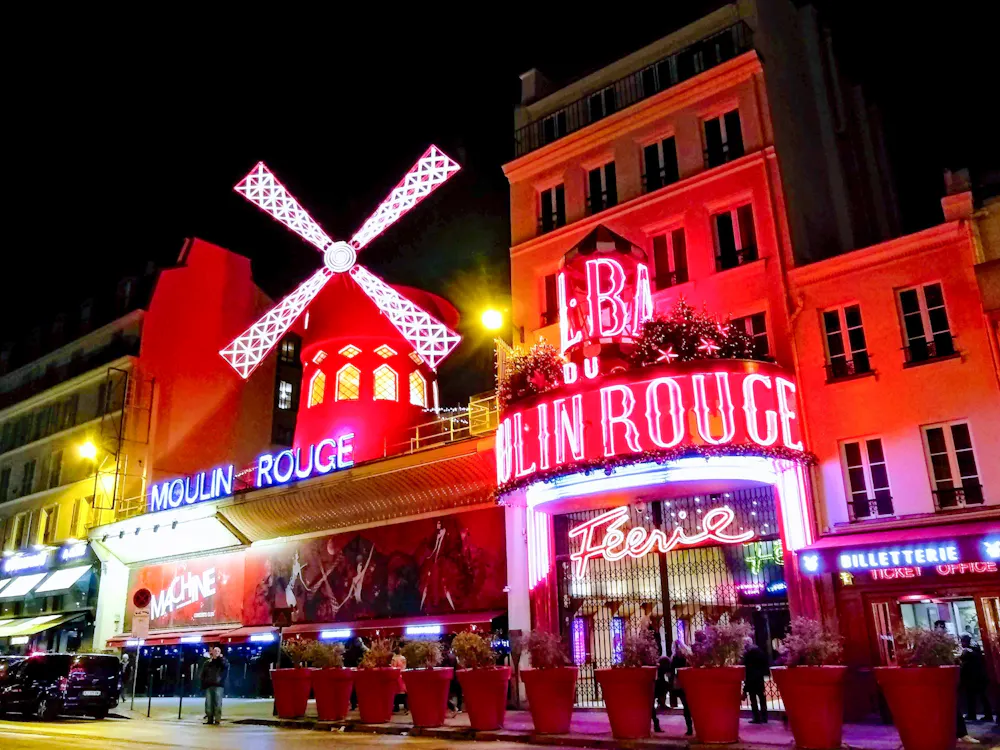 The Moulin Rouge or ‘red mill’ today, with its famous windmill.
Rafa Barcelos/Shutterstock
Ticket sales were boosted thanks to Baz Luhrmann’s 2001 film Moulin Rouge! and more recently Moulin Rouge! The Musical.
Since COVID, the Moulin Rouge management have diversified. The windmill’s interior has been rented out via AirBnB and the Moulin’s dance troupe has performed on France’s televised New Year’s Eve celebrations. This year, the Moulin Rouge and its dancers were part of the Paris Olympics celebrations, dancing in heavy rain.
Though people have come to appreciate the Eiffel Tower too, the Moulin Rouge can still argue its status as the pinnacle of live entertainment in the French capital: immediately recognisable, internationally visible, and quintessentially Parisian.


