

Could NZ foreign policy be Trumped? Why the government will be hoping Kamala Harris wins the US election
- Written by The Conversation
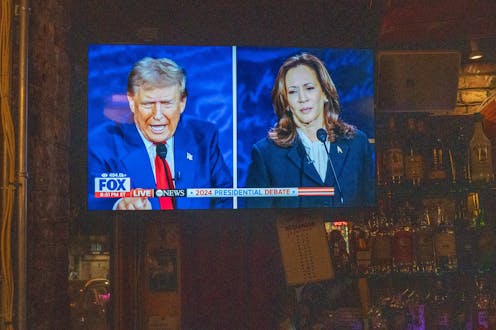
One of the political ironies of the race for the White House is that the foreign policy interests of New Zealand’s centre-right government are probably best served by Democratic candidate Kamala Harris winning.
Since the end of World War II, all New Zealand governments have supported multilateralism and an international rules-based order enshrined in the institutions of the United Nations.
The relationship with the United States has reflected that, and tends to outlast the periodic fluctuations associated with changes in government and policy in Wellington or Washington.
New Zealand’s current National-led coalition inherited close relations with the US, too. American visitor numbers were second only to Australians last year. The US is our third largest export market. And the two countries remain strategically linked within the Five Eyes intelligence sharing arrangement.
Nevertheless, one of the key foreign policy goals of the coalition is to strengthen alignment with traditional allies such as the US. Given the very different worldviews of Kamala Harris and Donald Trump, the November 5 election will have a large bearing on how successful any push for closer relations with the US can be.
Closer relations in the balance
On the one hand, Republican candidate Trump is opposed to multilateral institutions, unless they explicitly serve US national interests. And he wants to reverse the impact of globalisation by constraining immigration, free trade and global governance.
Nationalist slogans like “America First” promise a return to a so-called golden era of patriotism and sovereignty: a top-down world where the greatest power of all is unencumbered and free to assert its dominance.
On the other hand, Harris would seem to support a more traditional US foreign policy agenda. This recognises the importance of international institutions and alliances in a world where “isolation is not insulation”.
Whoever occupies the White House next, then, is likely to have a significant impact on New Zealand foreign policy.
Power plays and the Pacific
First, Trump’s belief in an international system run by great powers would seem to be a recipe for depriving smaller states like New Zealand of a voice on international issues that affect them.
Second, New Zealand’s regional focus on ties with Pacific Island nations – underpinned by close people-to-people links and a significant proportion of the country’s overseas development aid programme – is more likely to be complemented by a Harris foreign policy.
Outgoing president Joe Biden reversed decades of US neglect of much of the Pacific, which had played to the advantage of other external powers – notably China.
The Biden team launched the annual US-Pacific Islands Summit in 2022. And Kamala Harris played an active role in delivering US$800 million in development and climate assistance to Pacific Island nations in 2022-23.
Whether Trump will maintain this enhanced diplomatic and economic engagement in the Pacific (and elsewhere) is questionable. Similarly, after Biden rejoined the Paris Climate Accord, Trump will probably quit it for a second time.
AUKUS and Ukraine
Third, the New Zealand government faces the delicate task of navigating relations with an increasingly assertive China – the country’s biggest trade partner – while pursuing its goal of moving closer to the US.
Since March 2023, successive New Zealand governments have been considering joining an arrangement to share advanced defence technologies under pillar two of the AUKUS security partnership that aims to deter a rising China in the Indo-Pacific region.
It remains to be seen how China would react if New Zealand did join. But Trump’s insistence on US primacy in any multilateral agreement could make it more difficult for the government to win domestic support for pillar two membership.
Even outside the AUKUS debate, Trump is more likely to insist allies spend more on defence than they did traditionally.
Fourth, New Zealand has a big stake in the failure of Russia’s attempted annexation of Ukraine. Wellington’s interests are clearly more in line with Harris’ pledge to maintain support for Ukraine to restore its territorial integrity.
Trump’s promise to end the war within 24 hours, on the other hand, could probably only be achieved by giving Vladimir Putin what he wants.
The Middle East and the UN
Finally, there do not seem to be substantive policy differences between Trump and Harris on the catastrophic situation in Gaza, and increasingly Lebanon.
There remains a slim possibility a Harris administration might recognise unconditional support for the Israeli government of Benjamin Netanyahu is not sustainable for a superpower whose foreign policy is supposed to be driven by universal values and respect for international law.
But this would be near impossible for Trump. Indeed, he would probably provide Netanyahu with even greater support.
Overall, the foreign policy interests of the National-led coalition seem to align more with a Harris presidency than one led by Trump.
But even if Harris wins, the alignment of interests will not be perfect. US exceptionalism – an informal ideology that claims the nation is a political exemplar for the rest of the world – and Washington’s veto power in the UN security Council are likely to remain constraining factors on the New Zealand-US relationship.


