

Physics Nobel awarded to neural network pioneers who laid foundations for AI
- Written by The Conversation
The 2024 Nobel Prize in Physics has been awarded to scientists John Hopfield and Geoffrey Hinton “for foundational discoveries and inventions that enable machine learning with artificial neural networks”.
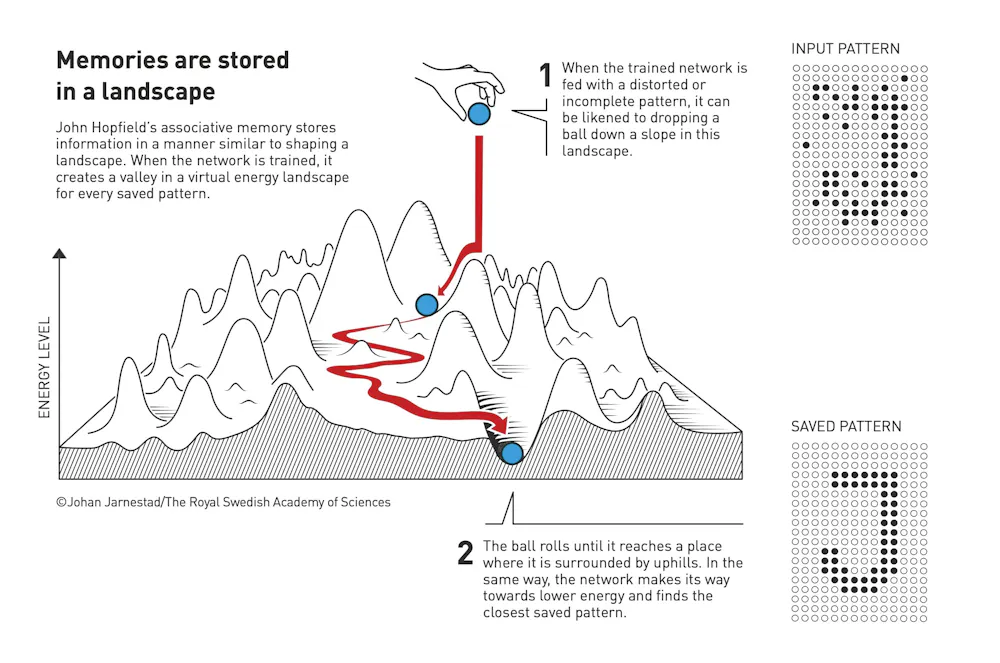
Inspired by ideas from physics and biology, Hopfield and Hinton developed computer systems that can memorise and learn from patterns in data. Despite never directly collaborating, they built on each other’s work to develop the foundations of the current boom in machine learning and artificial intelligence (AI).
What are neural networks? (And what do they have to do with physics?)
Artificial neural networks are behind much of the AI technology we use today.
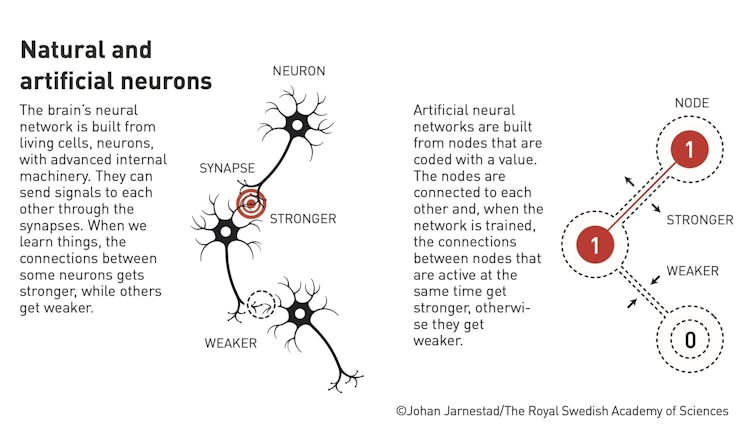
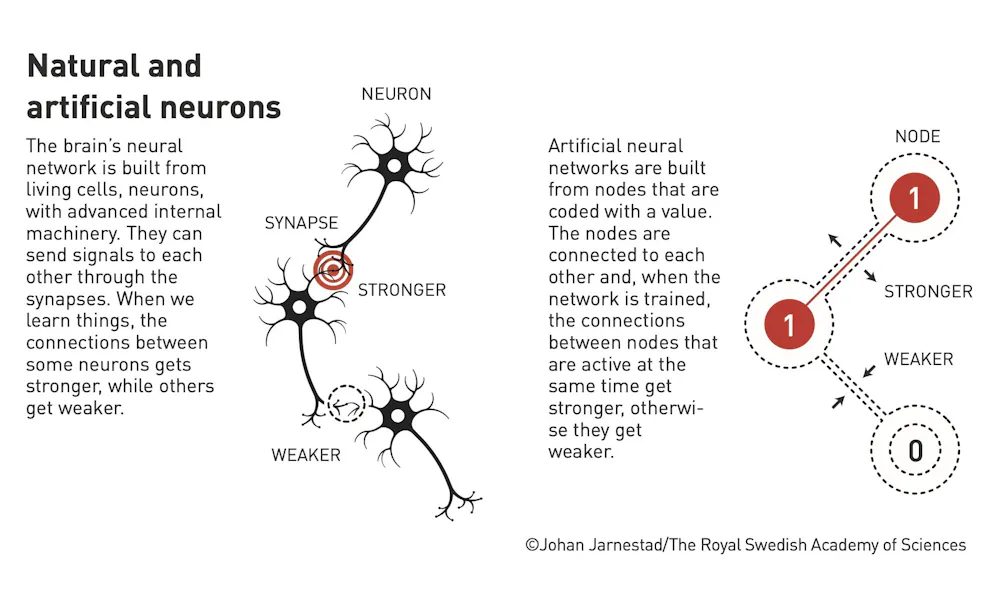
In the same way your brain has neuronal cells linked by synapses, artificial neural networks have digital neurons connected in various configurations. Each individual neuron doesn’t do much. Instead, the magic lies in the pattern and strength of the connections between them.
Neurons in an artificial neural network are “activated” by input signals. These activations cascade from one neuron to the next in ways that can transform and process the input information. As a result, the network can carry out computational tasks such as classification, prediction and making decisions.
 Johan Jarnestad / The Royal Swedish Academy of Sciences
Machines that can learn
Geoff Hinton (born 1947), sometimes called one of the “godfathers of AI”, is a British-Canadian computer scientist who has made a number of important contributions to the field. In 2018, along with Yoshua Bengio and Yann LeCun, he was awarded the Turing Award (the highest honour in computer science) for his efforts to advance machine learning generally, and specifically a branch of it called deep learning.
The Nobel Prize in Physics, however, is specifically for his work with Terrence Sejnowski and other colleagues in 1984, developing Boltzmann machines.
These are an extension of the Hopfield network that demonstrated the idea of machine learning – a system that lets a computer learn not from a programmer, but from examples of data. Drawing from ideas in the energy dynamics of statistical physics, Hinton showed how this early generative computer model could learn to store data over time by being shown examples of things to remember.
Johan Jarnestad / The Royal Swedish Academy of Sciences
Machines that can learn
Geoff Hinton (born 1947), sometimes called one of the “godfathers of AI”, is a British-Canadian computer scientist who has made a number of important contributions to the field. In 2018, along with Yoshua Bengio and Yann LeCun, he was awarded the Turing Award (the highest honour in computer science) for his efforts to advance machine learning generally, and specifically a branch of it called deep learning.
The Nobel Prize in Physics, however, is specifically for his work with Terrence Sejnowski and other colleagues in 1984, developing Boltzmann machines.
These are an extension of the Hopfield network that demonstrated the idea of machine learning – a system that lets a computer learn not from a programmer, but from examples of data. Drawing from ideas in the energy dynamics of statistical physics, Hinton showed how this early generative computer model could learn to store data over time by being shown examples of things to remember.
 Johan Jarnestad / The Royal Swedish Academy of Sciences
The Boltzmann machine, like the Hopfield network before it, did not have immediate practical applications. However, a modified form (called the restricted Boltzmann machine) was useful in some applied problems.
More important was the conceptual breakthrough that an artificial neural network could learn from data. Hinton continued to develop this idea. He later published influential papers on backpropagation (the learning process used in modern machine learning systems) and convolutional neural networks (the main type of neural network used today for AI systems that work with image and video data).
Why this prize, now?
Hopfield networks and Boltzmann machines seem whimsical compared to today’s feats of AI. Hopfield’s network contained only 30 neurons (he tried to make one with 100 nodes, but it was too much for the computing resources of the time), whereas modern systems such as ChatGPT can have millions. However, today’s Nobel prize underscores just how important these early contributions were to the field.
While recent rapid progress in AI – familiar to most of us from generative AI systems such as ChatGPT – might seem like vindication for the early proponents of neural networks, Hinton at least has expressed concern. In 2023, after quitting a decade-long stint at Google’s AI branch, he said he was scared by the rate of development and joined the growing throng of voices calling for more proactive AI regulation.
After receiving the Nobel prize, Hinton said AI will be “like the Industrial Revolution but instead of our physical capabilities, it’s going to exceed our intellectual capabilities”. He also said he still worries that the consequences of his work might be “systems that are more intelligent than us that might eventually take control”.
Johan Jarnestad / The Royal Swedish Academy of Sciences
The Boltzmann machine, like the Hopfield network before it, did not have immediate practical applications. However, a modified form (called the restricted Boltzmann machine) was useful in some applied problems.
More important was the conceptual breakthrough that an artificial neural network could learn from data. Hinton continued to develop this idea. He later published influential papers on backpropagation (the learning process used in modern machine learning systems) and convolutional neural networks (the main type of neural network used today for AI systems that work with image and video data).
Why this prize, now?
Hopfield networks and Boltzmann machines seem whimsical compared to today’s feats of AI. Hopfield’s network contained only 30 neurons (he tried to make one with 100 nodes, but it was too much for the computing resources of the time), whereas modern systems such as ChatGPT can have millions. However, today’s Nobel prize underscores just how important these early contributions were to the field.
While recent rapid progress in AI – familiar to most of us from generative AI systems such as ChatGPT – might seem like vindication for the early proponents of neural networks, Hinton at least has expressed concern. In 2023, after quitting a decade-long stint at Google’s AI branch, he said he was scared by the rate of development and joined the growing throng of voices calling for more proactive AI regulation.
After receiving the Nobel prize, Hinton said AI will be “like the Industrial Revolution but instead of our physical capabilities, it’s going to exceed our intellectual capabilities”. He also said he still worries that the consequences of his work might be “systems that are more intelligent than us that might eventually take control”.


