

How we solved the mystery of the pink sand on South Australia’s beaches – podcast
- Written by The Conversation
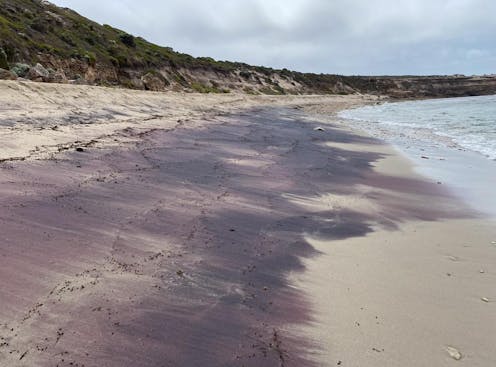
Take a walk along a beach in parts of South Australia, and you may come across unusual patches of pink sand. When a team of geologists began analysing samples of this mysterious sand to find out where it comes from, their search took them back through time to a previously undiscovered mountain range in Antarctica.
In this episode of The Conversation Weekly podcast, we speak to geologist Sharmaine Verhaert about the discovery and what it’s revealing.
It all started with a routine field trip in 2021. Two University of Adelaide scholars, Stijn Glorie and Martin Hand, took their undergraduate geology class to a nearby beach called Petrel Cove, along the coast of the Fleurieu Peninsula in South Australia.
They were intrigued by the patches of pink sand they found there. This sand was made up of a rock called garnet that forms deep inside the Earth’s crust, in a process similar to diamonds.
They decided to take samples back to their lab, where Verhaert works as a PhD student. The geologists knew the pink garnet sand couldn’t have formed on the beach, which lacked the right geological conditions, and also couldn’t have travelled far by sea as it would have been destroyed by long exposure to the ocean.
Verhaert used a process called isochron dating to analyse the approximate age of the garnet rocks – including a technique developed at the University of Adelaide that combines laser analysis with a mass-spectrometer. She explained:
The age we got was 590 million years old, which is a geological period we call the Ediacaran. This surprised us because there aren’t any known Ediacran garnets around in South Australia.
The garnets didn’t match the ages of other known deposits in South Australia, so Verhaert and her colleagues began looking elsewhere:
At the time, Australia was actually connected to Antarctica and formed one big continent, the supercontinent Gondwana. We also know there have been a series of glacial periods where the ice sheets extended so far that they would cross both Antarctica and Australia. These ice caps and ice sheets can move a lot of sediment and rocks to other places.
This glacial movement, originating from the Transantarctic mountains in East Antarctica, left deposits along the beaches in South Australia. And it turned out that some of these deposits, at Hallet Cove conservation park and Kangaroo Island, matched the age of the garnets found at Petrel Cove.
Bringing all the different clues together, knowing that the garnets come from glacial deposits, knowing the age of the garnets [and] the direction of the ice sheet flow, we could make the conclusion that the garnets might have come from the region in East Antarctica.
There was just one problem with this conclusion: prior geological analysis had shown the Transantarctic mountain range, which divides East and West Antarctica, is too young to be the source of the pink sands.
To hear how Verhaert and her colleagues traced the origin of the garnets back to another mountain range which they now believe is buried under the ice in Antarctica, listen to The Conversation Weekly podcast.
This episode of The Conversation Weekly was produced by Katie Flood, Gemma Ware and Mend Mariwany. Sound design was by Michelle Macklem, and our theme music is by Neeta Sarl.
You can find us on Instagram at theconversationdotcom or via email. You can also subscribe to The Conversation’s free daily email here.
Listen to The Conversation Weekly via any of the apps listed above, download it directly via our RSS feed or find out how else to listen here.


