

Why do kids cheat? Is it normal, or should I be worried?
- Written by The Conversation
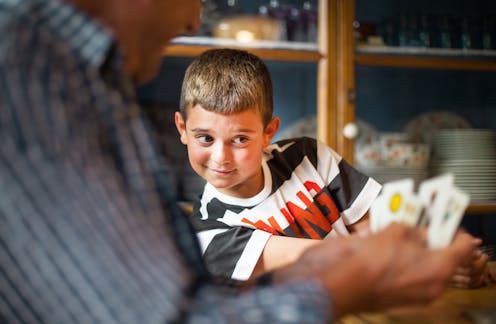
Everyone knows a kid who cheats at Monopoly or backyard cricket. Perhaps they have even cheated on a test at school.
If your notice your own child is doing this, you may worry they are headed for a life of crime.
But in developmental terms, cheating is not usually a cause for concern for kids.
What is cheating?
Cheating occurs when a child behaves dishonestly to gain an unfair advantage. They might pretend to roll a six, peek at others’ cards, score a sports game incorrectly, or use video game modifications to skip levels.
Despite parents’ and teachers’ best efforts, cheating is remarkably common. In one experiment, five-year-olds were asked not to peek inside a box while the experimenter left the room. Almost all peeked and most then denied having done so.
A sign of development
The capacity to deceive can signal the emergence of new skills, including an understanding of others peoples’ minds.
To cheat effectively, we have to think about what someone else is thinking. We then need to trick them into believing a different reality. These cognitive skills only emerge in preschool, and it is not until the primary years that children can successfully maintain a false story over time.
Cheating at school
As children get older, they can get more cautious about cheating in general, but also start cheating at school.
In a US study, more than three in four high school students reported cheating at school at least once over the past year.
Common techniques included sharing their work with others, getting test answers ahead of time, plagiarising from the internet, and collaborating when they weren’t supposed to.
Students were more likely to see cheating as acceptable when helping a peer, or when they could rationalise the behaviour in a pro-social way (for example, they ran out of time and needed to cheat because they were caring for a family member).
Temptation matters
Like adults, children are more likely to cheat when the temptation is greater. In one study, children aged seven to ten were more likely to cheat at a die-rolling game if they could win a bigger prize.
Children and adolescents also report being more likely to cheat to avoid negative consequences. As far back as 1932, US school principal M.A. Steiner wrote how too much work encourages students to cheat. In a 2008 study, students themselves reported cheating at school because they were uninterested in the material or under pressure to perform.
While temptation encourages cheating, the risk of being caught can encourage honesty. Children must weigh up the benefits of cheating against the risks of being caught.
As they get older, children may also consider how cheating impacts their sense of self. For example, “being a good person is important to me – so I won’t cheat”.
Do boys cheat more than girls?
Some children are more likely to cheat than others. For example, in a 2019 study in which children’s rolls of six dice could win them prizes, boys cheated more than girls. Boys and girls also approached cheating differently: girls were more likely to cheat to avoid losses, while boys were equally motivated by losses and gains.
Social skills also make a difference. A 2003 US study showed second grade children who have been rejected by their peers are more likely to cheat at board games – even when playing with new children they have never met before. It is possible such children are not as good at regulating their emotions and behaviours.
Adolescents with lower self-restraint and greater tolerance for breaking rules are more likely to accept academic cheating, as are those who misbehave in class.
How can adults discourage cheating?
Although cheating is common, it can pose increasing problems for children and teens as the stakes become higher. Research with Chinese students in the eighth grade showed those who cheated when scoring their own test were less likely to have learned the correct answer later on.
Here are four things parents and teachers can do to help discourage cheating.
1. Have open conversations: talk openly and compassionately about why cheating is not a good idea (for example, “it ruins the fun for your friends”). Research shows children and adolescents who made a promise to experimenters not to cheat at a game were less likely to do so. But children who fear getting in trouble are less likely to tell the truth.
2. Don’t put too much pressure on results: when talking about school, use language related to learning rather than performance (“just try your best, that’s all you can do”). Studies show highly competitive academic environments make cheating more likely, because the benefits of success and risks of failure are heightened.
3. Be positive about your child’s character: in one study, preschoolers were allocated to one of two groups. In the “good reputation” group, children were told “I know kids in your class and they told me you were a good kid”. In another group, children were not told anything. All children were then asked not to peek at a tempting toy while the experimenter left the room. Those in the good reputation group were less likely to cheat (60%) than those in other group (90%).
4. Show kids how it’s done: if adults are being honest and open, children are more likely to do the same. In one study, children were told there was a big bowl of candy in the next room. When this turned out to be a lie, children themselves were more likely to cheat in a game and to lie about it.
Read more https://theconversation.com/why-do-kids-cheat-is-it-normal-or-should-i-be-worried-242022


