

Stoneflies change colour in response to deforestation, suggesting humans can alter evolution – new research
- Written by The Conversation
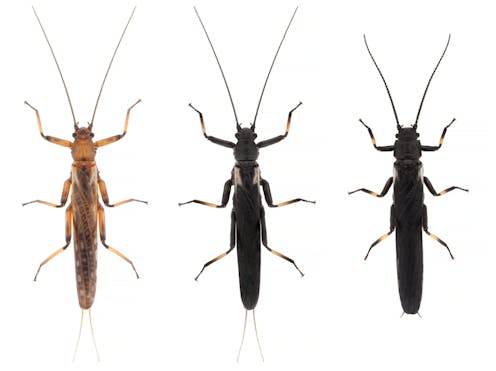
As we continue to change the planet, scientists are worried we might also be altering the evolutionary trajectories of the species that live alongside us, perhaps even including some irreversible shifts.
Certainly, the evidence for change is everywhere. As the planet warms, species’ ranges are shifting and their life cycles are changing. As we harvest the largest fish in the ocean, the species affected are now maturing at smaller sizes.
But are these shifts we observe in wild populations underpinned by genetic changes (mutations in the DNA) or are they simply flexible responses to environmental change? If the changes are genetic, how are they happening?
So far, researchers have observed fewer clear-cut examples of human-induced evolution in the wild than one might imagine. But our new study may provide a new “textbook” case of human-driven evolution in wild insects.
Our findings are centred on an intriguing case of “mimicry” from New Zealand, in which a harmless insect has evolved to mimic the warning colours of a highly toxic species.
Forest removal drives colour shift
Convincingly demonstrating “evolution in action” involves finding the agents of natural selection (environmental factors driving the change) and discovering the genetic mechanism.
Until now, the peppered moth was the “classic” example of human-driven evolution. Dark-coloured specimens of the moth suddenly appeared during the 19th century. It was a likely response to industrial pollution which meant light-coloured individuals were no longer blending in to the increasingly sooty British environment. Despite its broad appeal, some aspects of even this famous case have been criticised as unclear and anecdotal.
We worked on stoneflies and the impact of deforestation.
The black stonefly Austroperla lives in forests. It produces cyanide to deter potential predators, and to advertise its toxicity this species has high-contrast black, white and yellow markings, reminiscent of wasp colouration.
The non-toxic Zelandoperla stonefly has evolved astonishingly similar warning colouration, apparently to trick predators (forest birds) into assuming that it, too, is toxic. The intricate and unique ecological interactions between these insects and their predators have apparently evolved together over millions of years.
Where do humans come into this story? Aotearoa New Zealand was the last major landmass to be colonised by people. In many places the human impacts on its ecosystems have been devastating.
In addition to species extinctions, New Zealand has lost much of its original native forest cover in just a few centuries. This deforestation has wiped out countless populations of forest birds, along with the poisonous, forest-dependent Austroperla.
Our study reveals this widespread deforestation has also proven a game changer for the stonefly “mimic”. As its predators and the poisonous species it mimics have vanished from many regions, there is no longer much point in displaying warning colouration.
In an astonishing about-turn, Zelandoperla populations from deforested habitats have quickly lost their spectacular “mimic” colouration. It turns out that the production of this intricate colouration was costly, and when no longer essential, evolution rapidly removed it – in a case of “use it or lose it”.
Genetic change
In our study, we compared insect populations across several parts of the South Island. We found a remarkably consistent picture. The removal of forest has driven similar colour shifts across different deforested regions.
The finding that evolutionary change can be “predictable” offers hope that scientists can use evolutionary theory to predict future biodiversity shifts.

How do we know birds have played a key role in this rapid colour change? By placing stonefly models of different colours in a variety of habitats, we were able to demonstrate that birds only avoid attacking stoneflies with the “warning” colouration when they are in forests.
Another challenge was to show that this colour change represents evolution at the DNA level rather than a flexible response to environmental change. We looked at genetic variation across the Zelandoperla genome and found that just a single gene – ebony – is almost completely responsible for this colour evolution.
Our study also reveals the pace of evolutionary change. By comparing regions deforested soon after human arrival (for example Central Otago, which was deforested around 600 to 700 years ago) with those cleared much more recently (Otago Peninsula, 150 years ago), we show that evolution has proceeded steadily yet inexorably over this human timeframe.
On the positive side, the finding that at least some of our native species can adapt in the face of rapid environmental change suggests ongoing resilience of our native biodiversity. However, our results also highlight how quickly the intricate interactions that have evolved among native species over millennia can be lost from disturbed ecosystems.
These new findings raise tantalising questions about the potential to reverse the negative impacts of deforestation on our native biodiversity. In particular, our increasing focus on reforestation and ecological restoration provides hope for restoring the complex ecosystems we have inherited.


