

Hidden women of history: the Australian children’s author who captured the bush – before May Gibbs’ Australiana empire
- Written by The Conversation
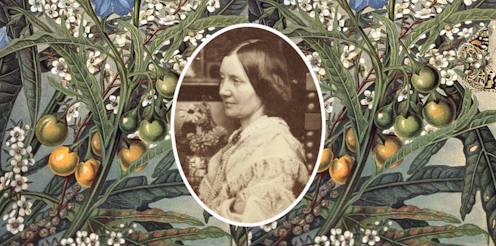
May Gibbs is a household name in Australia. Her most famous book, Tales of Snugglepot and Cuddlepie, published in 1918, has never been out of print. Chances are you have read her work, or had it read to you. You’ll almost certainly have seen her personified native flora illustrations, which these days adorn everything from tea towels to pyjamas.

 Louisa Anne Meredith’s illustrations were naturalistic, unlike May Gibbs’.
University of Melbourne
Dedicated to her craft
Louisa Anne Meredith (born Twamley in 1812) was an author and illustrator, born to a precariously middle-class family in Birmingham. Her father, Thomas Twamley, was a hard-working corn miller and dealer. Louisa’s mother (who shares her name) married him much to the dismay of her prominent family, the Merediths. They were descended from Welsh nobility.
At 22, Twamley’s first collection, Poems (1835), was positively received. English critic Leigh Hunt sang her praises in his 1837 poem, Blue-Stocking Revels, or The Feast of the Violets:
Then came young Twamley,Nice sensitive thing,Whose pen and whose pencilgive promise like spring.
By her mid-20s, Twamley had a handful of books in print under her maiden name, as well as a series of prints, sketches, paintings, colour plates and miniatures. She was entirely dedicated to her craft. Her fresh style of publishing original poems alongside accomplished naturalistic illustrations was something new.
Tasmanian life, for English readers
Twamley’s accomplishments were numerous by the time she married her maternal cousin, Charles Meredith. The couple emigrated to Australia in 1839. Meredith’s first book published from the colony, Notes and Sketches of New South Wales (1844), offered readers a “small fund of information on common every-day topics relating to these antipodean climes”. Louisa’s prose was accompanied by her original illustrations of colonial life.
By 1840, she settled in Tasmania and made the island her chief literary concern. She published a series of books depicting Tasmanian life, intended for readers there and back in England. In addition to her writing, Louisa was an active conservationist, as a member of the Society for the Prevention of Cruelty to Animals.
Louisa Anne Meredith’s illustrations were naturalistic, unlike May Gibbs’.
University of Melbourne
Dedicated to her craft
Louisa Anne Meredith (born Twamley in 1812) was an author and illustrator, born to a precariously middle-class family in Birmingham. Her father, Thomas Twamley, was a hard-working corn miller and dealer. Louisa’s mother (who shares her name) married him much to the dismay of her prominent family, the Merediths. They were descended from Welsh nobility.
At 22, Twamley’s first collection, Poems (1835), was positively received. English critic Leigh Hunt sang her praises in his 1837 poem, Blue-Stocking Revels, or The Feast of the Violets:
Then came young Twamley,Nice sensitive thing,Whose pen and whose pencilgive promise like spring.
By her mid-20s, Twamley had a handful of books in print under her maiden name, as well as a series of prints, sketches, paintings, colour plates and miniatures. She was entirely dedicated to her craft. Her fresh style of publishing original poems alongside accomplished naturalistic illustrations was something new.
Tasmanian life, for English readers
Twamley’s accomplishments were numerous by the time she married her maternal cousin, Charles Meredith. The couple emigrated to Australia in 1839. Meredith’s first book published from the colony, Notes and Sketches of New South Wales (1844), offered readers a “small fund of information on common every-day topics relating to these antipodean climes”. Louisa’s prose was accompanied by her original illustrations of colonial life.
By 1840, she settled in Tasmania and made the island her chief literary concern. She published a series of books depicting Tasmanian life, intended for readers there and back in England. In addition to her writing, Louisa was an active conservationist, as a member of the Society for the Prevention of Cruelty to Animals.
 Malunnah House in Orford, Tasmania was owned by Louisa Anne Meredith and her husband Charles from 1868 to 1879.
peterhut (Muirland Publishing)/Flickr, CC BY
While Meredith is largely remembered for her botanical illustrations and travel writing, she was prolific as a children’s writer. She published a range of books for children set in Tasmania, created from her colonial perspective. Public knowledge of her contributions to Australian children’s literary history is scarce outside Tasmania.
Meredith’s writing for children includes Loved and Lost! The True Story of a Short Life (1860), Grandmamma’s Verse Book for Young Australia (1878), Tasmanian Friends and Foes, Feathered, Furred, and Finned (1880), and Waratah Rhymes for Young Australia (1891).
Malunnah House in Orford, Tasmania was owned by Louisa Anne Meredith and her husband Charles from 1868 to 1879.
peterhut (Muirland Publishing)/Flickr, CC BY
While Meredith is largely remembered for her botanical illustrations and travel writing, she was prolific as a children’s writer. She published a range of books for children set in Tasmania, created from her colonial perspective. Public knowledge of her contributions to Australian children’s literary history is scarce outside Tasmania.
Meredith’s writing for children includes Loved and Lost! The True Story of a Short Life (1860), Grandmamma’s Verse Book for Young Australia (1878), Tasmanian Friends and Foes, Feathered, Furred, and Finned (1880), and Waratah Rhymes for Young Australia (1891).
 State Library NSW
Her work found young readers in both Australia and England. Her writing often dramatises this connection. Waratah Rhymes, for example, features a dedication in which she signs off from London in 1891 “to the young Colonists of to-day”, inviting their “warm welcome”.
Meredith’s contribution to the history of Australian children’s literature rests in her desire to write an account of “island life” for the white Australian colonial child. On the one hand, she reconfigured familiar European genres, such as the adventure novel (she was a fan of Gulliver’s Travels) and fairy tale. On the other, her aesthetic was distinctively colonial, expressed through Tasmanian fauna and flora.
In these books, the settler child is positioned as inquisitor and mini colonialist. Their discovery of the landscape through fictional encounters positions them to craft the nation in their image.
They reflect the “recurring narratives of nation-building” identified by Goorie and Koori critic and poet, Evelyn Araluen, as typical of Australian children’s literature. Araluen actively dismantles those narratives in her Stella prize-winning collection, Dropbear.
‘Cutesifying the bush’ vs naturalism
State Library NSW
Her work found young readers in both Australia and England. Her writing often dramatises this connection. Waratah Rhymes, for example, features a dedication in which she signs off from London in 1891 “to the young Colonists of to-day”, inviting their “warm welcome”.
Meredith’s contribution to the history of Australian children’s literature rests in her desire to write an account of “island life” for the white Australian colonial child. On the one hand, she reconfigured familiar European genres, such as the adventure novel (she was a fan of Gulliver’s Travels) and fairy tale. On the other, her aesthetic was distinctively colonial, expressed through Tasmanian fauna and flora.
In these books, the settler child is positioned as inquisitor and mini colonialist. Their discovery of the landscape through fictional encounters positions them to craft the nation in their image.
They reflect the “recurring narratives of nation-building” identified by Goorie and Koori critic and poet, Evelyn Araluen, as typical of Australian children’s literature. Araluen actively dismantles those narratives in her Stella prize-winning collection, Dropbear.
‘Cutesifying the bush’ vs naturalism
 Meredith’s illustrations for children are naturalist.
University of Melbourne
There is a striking resemblance between the works and interests of Meredith and Gibbs, who was also a member of the Society for the Prevention of Cruelty to Animals. Yet there are also significant differences.
Meredith was interested in science. She wanted to render scientific concepts legible for young readers by, as she explained in Our Wild Flowers (1839), giving “a little pleasant information, without any difficult terms, or unexplained names”.
While Gibbs had her own successful career as a botanical illustrator, in her writing for children she concocted a magic formula for cutesifying the bush. Her style exemplifies what Araluen calls “intricate forms of kitsch”. Where Meredith’s illustrations for children take inspiration from naturalists such as John Gould, Gibbs puts bums on gumnuts and reins on seahorses.
Meredith’s illustrations for children are naturalist.
University of Melbourne
There is a striking resemblance between the works and interests of Meredith and Gibbs, who was also a member of the Society for the Prevention of Cruelty to Animals. Yet there are also significant differences.
Meredith was interested in science. She wanted to render scientific concepts legible for young readers by, as she explained in Our Wild Flowers (1839), giving “a little pleasant information, without any difficult terms, or unexplained names”.
While Gibbs had her own successful career as a botanical illustrator, in her writing for children she concocted a magic formula for cutesifying the bush. Her style exemplifies what Araluen calls “intricate forms of kitsch”. Where Meredith’s illustrations for children take inspiration from naturalists such as John Gould, Gibbs puts bums on gumnuts and reins on seahorses.
 Illustration by Lousia Anne Meredith.
University of Melbourne
Meredith does this by importing the British-colonial apparatus of taxonomy, scientific vocabulary and botanical illustration, to order and explain a landscape perceived as being both wild and ripe for cultivation.
Many scholars, including Araluen, have argued Gibbs’ work embodies some of the worst aspects of colonisation. Her imagery and narrative, argues childhood researcher Joanne Faulkner, “reimagined the bush as a ‘home’ for colonizers, essentially ‘indigenising’ them in the image of white gumnut babies”.
These national emblems, embraced by many non-Indigenous Australians, were crafted on stolen land.
Exporting Australia’s children’s stories
In 1884, the Tasmanian government awarded Meredith a pension of £100 (the equivalent of around A$17,000 today) for “distinguished literary and artistic services” to the island.
Since Meredith, Australian children’s books and media have become lucrative exports. Typically, they sell an optimistic image of the sun-drenched “lucky country” to local and international audiences.
Meredith was cannily attuned to the importance of trading a desirable image of her colonial setting. She referenced Australia’s “sunny clime” and “fertile hill[s] and glade” in Waratah Rhymes.
Illustration by Lousia Anne Meredith.
University of Melbourne
Meredith does this by importing the British-colonial apparatus of taxonomy, scientific vocabulary and botanical illustration, to order and explain a landscape perceived as being both wild and ripe for cultivation.
Many scholars, including Araluen, have argued Gibbs’ work embodies some of the worst aspects of colonisation. Her imagery and narrative, argues childhood researcher Joanne Faulkner, “reimagined the bush as a ‘home’ for colonizers, essentially ‘indigenising’ them in the image of white gumnut babies”.
These national emblems, embraced by many non-Indigenous Australians, were crafted on stolen land.
Exporting Australia’s children’s stories
In 1884, the Tasmanian government awarded Meredith a pension of £100 (the equivalent of around A$17,000 today) for “distinguished literary and artistic services” to the island.
Since Meredith, Australian children’s books and media have become lucrative exports. Typically, they sell an optimistic image of the sun-drenched “lucky country” to local and international audiences.
Meredith was cannily attuned to the importance of trading a desirable image of her colonial setting. She referenced Australia’s “sunny clime” and “fertile hill[s] and glade” in Waratah Rhymes.
 May Gibbs was successful in marketing her work, now a merchandising empire.
Perth Mint/AAP
Both Meredith and Gibbs were successful in the business of their writing, explicitly considering their work’s marketability. Meredith had her own monogram branding. She advertised the availability of Grandmama’s Verse Book for international distribution.
Gibbs commissioned a set of Gumnut Babies postcards, anticipating what would become a merchandising empire (the royalties support the works of The Northcott Society and Cerebral Palsy Alliance). It now includes crockery, bedspreads, plushies, pyjamas, stationery and more.
Last year, the Royal Society of Tasmania established the Louisa Anne Meredith Medal to be awarded every four years to a “person who excels in the field of arts or humanities, or both, with outstanding contributions evidenced by creative outputs”.
The Australian children’s literary market is just as internationally saleable as it was in Meredith’s time. Today, the global phenomenon of Bluey continues her legacy of charming children (and adults) around the world through personified Australian animals.
May Gibbs was successful in marketing her work, now a merchandising empire.
Perth Mint/AAP
Both Meredith and Gibbs were successful in the business of their writing, explicitly considering their work’s marketability. Meredith had her own monogram branding. She advertised the availability of Grandmama’s Verse Book for international distribution.
Gibbs commissioned a set of Gumnut Babies postcards, anticipating what would become a merchandising empire (the royalties support the works of The Northcott Society and Cerebral Palsy Alliance). It now includes crockery, bedspreads, plushies, pyjamas, stationery and more.
Last year, the Royal Society of Tasmania established the Louisa Anne Meredith Medal to be awarded every four years to a “person who excels in the field of arts or humanities, or both, with outstanding contributions evidenced by creative outputs”.
The Australian children’s literary market is just as internationally saleable as it was in Meredith’s time. Today, the global phenomenon of Bluey continues her legacy of charming children (and adults) around the world through personified Australian animals.


