

Canada-U.S. history provides lessons on how Canada can deal with a hostile Donald Trump
- Written by The Conversation
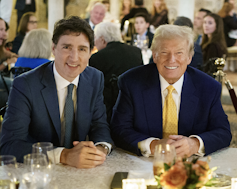
Donald Trump’s threat of 25 per cent tariffs against Canada — combined with his ongoing denigration of Canadian sovereignty, including his recent threat to take the country “by economic force” — have Canadians rightly concerned about the immediate future.
Unfortunately, the federal government’s initial reaction to Trump 2.0 has not inspired confidence.
The tone was set with what longtime Liberal strategist Peter Donolo called outgoing Prime Minister Justin Trudeau’s “panicked — and degrading — pilgrimage to Mar-a-Lago.”
The government’s $1.3 billion in border measures — including “an aerial intelligence task force with more helicopters and drones” and a “North American joint strike force” to fight organized crime — are, in a sense, even worse: answers to problems that exist only in Trump’s fevered imagination.
Bothered by the trade deficit
As Canadian officials certainly know, Trump’s unhinged portrayals of illegal migration (up in recent years but far below the levels seen at the U.S.-Mexico border) and fentanyl imports (less than 20 kilograms of fentanyl in 2023 intercepted by the United States at its northern border) are ridiculous.
Trump’s actual problem is reportedly the U.S. trade deficit with Canada (also a manufactured problem that’s actually a sign of American economic strength).
These border policies are troublesome on their own. But they also won’t buy peace because this isn’t a policy discussion; it’s an exercise in domination for domination’s sake.
What will be sacrificed?
Appeasement — figuring out Trump’s price and paying it — will not work. It risks giving away the store. What will a Liberal or Conservative government sacrifice in the name of keeping the border open to commerce? How far is too far?
A politics of appeasement will also poison the democratic wellspring. On every policy, Canadians will find themselves wondering whether their governments are acting in Canadians’ best interests or in Trump’s.
This is Canada’s unenviable policy dilemma for at least the next four years: How to deal with an increasingly hostile U.S. while acting, and being seen to act, in Canada’s best interests.
Canadian policymakers need to figure out how to draw, and how to recognize, the lines between actions in the national interest and sovereignty-extinguishing appeasement.
Fortunately, history does provide some guidance. This isn’t the first time the U.S. has posed an existential economic threat to Canada. Two crises in particular, 136 years apart, offer important lessons for navigating the next four years, and even beyond.
Read more: How Canada and the country's premiers must respond to Trump's trade and energy policies
Lesson one: Always have a plan
Our first lesson: Have many pre-existing plans.
The Sept. 11, 2001, terrorist attacks against the U.S. permanently reoriented American views on their two borders. Almost overnight, security became a paramount concern, displacing the then-prevailing ideology favouring open borders and cross-border trade.
The threat to the Canadian economy was as clear then as it is now. All of a sudden, the U.S. was demanding that its two neighbours do something about the border. The only problem: the Americans didn’t have a plan because, ironically, they hadn’t previously paid much attention to border infrastructure.
Fortunately for Canada, Canadian officials had been thinking a lot about how to modernize the border and had been pushing the U.S. to take border security seriously for a long while. As a result, when the U.S. rediscovered its northern border, Canada had a policy ready to go.
The resulting agreement, the December 2001 Smart Border Accord, addressed both Canadian economic and U.S. security interests. Key elements of the agreement were based on proposals that Canada had been promoting for years.
The federal government responded well to the 9/11 shock because it had policies ready to go when they were needed. The governing Liberals had done the planning, which itself requires a strong sense of what’s in the national interest.
The Canadian and U.S. economies remain at least as entwined as they were in 2001. That means Canadian federal and provincial governments must arm themselves with non-improvised, made-in-Canada policies that will help ensure Canadian responses to imminent U.S. demands are done in the country’s best interests.
Lesson two: Focus on the homefront
The second lesson: Look east, west and north, not south.
As I’ve argued previously, Canada-U.S. interdependence, once our greatest strength, is now a gaping vulnerability.
But, again, we’ve been here before.
In 1866, the U.S. abrogated the Canadian-American Reciprocity Treaty with British North America. Then, as now, the American economy exerted a strong gravitational pull on the northern British colonies.
But that pull isn’t a natural phenomenon; it’s regulated by laws and treaties. Trade flows can be interrupted and laced with uncertainty. It was just such an interruption that in part spurred Canadian political leaders to unite in Confederation, leading to the birth of Canada in 1867.
Trump’s tariff threat, like the events of 1866, should remind Canadians that access to the American market can be impaired or cut off; it can never be 100 per cent guaranteed. Now, as Canada did more than 150 years ago, the country must reinvest in building cross-Canada economic, political and cultural bonds.
Particularly important areas are energy — 70 per cent of Ontario’s natural gas in 2023 came from the U.S., complicating Canada’s ability to play the energy trump card in Canada-U.S. negotiations; communication (including revitalizing the CBC and regulating online platforms), manufacturing and internal trade, each of which is essential to the ability of a state to self-govern.
A path forward
For Canadian leaders, these history lessons offer a productive path forward. For citizens, they offer us a benchmark against which to judge our governments’ dealings with the U.S.
In our proposals to address U.S. concerns, look for evidence that they are the result of planning, that they promote Canadian interests and don’t just respond to U.S. demands. Look also to the extent to which governments strengthen internal, domestic ties. These indicate governments are trying to promote the national interest.
Read more: Canada, the 51st state? Eliminating interprovincial trade barriers could ward off Donald Trump
Following both lessons will require a degree of nation-building that Canadians haven’t seen since the 1960s, significant state capacity-building and thoughtful, mature debates about what Canadians want their country to be. They also imply a degree of strategic thought that is currently hard to find in Canada’s federal and provincial capitals.
But they also have the benefit of being proactive, not reactive — of taking a situation not of Canada’s own choosing and deciding what to make of it.


