

New study challenges a major theory on why some kangaroos mysteriously went extinct
- Written by The Conversation
The extinction of the megafauna – giant marsupials that lived in Australia until 60,000 to 45,000 years ago – is a topic of fierce debate. Some researchers have suggested a reliance on certain plants left some species susceptible to changes in climate.
Our research, published today in Science, indicates that for short-faced kangaroos, which comprise the bulk of the extinct megafauna, their diets were broad and comparable to many long-faced kangaroos which survived the extinction event.
Broad diets would have made short-faced kangaroos well adapted to the last ice age in Australia, bringing diet-based extinction scenarios into doubt.
What was the Australian megafauna?
Megafauna is a loose term referring to all the species present in the Pleistocene of Australia (2.6 million to 12,000 years ago) which haven’t survived until today.
Two features unite them: a generally large body size and being extinct. By 40,000 years ago, 90% of large species in Australia had died out.
This included giant flightless birds, the rhino-sized marsupial Diprotodon, marsupial lions and many others.
The cause of this extinction has been the subject of debate for some time. Some researchers argue megafaunal species were wiped out by climate change associated with the last ice age.
Others suggest the arrival of humans directly or indirectly led to their extinction. A third option also considers a combination of these two factors.

Different types of kangaroos
More than half of the extinct marsupial megafauna were kangaroos. Most, though not all of these, were sthenurines or short-faced kangaroos. Long-faced kangaroo species (macropodids) lived alongside sthenurines, and survive around Australia today.
Along with shorter faces, sthenurines had longer arms and a heavier build than their long-faced cousins. Many walked on two feet like a human or a Tyrannosaurus rex.
The short faces allowed sthenurines to crush plants with greater force, leading palaeontologists to suggest sthenurines were browsers – herbivores that specialise in consuming the leaves of shrubs and other plants.
If a change in climate then reduced the availability of these plants, this could have led to short-faced kangaroo extinction. Meanwhile the grazing (grass-eating) long-faced kangaroos were mostly able to survive.
 The varied diets of different kangaroo species.
Traci Klarenbeek/Flinders University
The varied diets of different kangaroo species.
Traci Klarenbeek/Flinders University
Browsers, mixed feeders, grazers
To investigate this idea, we used a method called dental microwear texture analysis. When an animal chews its food, the food leaves microscopic scratches on its teeth. The shape of these scratches changes based on the physical properties of the food: grasses typically make thin scratches, while leaves create deeper gauges.
By scanning the teeth under a fancy microscope called a confocal profiler, we end up with a 3D-scan of a tiny area of the tooth surface, which can then be analysed using algorithms that quantify its texture.
To see how microwear relates to diet, we compiled a massive baseline of modern macropods whose diets we know really well.
This included 17 species, from browsers (like quokkas, mostly eating the leaves of shrubs), through mixed feeders (like red-necked wallabies, eating large contributions of browse and grass) to grazers (like red kangaroos, who mostly eat grass).
 Scans produced in the study. Each scan is less than a quarter of a millimetre in length.
Sam Arman/MAGNT
Scans produced in the study. Each scan is less than a quarter of a millimetre in length.
Sam Arman/MAGNT
To understand diets in the Pleistocene, we looked at fossils from Victoria Fossil Cave in the Naracoorte Caves World Heritage Area.
We found overall there was a high degree of mixed feeding taking place at Naracoorte in the Pleistocene. Four species of short-faced kangaroos and three species of long-faced kangaroos all had very similar diets – they were mixed feeders.
This alone dispels the notion that all short-faced kangaroos were driven extinct as a direct result of a restricted diet. Mixed feeding is a common strategy among kangaroos today, especially in parts of Australia with more vegetation. It allows species to adapt their diets to changing conditions and mixed environments.
Some specialists too
Not everyone was a mixed feeder at Naracoorte. The swamp wallaby and three short-faced kangaroos all had browsing diets. Two of these sthenurines, both from the genus Simosthenurus, had very distinct “browsing signatures” – suggesting they had specialist diets.
Meanwhile, a now-extinct long-faced kangaroo known as Protemnodon had a specialised grazing diet.
These specialists also provide useful info. Since they were at separate ends of the dietary spectrum, they were unlikely to have been driven extinct by the same shift in climate.
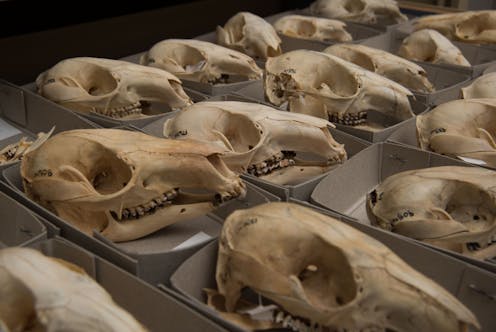
 Skulls of kangaroos featured in the study. Left to right: Protemnodon, Macropus, Procoptodon.
Traci Klarenbeek/Flinders University
Skulls of kangaroos featured in the study. Left to right: Protemnodon, Macropus, Procoptodon.
Traci Klarenbeek/Flinders University
This gels with recent evidence that shows Pleistocene climate changes were less dramatic in the southern hemisphere, compared to the northern hemisphere, where the true “ice ages” took hold with massive ice sheets forming across whole continents.
Where evolution meets practicality
So, if short- and long-faced kangaroos had overlapping diets, why are their heads so different? Essentially, this comes down to where evolution meets practicality.
Evolution has changed the shape of these two kangaroo species down different paths, adapted to eating different foods. But this adaptation doesn’t dictate that an animal only eats one type of food, especially in an environment with plentiful nutritious vegetation.
Mixed feeding among many kangaroos today shows long-faced roos are not bound to grazing. Our work suggests short-faced kangaroos were similarly not bound to browsing.
Instead, these adaptations define the “end-members” of diet: tough-to-process foods that are consumed in times or environments where other foods are unavailable.
Our work shows most kangaroos at Naracoorte, including sthenurines, had a high degree of mixed feeding. They were well adapted to Pleistocene environments.
Our work is just one piece of the megafaunal extinction puzzle, slowly taking shape as we learn more about the ecology of extinct species, and how they interacted with Pleistocene environments and the arrival of humans.


