

Beyond the Israel–Hamas ceasefire, the future looks unclear. Here are six key unanswered questions
- Written by The Conversation
The ceasefire agreement between Israel and Hamas, to come into effect on Sunday, has understandably been welcomed by the overwhelming majority of Israelis and Palestinians.
Israelis are relieved that a process for freeing 33 more hostages in Hamas custody is to begin, with more to come in future phases.
Palestinians can now hope the daily bombing that has killed nearly 50,000 Gazans over the past 15 months will finally end, and that desperately needed humanitarian assistance will start to flow into the strip.
But once the euphoria subsides, hard issues will emerge. Here are six key questions arising from this new agreement. The answers, as yet unclear, will shape the region and the lives of those who live in it.
1. Why did it take so long?
As US President Joe Biden said in announcing the agreement, the deal now reached was initially proposed by him in May last year.
Why, then, has it taken nearly eight months to be accepted by both sides?
Palestinian civilians in Gaza, who have borne the pain and suffering of the Israeli onslaught, can rightly ask whether Hamas could have made concessions to enable a ceasefire earlier.
Israelis are already asking if Prime Minister Benjamin Netanyahu deliberately held back his government’s agreement to a ceasefire to safeguard his political position and keep his government in office.

Even more darkly, did Netanyahu choose to prolong the war until President-elect Donald Trump could be in a position to claim credit for achieving the release of the remaining hostages? Trump’s Middle East envoy Steve Witkoff was reportedly involved in discussions with Netanyahu in the final phase of the negotiations in Qatar.
2. How will aid get into Gaza?
An important part of the ceasefire is the urgent provision of humanitarian aid. Some 600 trucks of provisions are reportedly ready to begin entering Gaza on a daily basis.
But how will the aid be distributed?
In November last year, the Israeli Knesset passed a law banning official Israeli dealings with the United Nations Relief and Works Agency (UNRWA), the UN body responsible for helping Palestinian refugees.
That means Israeli visas cannot be issued to UNRWA foreign staff, so they cannot operate within Israel or Israeli-controlled territory.
The ban was imposed because Israel believes some 13 UNRWA staff were involved in the October 7 2023 attack that ignited the war.
However, the UN says no other body is currently equipped to administer aid distribution inside the strip.
 With UNWRA currently banned by Israel, it’s hard to see how humanitarian aid will reach Gazans.
Ohad Zwigenberg/AP
With UNWRA currently banned by Israel, it’s hard to see how humanitarian aid will reach Gazans.
Ohad Zwigenberg/AP
3. What will happen in the next phases?
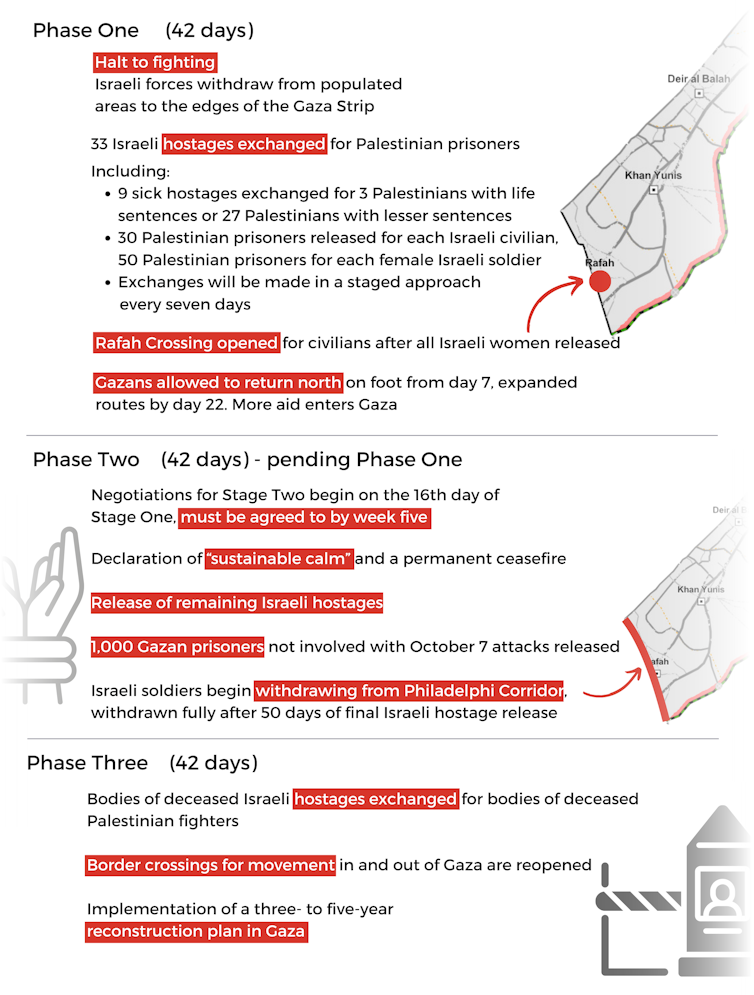
The second and third phases of the Biden plan still have to be negotiated. That involves a long-term end to the conflict, the release of remaining hostages – those still alive and the remains of those who have died – and the start of the reconstruction of Gaza.
Those two phases will be much harder to finalise than the initial ceasefire.
 Israel-Hamas ceasefire plan, partly based on the May 27 2024 agreement.
The Conversation, CC BY-SA
Israel-Hamas ceasefire plan, partly based on the May 27 2024 agreement.
The Conversation, CC BY-SA
Hamas is demanding all Israeli forces leave Gaza. Israel is refusing.
Israel is also demanding Hamas have no part in governance of Gaza. But if that point is conceded, it raises the question of who or what will take over Hamas’s governing role.
The Palestinian Authority, which oversees Palestinian affairs in the West Bank, is unpopular in Gaza.
Without a viable alternative, what are the chances of Gaza descending into administrative lawlessness, with the strip divided into rule by rival gangs? Unfortunately, quite high.
4. How is Israeli domestic politics affected?
Netanyahu has spent the conflict trying to appease right-wing elements of his party, particularly National Security Minister Itamar Ben-Gvir and Finance Minister Bezalel Smotrich.
Both strongly oppose the ceasefire agreement and have threatened to quit the government.
The deal is reported to have enough support to pass. But whether and how they might have been placated in the final internal negotiations remains to be seen.
Have they been offered broader scope on settlements, or even annexation of the West Bank, to ensure they don’t scuttle the ceasefire by withdrawing from the government and forcing new elections?
 Israeli National Security Minister Itamar Ben-Gvir has threatened to leave government over the ceasefire deal.
OHAD ZWIGENBERG/POOL/EPA
Israeli National Security Minister Itamar Ben-Gvir has threatened to leave government over the ceasefire deal.
OHAD ZWIGENBERG/POOL/EPA
5. Will Hamas survive?
Hamas is degraded, but not destroyed. It is now more like a guerilla band than an organised military force.
But despite the fact that total elimination of Hamas was one of Netanyahu’s war aims, it’s still standing.
Netanyahu can point to his other successes in the war, such as the killing of Hamas’s top leadership structure.
Israel also neutralised Hamas’s ally, Lebanese Hizballah (also spelt Hezbollah), through the extraordinary exploding pagers and walkie-talkies and killing of Hizballah leader Hassan Nasrallah.
But critics will claim Netanyahu has fallen short of his war aims. As long as Hamas is still active, many Israelis will fear it will have the capacity to rebuild and threaten Israel again.
6. What does the future hold for Netanyahu?
Netanyahu is one of Israel’s great political survivors. But he has been badly damaged by the war.
The Hamas attack of October 7 2023 happened on his watch. It traumatised Israelis deeply and they won’t easily forgive or forget.
Moreover, he is now subject to an International Criminal Court arrest warrant on charges that he breached international humanitarian law in his conduct of the war.
And the International Court of Justice has said there is a “plausible” case that Israel’s retaliation for the Hamas attacks has been genocidal. This is not good for Israel’s international image.
On top of all that, his trial over three corruption charges is proceeding. There are now serious doubts his government would survive if it were forced to elections before the end of next year, when they are formally due.
The next six weeks, as the first phase of the ceasefire takes effect, will provide answers to some of these questions – but probably not all.


