

Planetary waves, cut-off lows and blocking highs: what's behind record floods across the Southern Hemisphere?
- Written by The Conversation
From February to May 2022, many places in Queensland, New South Wales and Western Australia have seen record-breaking daily and monthly rainfall. Repeated periods of persistent and intense rain have caused devastating and widespread floods.
In Queensland and New South Wales alone, the floods and storms caused an estimated AU$3.35 billion in insured losses, making these the costliest floods in Australia’s history and the fifth most costly natural disaster. More than 20 people lost their lives.
Read more: The east coast rain seems endless. Where on Earth is all the water coming from?
Similar events have occurred around the Southern Hemisphere. Brazil was hit with heavy rain, flash flooding and landslides in February and March, killing more than 200 people. In April and May it was South Africa’s turn, as torrential downpours destroyed homes and infrastructure, resulting in some 400 deaths and US$1.5 billion in property damage.
Behind most of these intense rain events lies a particular combination of weather conditions: a “cut-off low” over the coast, pinned in place by a “blocking high” out to sea. This configuration itself is not uncommon, but this year’s repeated events and their high impact have been unusual.
What caused the extreme rainfall this year?
Outside the tropics, weather is mainly driven by what are called “Rossby waves” or “planetary waves”. These are wiggles in the jet stream, which is a band of strong winds the upper atmosphere that goes right around the globe.
When winds are displaced to the north or south by mountains or weather systems, they can push part of the jet stream out of its normal position. This undulation in the jet stream is a Rossby wave.
Rossby waves usually then move eastward, guided by the jet stream. Under the right conditions the waves can amplify and break, just like ocean waves at the shore.
When this happens, the breaking wave can form a region of high pressure air at ground level, which may stay in one place for some time. This high-pressure region can in turn cause other weather systems (such as low-pressure systems bearing rain) to stall over one location.
Stalled weather systems that stay put for a long time can lead to prolonged downpours, but also to lengthy heat waves.
Read more: The North American heatwave shows we need to know how climate change will change our weather
During the flooding on the east coast of Australia, an amplifying Rossby wave formed a high-pressure system over the Tasman Sea, as well as a low-pressure region in the upper atmosphere known as a “cut-off low”.
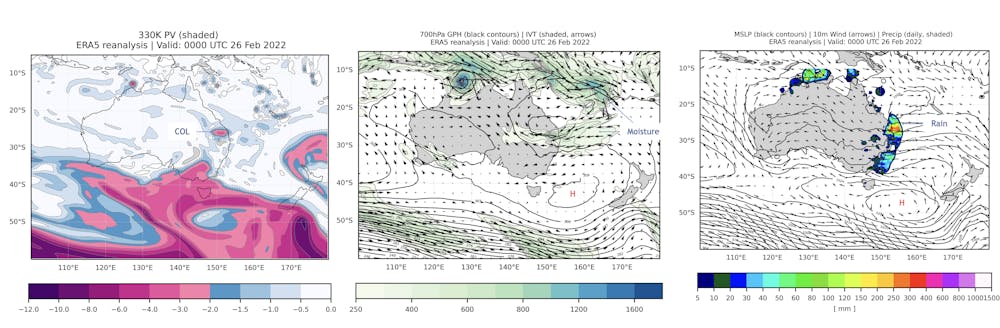
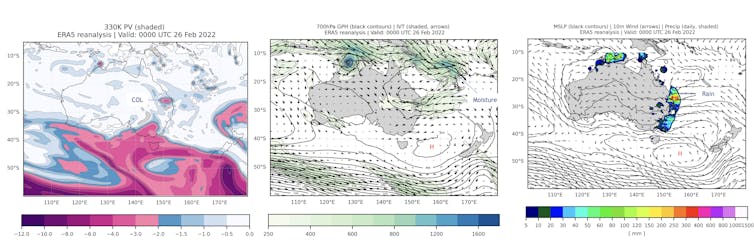
This setup provided the two ingredients required for rain: a supply of moisture, in the form of easterly winds around the high carrying moist air from the ocean to the land; and a mechanism to lift that moisture, provided by the presence of the cut-off low. As the low moved between southern Queensland and northern New South Wales, so did the rain.
The same fingerprint was also seen during the floods in South Africa and Brazil. For the flood events in south-west Western Australia, the moist onshore flow was boosted by a low between the coast and the high to the west over the Indian Ocean.
What does climate change mean for these events?
One of the most difficult challenges for atmospheric scientists is understanding how global warming will change the weather at the regional scale.
Weather forecasts are a crucial tool for mitigating the effects of extreme weather, providing predictions of such events up to a week in advance. Accurate forecasts are vital to afford critical time for response mobilisation, such as warnings, evacuations and deployment of emergency services.
At present, the El Niño–Southern Oscillation, a measure of sea surface temperatures in the Pacific Ocean, is in the La Niña phase for the second year in a row. La Niña is associated with rainier-than-normal conditions over north-eastern Australia, south-eastern Africa and northern Brazil.
Read more: Stalled weather: how stuck air pressure systems drive floods and heatwaves
In addition, global warming is likely to lead to more intense rainfall because warmer air can hold more moisture. However, we still have a lot to learn about where that rain is likely to fall, and how frequent and intense the rainfall is likely to be.
To understand how extreme weather like this year’s Southern Hemisphere deluges will change as the climate warms, we must understand the underlying physical processes responsible for their development.
At present, different climate models show different things about what climate change means for Rossby waves and wave breaking. The models don’t yet have high enough resolution to explicitly include some of the detailed physical processes related to rainfall, jet streams and Rossby waves.
While the models agree that climate change will alter the position and speed of the jet stream winds, they disagree about what will happen to Rossby waves. Investment in the research necessary to answer these questions is therefore imperative.


