

I am a climate scientist – and this is my plea to our newly elected politicians
- Written by The Conversation
The 2022 federal election will go down in history as Australia’s climate change election.
Australians resoundingly voted for ambition on climate action, something which has been missing for a decade under a Coalition government, along with integrity and gender equality.
I am a climate scientist who has spent the last two decades studying how our climate is changing and sharing our increasingly urgent and frightening findings with the world.
This is my plea to our newly elected politicians.
Nerilie Abram working at Mount Brown South in Antarctica. Ali Criscitiello, Author providedDear Mr Albanese,
Congratulations on becoming the 31st Prime Minister of Australia.
If you wanted a clear mandate that the people are ready for ambitious and immediate climate action, then Australian voters certainly delivered that last Saturday. And how could they not?
Climate change is already impacting every inhabited part of our planet. Over the past few years Australians have suffered devastating bushfires and killer heat, catastrophic off-the-charts flooding, damage along our coasts from relentlessly rising seas, and the drawn-out hardship of droughts.
I spend every day looking at the data that tells us each of those climate extremes will keep getting worse.
Every tonne of carbon dioxide that we emit adds to global warming. And every fraction of a degree of further warming will cause climate impacts to become more frequent and more intense.

So I implore you and the Labor Party to govern like every decision, and every year, matters. Because it really, really does.
You’ll have a chance to prove on the world stage that the Australian Government is serious about climate action at the international climate conference, COP27, in Egypt later this year. You’ve got some work to do, because COP26 last year was an embarrassment for our nation.
Read more: 'The Australian way': how Morrison trashed brand Australia at COP26
We took little more than a three-word slogan to the conference in Glasgow, and came away from those negotiations as a climate villain. The world is waiting for Australia to increase our 2030 commitment to reducing greenhouse gas emissions at COP27.
Labor’s plan to reduce Australia’s emissions by 43% by 2030 is a good start. Though it will still put us on track to contribute to more than 2℃ of global warming (roughly twice the warming level we’re currently at).
Fortunately, the international climate negotiations framework is designed for ratcheting up ambition over time. This means Australia can still increase our 2030 ambition further and do our fair share to limit warming to 1.5℃, which would be a much safer pathway.

To the Greens,
Well done on your record-high vote. Yours was a campaign with a climate policy aligned to the science of what’s needed from Australia to keep the 1.5℃ warming goal alive. I hope you’re able to push from inside the house and the senate to make that a reality.
The strength of the Greens vote in Queensland perhaps shouldn’t have been a surprise to me. Nowhere else in Australia would the difference between 1.5℃ and 2℃ of warming be more apparent.
Read more: Why 2℃ of global warming is much worse for Australia than 1.5℃
Earlier this year I wrote the saddest research proposal I ever have. A decade ago I could not have imagined having to pen anything like it, but here we are.
I study climate change and its impacts using corals that have grown in the ocean for centuries. These ancient corals faithfully record natural and human-caused changes in the environment around them.
But now those very coral records I use to study the climate are being destroyed by climate change. My proposal is to call for an urgent international effort to recover valuable scientific samples from coral reefs before they’re lost forever.
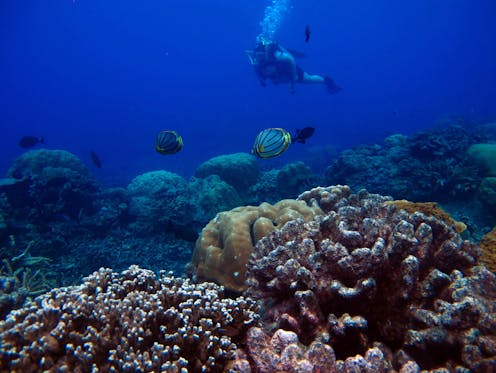
Corals are one of the many ways that scientists study climate change.Amid all of the bluster of this election campaign, the Great Barrier Reef quietly bleached for the fourth time in the last seven years. As scientists we knew to expect this – at 1.5℃ of warming 90% of reefs will have been lost, and at 2℃ the wondrous Great Barrier Reef as we know it today will no longer exist.
This most recent bleaching event hits me hard. Maybe it hit Queensland voters hard this time too?
I wish the elected Greens well as they work inside Parliament to do what’s needed to give the reef a fighting chance.
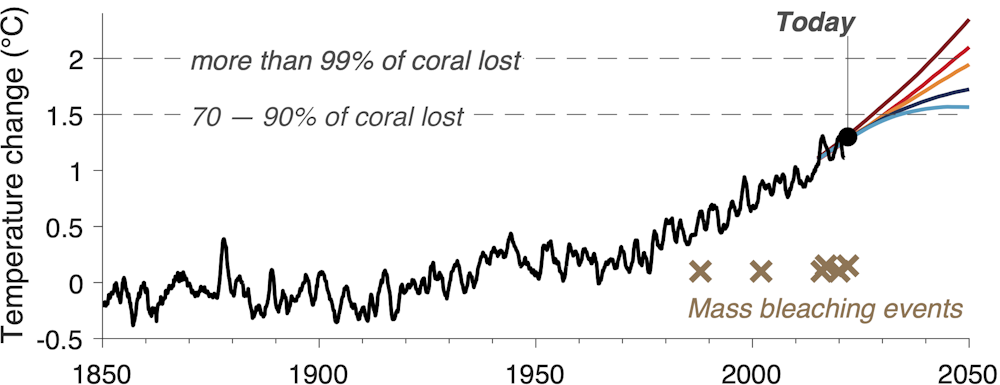 Global temperature change since 1850 (black) and various IPCC projections for future warming (colours). Crosses indicate the six mass coral bleaching events on the Great Barrier Reef, including 4 in the last 7 years. Temperature data from Berkeley Earth and CMIP6 future climate experiments.
To the Teal Independents,
Thank you for putting yourselves forward. For seeing the political status quo was not working for the people, and having the courage and conviction to provide Australians with an alternative.
It is well recognised that women need to be at the heart of climate action and solutions. Globally, female representation in politics has been shown to lead to stronger climate policies and better conservation outcomes.
It makes me proud and hopeful to see the Australian people have elected so many strong, talented, independent women to our parliament.
 Yet another mass coral bleaching event has hit the Great Barrier Reef this year.
N. Mattocks/GBRMPA via AP
To every member of our new parliament,
Its time to get to work. The federal government has squandered the last decade and made the job harder.
But fortunately, Australia’s state governments have made a start while federal government dallied. Australia’s states and territories adopted net-zero targets before the federal government, and together those commitments are estimated to represent defacto national emission reductions of around 37-42% by 2030.
Tackling the climate crisis is going to take a scale of ambition unlike anything we’ve ever seen before. But we have many solutions for decarbonising our energy and transport sectors ready to go. We will have to deploy these as quickly as possible to make the significant cuts to emissions needed this decade.
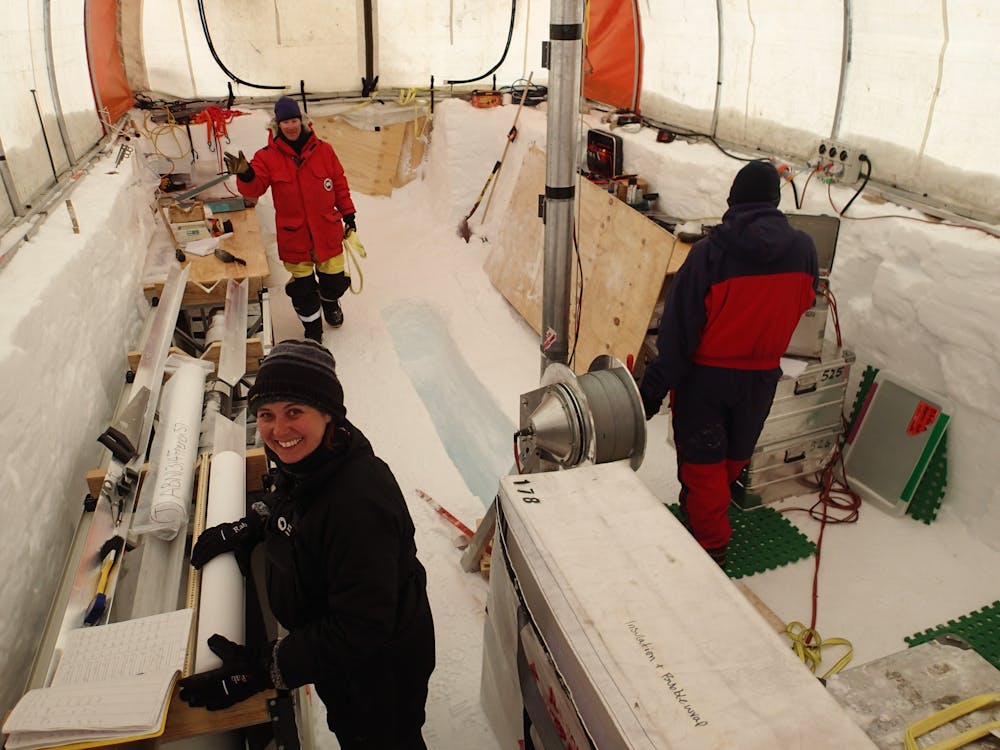 Scientists working in an ice core drilling trench in East Antarctica.
Nerilie Abram, Author provided
In future decades we will also need solutions that don’t yet exist. This includes technologies and enhanced nature-based solutions that will help us to draw carbon dioxide back out of the atmosphere. These need to be underpinned by an investment in fundamental science today, so we can forge a pathway to those as-yet-unknown solutions.
People in Australia, and our neighbours in the Pacific, also need your help. Climate extremes are going to worsen and we need investment in the climate science and modelling capabilities to be able to improve adaptation decisions at the local scale.
To paraphrase our new Prime Minister, together you can end the climate wars and seize the abundant opportunities that Australia has to be a climate leader.
Good luck.


