

‘I was shocked’: a scientist tracking koalas films startling behaviour between young males
- Written by The Conversation
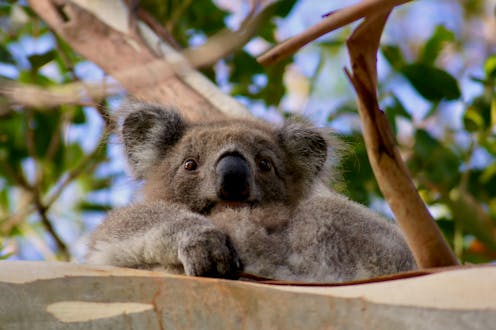
It’s a cold, drizzly night in a forest west of Melbourne. I’m sitting on a damp log, clutching a thermos of lukewarm tea and watching a koala snooze on a branch above me. Suddenly, it lifts its head. I sit up straight, pen poised to record what happens. But the koala simply yawns and resumes the blob position. I sigh and take another sip of tea.
Why am I doing this? To research the social behaviour of koalas and hopefully learn more about what they do at night, when they are most active.
After many nights, and many sips of tea, I witness something truly unexpected: male koalas engaging in affectionate behaviours with each other, such as play and grooming. I was shocked. Adult koalas are normally solitary, so observations such as this are exceedingly rare.
My new research paper presents these findings. It provides the most detailed account of these behaviours to date, and offers a unique glimpse into how social dynamics between koalas may change when they are forced to live in close quarters.
Why are these behaviours so surprising?
Most animals exhibit some type of social behaviour. These can include mating, vocalising to communicate, or defending their territory. But some highly social, group-living animals – such as wolves, primates and dolphins – will also display friendly and peaceful acts between individuals, such as grooming each other and playing.
These are known as “affiliative” behaviours, and they are key to social relationships between animals, and to maintaining complex social hierarchies.
Adult koalas, though, are generally solitary (except, obviously, when mating). They are usually widely spread over an area and rarely come face-to-face, instead interacting over long distances by vocalising and leaving their scent.
And when male koalas do physically interact, it is usually a violent affair. More than once, I’ve seen male koalas scratched and bloodied — missing chunks of fur and even a claw — after fighting with a rival male.
That’s why my observations of affection between young male koalas were so surprising.

What I saw after dark
Over three painstaking weeks, I studied a koala population in the woodlands of Cape Otway, southern Victoria. Each night, I went out between 9pm and 2am to track and observe the males. I used a red-light spotlight to avoid disturbing them. If I saw something interesting, I filmed it. You can watch the video below.
After two weeks, I observed three males engaging in unexpected “affiliative” behaviours. They were grooming each other, sniffing each other’s genitals and vocalising to each other in soft, high-pitched calls, similar to the sounds baby koalas make.
They also appeared to be playing. They would gently — but perhaps provocatively — bite one another on the arm and ear, a bit like cheeky puppies do.
These interactions weren’t brief, either. I watched the koalas for two hours before finally giving in to sleep. When I went back at lunchtime the next day, they were still at it.
What’s behind these affectionate behaviours?
This type of social interaction between wild koalas had only been observed once before, more than 30 years ago, in a high-density koala population on French Island off Victoria.
Like that earlier observation, the koalas I recorded were young adult males, roughly aged between three and five years. Hormonal activity can surge at this life stage, leading to an increase in social behaviours such as play and boldness.
But if the affectionate behaviours were solely the result of teenage hormones, you’d expect it to be observed more often in many koalas in this age group. But that’s not the case.
Instead, these behaviours are most likely a result of the large koala populations.
Typically, fewer than two koalas are found per hectare. At Cape Otway, there were 15 koalas per hectare. This number can reach up to 20 in parts of South Australia and Victoria.
This high density means the home ranges of koalas are more likely to overlap and their interactions will be more frequent. It also means competition for food, space and mates can be especially high.

So young males might use affectionate behaviours — such as grooming and playing — to reduce conflict and manage stress. It may help individuals become familiar with their neighbours, establish hierarchies and avoid aggressive encounters.
Genetics may also play a role. Like many high-density koala populations, this population had low genetic diversity, meaning there was a high degree of relatedness among individuals.
Low genetic diversity can be a big problem for species overall. But it does mean some animals might identify their relatives, and tolerate being close to them.
The causes of low genetic diversity in high-density koala populations are complex. The species was almost hunted to extinction. This meant a vastly reduced number of koalas could pass on their genes to the next generation. To make matters worse, habitat destruction can prevent koalas from dispersing over a wide area.
 This truckload of koala pelts was taken during the 1927 open season in Queensland.
State Library of Queensland, CC BY-ND
This truckload of koala pelts was taken during the 1927 open season in Queensland.
State Library of Queensland, CC BY-ND
The complex reality of koala conservation
Koalas are listed as endangered in New South Wales, Queensland and the ACT. But high-density koala populations, such as the one I observed in Cape Otway, also present major conservation challenges.
Too many koalas feeding in an area puts pressure on preferred tree species. This can result in mass tree death, and habitat loss for koalas and other species. In some cases, koalas can starve.
Unfortunately, there are no quick and easy solutions to this issue. Moving koalas from crowded areas to places where they are endangered often isn’t possible, due to differences in climate and the unique gut bacteria koalas need for their local food trees.
 Koalas in an overabundant population in Cape Otway, Victoria, in 2013. Left: Koalas converged on trees that had not been completely defoliated. Right: Individuals became nutritionally stressed from the lack of food and many starved.
Desley Whisson, Deakin University
Koalas in an overabundant population in Cape Otway, Victoria, in 2013. Left: Koalas converged on trees that had not been completely defoliated. Right: Individuals became nutritionally stressed from the lack of food and many starved.
Desley Whisson, Deakin University
Other interventions, such as fertility control, can be effective. But this takes many years of intensive effort and significant funding, making it vulnerable to budget cuts and shifting priorities.
Some experts say culling could be used to control koala numbers and conserve the surrounding habitat, as it is for kangaroos. However, this is likely to draw widespread public opposition.
These complex challenges offer an unexpected silver lining, however. As my experience shows, high-density koala populations provide unique opportunities to observe rare social behaviours in this iconic species. All you need is curiosity, a big cup of tea, and patience.


