

An unexpected anomaly was found in the Pacific Ocean – and it could be a global time marker
- Written by The Conversation
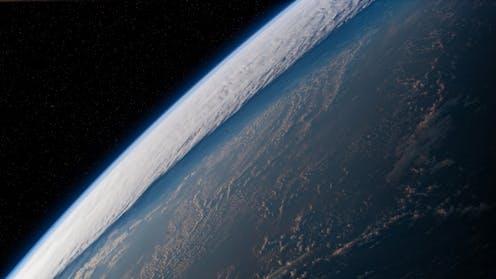
Earth must have experienced something exceptional 10 million years ago. Our study of rock samples from the floor of the Pacific Ocean has found a strange increase in the radioactive isotope beryllium-10 during that time.
This finding, now published in Nature Communications, opens new pathways for geologists to date past events gleaned from deep within the oceans.
But the cause of the beryllium-10 anomaly remains unknown. Could it have been major shifts in global ocean currents, a dying star, or an interstellar collision?
Extremely slow rocks deep in the ocean
I am on a hunt for stardust on Earth. Previously, I’ve sifted through snow in Antarctica. This time, it was the depths of the ocean.
At a depth of about 5,000 metres, the abyssal zone of the Pacific Ocean has never seen light, yet something does still grow there.
Ferromanganese crusts – metallic underwater rocks – grow from minerals dissolved in the water slowly coming together and solidifying over extremely long time scales, as little as a few millimetres in a million years. (Stalactites and stalagmites in caves grow in a similar way, but thousands of times faster.)
This makes ferromanganese crusts ideal archives for capturing stardust over millions of years.
The age of these crusts can be determined by radiometric dating using the radioactive isotope beryllium-10. This isotope is continuously produced in the upper atmosphere when highly energetic cosmic rays strike air molecules. The strikes break apart the main components of our air – nitrogen and oxygen – into smaller fragments.
Both stardust and beryllium-10 eventually find their way into Earth’s oceans where they become incorporated into the growing ferromanganese crust.
One of the largest ferromanganese crusts was recovered in 1976 from the Central Pacific. Stored for decades at the Federal Institute for Geosciences and Natural Resources in Hanover, Germany, a 3.7kg section of it became the subject of my analysis.
Much like tree rings reveal a tree’s age, ferromanganese crusts record their growth in layers over millions of years. Beryllium-10 undergoes radioactive decay really slowly, meaning it gradually breaks down over millions of years as it sits in the rocks.
As beryllium-10 decays over time, its concentration decreases in deeper, older sediment layers. Because the rate of decay is steady, we can use radioactive isotopes as natural stopwatches to discern the age and history of rocks – this is called radioactive dating.
A puzzling anomaly
After extensive chemical processing, my colleagues and I used accelerator mass spectrometry – an ultra-sensitive analytical technique for longer-lived radioactive isotopes – to measure beryllium-10 concentrations in the crust.
This time, my research took me from Canberra, Australia to Dresden, Germany, where the setup at the Helmholtz-Zentrum Dresden-Rossendorf was optimised for beryllium-10 measurements.
The results showed that the crust had grown only 3.5 centimetres over the past 10 million years and was more than 20 million years old.
However, before I could return to my search for stardust, I encountered an anomaly.
Initially, as I searched back in time, the beryllium-10 concentration declined as expected, following its natural decay pattern – until about 10 million years ago. At that point, the expected decrease halted before resuming its normal pattern around 12 million years ago.
This was puzzling: radioactive decay follows strict laws, meaning something must have introduced extra beryllium-10 into the crust at that time.
Scepticism is crucial in science. To rule out errors, I repeated the chemical preparation and measurements multiple times – yet the anomaly persisted. The analysis of different crusts from locations nearly 3,000km away gave the same result, a beryllium-10 anomaly around 10 million years ago. This confirmed that the anomaly was a real event rather than a local irregularity.

Ocean currents or exploding stars?
What could have happened on Earth to cause this anomaly 10 million years ago? We’re not sure, but there are a few options.
Last year, an international study revealed that the Antarctic Circumpolar Current – the main driver of global ocean circulation – intensified around 12 million years ago, influencing Antarctic ocean current patterns.
Could this beryllium-10 anomaly in the Pacific mark the beginning of the modern global ocean circulation? If ocean currents were responsible, beryllium-10 would be distributed unevenly on Earth with some samples even showing a lack of beryllium-10. New samples from all major oceans and both hemispheres would allow us to answer this question.
Another possibility emerged early last year. Astrophysicists demonstrated that a collision with a dense interstellar cloud could compress the heliosphere – the Sun’s protective shield against cosmic radiation – back to the orbit of Mercury. Without this barrier, Earth would be exposed to an increased cosmic ray flux, leading to an elevated global beryllium-10 production rate.
A near-Earth supernova explosion could also cause an increased cosmic ray flux leading to a beryllium-10 anomaly. Future research will explore these possibilities.
The discovery of such an anomaly is a windfall for geological dating. Various archives are used to investigate Earth’s climate, habitability and environmental conditions over different timescales.
To compare ice cores with sediments, ferromanganese crusts, speleothems (stalagmites and stalactites) and others, their timescales need to be synchronous. Independent time markers, such as Miyake events or the Laschamp excursion, are invaluable for aligning records thousands of years old. Now, we may have a corresponding time marker for millions of years.
Meanwhile, my search for stardust continues, but now keeping an eye out for new 10-million-year-old samples to further pin down the beryllium-10 anomaly. Stay tuned.


