

Long before debates over ‘wokeness’, Epicurus built a philosophy that welcomed slaves, women and outsiders
- Written by The Conversation
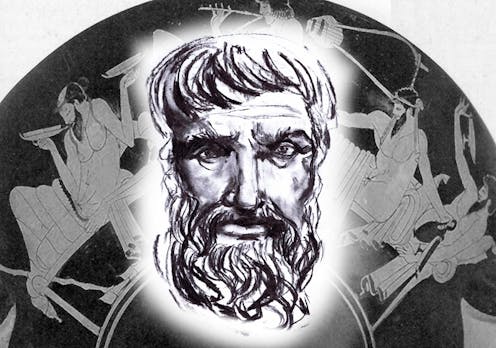
If you peruse the philosophy section of your local bookshop, you’ll probably find a number of books on Stoicism – an ancient philosophy enjoying a renaissance today. But where are the Epicureans?
Both philosophical schools were popular in the ancient world. However, while stoic works such as Meditations by Marcus Aurelius and Seneca’s letters still fill the shelves, alongside contemporary takes such as The Daily Stoic (2016), Epicureanism largely remains a historical curiosity.
Today, the Greek thinker Epicurus (341–270 BCE) is mostly remembered as the originator of the term “epicurean”, which describes someone devoted to sensual enjoyment, particularly of fine food and drink.
And while it’s true Epicurus argued pleasure is the highest human good, there’s a lot more to Epicureanism than merely savouring a glass of Shiraz with haute cuisine.
Philosophers in the garden
Epicurus was born on the island of Samos to Athenian parents. He studied philosophy in Athens before travelling to the island of Lesbos to establish a philosophical academy.

Upon returning to Athens in 306 BCE, he bought a tract of land and began a philosophical community known as the Garden.
The Garden was radically different from other philosophical communities at the time. While Plato’s Academy generally trained the children of the Athenian elite, and Aristotle tutored nobles such as Alexander the Great, Epicurus’ Garden was far more inclusive. Women and slaves were welcome to join the dialogue.
The community led a frugal life and practised total equality between men and women, which was uncommon at the time. In this atmosphere, noblewomen and courtesans, senators and slaves, all engaged in philosophical debate.
While many early Epicureans have disappeared from the annals of history, we know of some women, such as Leontion and Nikidion, who were early proponents of Epicurean thought.

Philosophy as a way of life
It isn’t just the Garden’s inclusivity that gives it contemporary appeal, but its entirely unique notion of what constitutes a philosophical life.
According to Epicurus, a philosopher wasn’t someone who taught or wrote philosophical tracts. A philosopher was someone who practised what the French philosopher Pierre Hadot describes, in his work on Epicureanism, as “a certain style of life”.
Epicureanism was a daily practice, rather than an academic discipline. Anyone who strove to live a philosophical life was part of the Epicurean community and was considered a philosopher.
The concept of philosophy Epicurus promoted was more egalitarian and all-encompassing than the narrow definition we often see used today.
The pursuit of pleasure
But what did it mean to be a practising Epicurean? Epicurus conceived of philosophy as a therapeutic practice. “We must concern ourselves with the healing of our own lives,” he wrote.
This process of healing involves developing an inner attitude of relaxation and tranquillity known as anesis in Ancient Greek. To do this, Epicureans sought to turn their minds away from the worries of life and focus instead on the simple joy of existence.
 Epicurus distinguished between different types of pleasure and advocated for a life of moderate pleasure, rather than excessive indulgence.
Wikimedia
Epicurus distinguished between different types of pleasure and advocated for a life of moderate pleasure, rather than excessive indulgence.
Wikimedia
According to Epicurus, unhappiness comes because we are afraid of things which should not be feared, and desire things which are not necessary and are beyond our control.
Most notably, he rejected the idea of an afterlife, arguing the soul did not continue to exist after death. He also argued it was wrong to fear death as it
gives no trouble when it comes [and] is but an empty pain in anticipation.
Instead of fearing punishment in the beyond, he said we should focus on the possibilities for pleasure in the here and now. But that doesn’t mean chasing every pleasure which comes our way; the task of the Epicurean is to understand which pleasures are worth pursuing.
The highest pleasures are not those which yield the highest intensity or last the longest, but those which are the least mixed with worry and the most likely to ensure peace of mind. In this vein, Epicurus sought to cultivate feelings of gratitude and appreciation for even the simplest everyday experiences.
While his critics cast him and his followers as unrestrained hedonists, he wrote in one letter that a single piece of cheese was as pleasurable as an entire feast.
For Epicureans, it is precisely the brevity of life that gives us such an exquisite capacity for pleasure. As one Epicurean Philodemus wrote:
Receive each additional moment of time in a manner appropriate to its value; as if one were having an incredible stroke of luck.
A philosophy for outsiders
Epicurus’ perennial appeal resides in how his philosophy gave strength and inspiration to outsiders. In the late 19th century, aesthetes such as critic Walter Pater and playwright Oscar Wilde praised Epicureanism as a way of life.
In Wilde’s letter De Profundis (From the depths) – written in 1897 while imprisoned in Reading Gaol on charges of indecency – he wrote that Pater’s novel Marius the Epicurean (1885) had given him both intellectual and spiritual solace during his trial.
Pater, too, had faced discrimination at Oxford for having homosexual relationships. His novel is an evocative celebration of the possibilities of a life lived in the pursuit of sensual and spiritual beauty.
In one of his earlier texts, The Renaissance (1873), Pater paraphrases Victor Hugo, writing
we are all under a sentence of death but with a sort of indefinite reprieve […] we have an interval, and then our place knows us no more. […] Our one chance lies in expanding that interval, in getting as many pulsations as possible into the given time.
This profoundly Epicurean sentiment, of a life lived in the interval, remains appealing to those who seek to turn their lives into a work of art.


