

Brisbane 2032 is no longer legally bound to be ‘climate positive’. Will it still leave a green legacy?
- Written by The Conversation
When Brisbane was awarded the 2032 Olympic and Paralympic Games, it came with a widely publicised landmark promise: the world’s first “climate-positive” games.
The International Olympic Committee had already announced all games would be climate-positive from 2030. It said this meant the games would be required to “go beyond” the previous obligation of reducing carbon emissions directly related to their operations and offsetting or otherwise “compensating” for the rest.
In other words, achieving net-zero was no longer sufficient. Now each organising committee would be legally required to remove more carbon from the atmosphere than the games emit. This is in keeping with the most widely cited definition of climate-positive.
Both Paris 2024 and Los Angeles 2028 made voluntary pledges. But Brisbane 2032 was the first contractually required to be climate-positive. This was enshrined in the original 2021 Olympic Host Contract, an agreement between the IOC, the State of Queensland, Brisbane City Council and the Australian Olympic Committee.
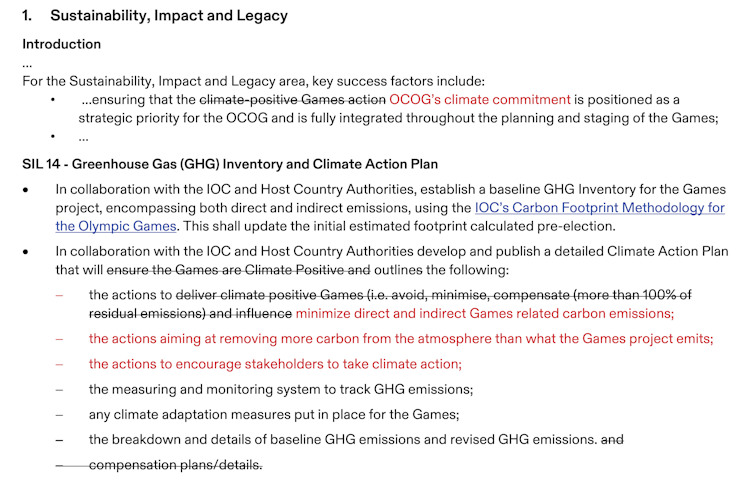
But the host contract has quietly changed since. All references to “climate-positive” have been replaced with weaker terminology. The move was not publicly announced. This fits a broader pattern of Olympic Games promising big on sustainability before weakening or abandoning commitments over time.
A quiet retreat from climate positive
Research by my team has shown the climate-positive announcement sparked great hope for the future of Brisbane as a regenerative city. We saw Brisbane 2032 as a once-in-a-lifetime opportunity to radically shift away from the ongoing systemic issues underlying urban development.
This vision to embrace genuinely sustainable city design centred on fostering circular economies and net positive development. It would have aligned urban development with ecological stewardship. Beyond just mitigating environmental harm, the games could have set a new standard for sustainability by becoming a catalyst to actively regenerate the natural environment.
Yet, on December 7 2023, the International Olympic Committee (IOC) initiated an addendum to the host contract. It effectively downgraded the games’ sustainability obligations.
It was signed by Brisbane City Council, the State of Queensland, the Australian Olympic Committee and the IOC between April and May 2024.

Asked about these amendments, the IOC replied it “took the decision to no longer use the term ‘climate-positive’ when referring to its climate commitments”.
But the IOC maintains that: “The requirements underpinning this term, however, and our ambition to address the climate crisis, have not changed”.
It said the terminology was changed to ensure that communications “are transparent and easily understood; that they focus on the actions implemented to reduce carbon emissions; and that they are aligned with best practice and current regulations, as well as the principle of continual improvement”.
Similarly, a Brisbane 2032 spokesperson told The Conversation the language was changed:
to ensure we are communicating in a transparent and easily understood manner, following advice from the International Olympic Committee and recommendations of the United Nations and European Union Green Claims Directive, made in 2023.
Brisbane 2032 will continue to plan, as we always have, to deliver a Games that focus on specific measures to deliver a more sustainable Games.
But the new wording commits Brisbane 2032 to merely “aiming at removing more carbon from the atmosphere than what the Games project emits”.
Crucially, this is no longer binding. The new language makes carbon removal an optional goal rather than a contractual requirement.

Aiming high, yet falling short
Olympic Games have adopted increasingly ambitious sustainability rhetoric. Yet, action in the real world typically falls short.
In our ongoing research with the Politecnico di Torino, Italy, we analysed sustainability commitments since the 2006 Winter Olympics in Turin. We found they often change over time. Initial promises are either watered down or abandoned altogether due to political, financial, and logistical pressures.
Construction activities for the Winter Olympic Games 2014 in Sochi, Russia, irreversibly damaged the Western Caucasus – a UNESCO World Heritage Site. Rio 2016 failed to clean up Guanabara Bay, despite its original pledge to reduce pollutants by 80%. Rio also caused large-scale deforestation and wetland destruction. Ancient forests were cleared for PyeongChang 2018 ski slopes.
Our research found a persistent gap between sustainability rhetoric and reality. Brisbane 2032 fits this pattern as the original promise of hosting climate-positive games is at risk of reverting to business as usual.
Victoria Park controversy
In 2021, a KPMG report for the Queensland government analysed the potential economic, social and environmental benefits of the Brisbane 2032 games.
It said the government was proposing to deliver the climate-positive commitment required to host the 2032 games through a range of initiatives. This included “repurposing and upgrading existing infrastructure with enhanced green star credentials”.
But plans for the Olympic stadium have changed a great deal since then. Plans to upgrade the Brisbane Cricket Ground, commonly known as the Gabba, have been replaced by a new stadium to be built in Victoria Park.
Victoria Park is Brisbane’s largest remaining inner-city green space. It is known to Indigenous peoples as Barrambin (the windy place). It is listed on the Queensland Heritage Register due to its great cultural significance.
Page 90 of the Olympic Host Contract prohibits permanent construction “in statutory nature areas, cultural protected areas and World Heritage sites”.
Local community groups and environmental advocates have vowed to fight plans for a Victoria Park stadium. This may include a legal challenge.
 The area of Victoria Park (64 hectares) compared with Central Park (341h), Regent’s Park (160h), Bois de Vicennes (995h).
Save Victoria Park
The area of Victoria Park (64 hectares) compared with Central Park (341h), Regent’s Park (160h), Bois de Vicennes (995h).
Save Victoria Park
What next?
The climate-positive commitment has been downgraded to an unenforceable aspiration. A new Olympic stadium has been announced in direct violation of the host contract. Will Brisbane 2032 still leave a green legacy?
Greater transparency and public accountability are needed. Otherwise, the original plan may fall short of the positive legacy it aspired to, before the Olympics even begin.


