

Giving up a daily coffee or weekly parma? How the cost-of-living crisis is reshaping our spending habits
- Written by The Conversation
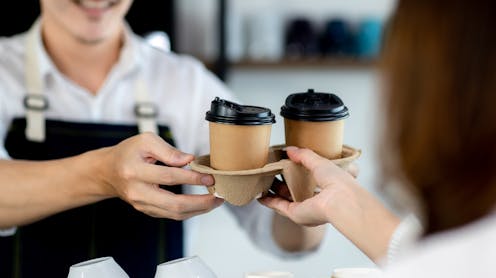
Remember when grabbing a coffee was just… grabbing a coffee? When a parma at the local was a budget meal? When Friday night takeaway was a reward for getting through the week? It didn’t require a financial spread sheet.
For many families navigating the cost-of-living crisis these small indulgences now have to be accounted for. They’re not just automatic purchases.
We’re not just cutting back on buying large discretionary items, like new cars. The impact of inflation on household budgets has fundamentally reshaped our relationship with food, social connection and small pleasures.
The current cost-of-living crisis can also create new spending habits. The ways we restructure our budgets can have lasting effects on our lives and local economies.
Price anchors
What five years ago was a A$3.80 coffee has now become $5.50 with some options as high as $7.00.
Despite the price change, customers have a mental reference point of what a coffee should cost from the pre-inflationary period.
Behavioural economists refer to this as “anchoring” – a rule of thumb price that purchase decisions are judged upon.
So if you are used to paying $5 for a daily coffee, any price above this is beyond what you see as reasonable value for money.
Look at parents at weekend sports matches. You’ll notice the increasing presence of the insulated mug full of homemade coffee, replacing the takeaway coffees from the local cafe.
For my family, Friday night was pizza night and $50 would easily feed a family of four. Then the inflationary price creep started. For us $70 was the tipping point. When the same order cost more we started making pizzas at home.
Mental accounting
Nobel laureate Richard Thaler introduced the concept of mental accounting in 1985, as a model of how we allocate money into to different categories for spending.
If the price is above our threshold point we mentally reassign its purchase to one of our other spending categories. It might shift from being an everyday item in our household budget to an occasionally purchased item.
Decision fatigue
During an inflation-fuelled cost-of-living crisis, we face not only financial strain but also significant decision fatigue from constant price revaluations.
This cognitive burden emerges as mental exhaustion when making even routine purchases.
Increasing pressure on our finances can trigger a scarcity mindset that consumes our thinking and affects our decision making.
Our focus shifts to immediate needs, such as paying weekly grocery bills, instead of long-term financial planning for a holiday or retirement.
The social cost
These new purchasing habits and economic shifts also have implications for our social connections. The cafe, the pub and takeaway night are not only about food but they are about community and building social connections.
The so-called third place is the place between work and home where you can be part of the community.
Buying goods is often accompanied by an exchange of conversation. As the cost-of-living crisis continues making fewer purchases reduces opportunities to connect.

If the little pleasures we consume as a daily or weekly ritual become luxuries, this can increase the loss of the third space. It means spaces such as cafes, restaurants and pubs no longer foster community cohesion and increase social capital.
As these goods become luxuries, social division intensifies. Rising prices exclude certain groups and may restrict social mixing across income levels.
What it means for businesses
A big question here is how much longer can some hospitality services survive as the cost-of-living crisis continues?
Australian Bureau of Statistics data reveals big changes for Australia’s café, restaurant and takeaway food industry.
After a severe downturn during early COVID-19 lockdowns (-35.3% in March-April 2020), the sector rebounded to pre-pandemic levels by March 2021. This was followed by extraordinary expansion during 2021-2022 (26.8% growth) as pent-up demand was unleashed.
But recent figures reveal a problem: while spending rose 3.76% from January 2024 to January 2025, real growth (adjusted for inflation) was negative at -0.43%.
Inflationary psychology explains how customers’ behaviour changes and they buy less over time. Eventually a point is reached where they won’t pay the higher price.
This means, in the case of the hospitality industry, fewer actual meals are being served due to higher prices.
The industry faces a tough situation with costs rising faster than general inflation due to expensive ingredients, higher wages from worker shortages, and increased energy prices.
Our happiness threshold
Humans have a set-point of happiness. When economic pressures mean we adjust to new spending patterns to save money for an extended period, the new patterns, become the norm.
Inflation, complicates social comparison. If everyone’s purchasing power falls simultaneously, relative positions may remain stable.
As the current cost-of-living crisis continues our little pleasures such as a weekly parma or daily coffee are increasingly becoming conscious choices rather than automatic purchases.
This has the potential to permanently change the way Australian households budget.


