

Bringing manufacturing back from overseas isn’t an easy solution to Trump’s trade war
- Written by The Conversation
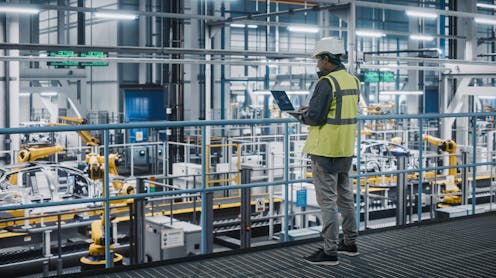
The past week has seen the United States single-handedly rewrite the underlying paradigm for global trade. And while it is fair to say that the methods are extreme, the underlying goal of the policy is not unique to the US.
Indeed, the push to support, and expand, domestic manufacturing through policy intervention is experiencing a resurgence not seen since the 1970s.
Many people believe the COVID pandemic exposed weaknesses in global supply chains. In reality, the pandemic simply accelerated an existing trend of slowing of integration.
Growing concerns around trade wars and risks from climate shock existed prior to COVID with both policymakers and firms rethinking globalisation strategies.
Countries were also becoming concerned about the manufacturing dominance of China and the potential weaponisation of economic activity.
The risks of rising concentration
The expansion of international trade has led to massive efficiencies in production.
But it has also led to concentration of certain sectors in certain regions. Examples include software development in Silicon Valley, semiconductor manufacturing in Taiwan and critical minerals processing in China.
This geographic concentration started to raise concerns for many countries. Reasons include climate events disrupting supply chains, pandemics and increasingly, geopolitical concerns.
In response to the rise in economic concentration, countries as diverse as Japan, South Korea, the European Union, India, Brazil and the US introduced policy actions to promote or return certain critical sectors to domestic production.
Australia’s Future Made In Australia plan is a prime example of this.
Trade disruptions
Even before the Trump tariffs, the US and other countries were alarmed by China’s control over key manufacturing sectors, and its associated ability to disrupt trade and commerce.
Australia experienced this first-hand when China imposed significant tariffs on wine and barley in response to Australia’s call for a COVID inquiry.
China’s willingness to use its economic position was demonstrated on Friday when it announced not just retaliatory tariffs, but export restrictions on seven categories of rare earth minerals. These are critical to strategic US sectors affecting companies like Apple and defence contractor Lockheed Martin.
Government support on the rise
This shift to increased economic resilience through self-reliance has led to a big surge in government intervention through industrial policies.
The objective of industrial policy is to target certain sectors in order to change the structure of economic activity within a country. It uses government policy to promote investment in sectors deemed under-served by markets.
While all countries have used some level of industrial policy, historically it was mainly confined to developing economies. It has been used sparingly since the 1970s. Between 2009 and 2017, the total number of industrial policies used by countries was less than 200.
Between 2017 and 2023 the use of industrial policy increased nine-fold. In 2023, there were roughly 2,500 industrial policy interventions put in place with two-thirds introduced by advanced economies. Almost 48% were concentrated in three: China, the EU and the US.
Intervening in markets
Generally, industrial policy has been out of favour with mainstream economists. It is very hard to get right as it relies on an in-depth knowledge of industries as well as an ability to predict the future.
Providing funding for one sector means less funding available for others. This could undermine new technologies or other as-yet unseen opportunities. It involves shifting resources from existing, efficient uses to less efficient uses.
It rarely works. A prime example are the many countries that have spent billions of dollars trying to recreate a domestic Silicon Valley with no success.
However, Trump is trying to do just that, on an economy-wide scale, mainly through tariffs. The tariffs announced also imply the US will go it alone. The approach takes fragmentation to a new level, where bilateral negotiations are the name of the game.
Shifting global alliances
Meanwhile the response from other nations such as Canada, Southeast Asian economies and even Europe, is to diversify and form new alliances without the US.
Indeed, the Canadian Prime Minister’s first trip overseas was not, as tradition dictates, to the US, but to Europe and the UK, whom he dubbed “reliable” partners.
Becoming more isolated and pushing other countries to China may not be what the US intends, but it is happening.
Last week, Japan and South Korea announced a joint strategy with China to promote regional trade. The EU’s trade representative went to Beijing shortly after the tariff announcement where the two nations announced plans to “deepen trade and investment” ties.
The risks of highly integrated supply chains in the face of security concerns, or changes in a trading partner’s domestic policy, have become glaringly clear.
How countries choose to address these concerns, especially through the widespread use of industrial policy, will create further disruption to markets. While it is considered politically expedient for security concerns, this will raise prices and limit choice in domestic markets. As the old adage reminds us, there is no free lunch.


