

Contemporary television is rarely as good as The Narrow Road to the Deep North
- Written by The Conversation
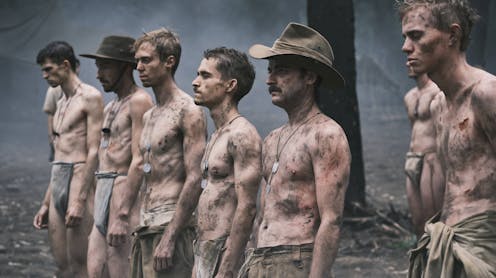
The Narrow Road to the Deep North stands as some of the most visceral and moving television produced in Australia in recent memory.
Marking a new accessibility and confidence to director Justin Kurzel, it reunites him with screenwriter Shaun Grant. Having produced some of the most compelling and confronting cinema on Australia’s darker history, this latest collaboration is no exception.
Their previous features Snowtown (2011), True History of the Kelly Gang (2020) and Nitram (2021) focused on disturbed psychopaths wanting to unleash their fury onto a society they blame for their own wrongs and injustices.
The Narrow Road to the Deep North, the World War II five episode miniseries, continues their exploration of Australia’s violent past while navigating a new direction in how they depict confused and damaged men.
Trauma of survival
Dorrigo Evans (Jacob Elordi/Ciarán Hinds) is a doctor sent to World War II. Captured during the Battle of Java he is taken as a prisoner of war (POW), where he is forced to lead his Australian soldiers on the building of the Burma-Thailand Railway.
Rather than an executor of violence, he is a pacifist and victim. Ultimately he has to make peace with his own trauma and guilt of survival when many around him perished – some of whom he knowingly sent to their inevitable death to ensure his own survival.
Faithfully adapted from Richard Flanagan’s novel, this production effectively creates interchanging timelines (seamlessly edited by Alexandre de Francesch) including prewar, war and postwar, and then flashes forward to Dorrigo in his mid-70s.
Elordi’s younger depiction of Dorrigo is filled with nuance and subtleties, often exuded through his stillness. This is harmoniously taken up by Hinds, who has to carry the weight of Dorrigo’s trauma and guilt decades later, with a worn and damaged quietness. Hinds is remarkable when faced to confront his celebrity as a war hero, desperate to give the truth over the expected yarns of mateship and heroism.
How do we tell the truth?
The Narrow Road to the Deep North has been scheduled to be released close to ANZAC Day, which always provokes broader conversations around the mythmaking and truth-telling of our war service and human sacrifice.
This production arrives as a thought-provoking essay on how military history continues to be told. Does the public really want accurate accounts, or more stories on mateship and heroism? Such questions filter dramatically across each episode and up to the final shot leaving us with much to consider.
As a war drama, The Narrow Road to the Deep North is almost entirely static. The combat the battalion engages in is eclipsed by the soldiers held as starving and malnourished prisoners, brutally forced in several graphic scenes to continue as slaves on the building of the railway at all costs.
The brutal and endless beating of Darky Gardiner (Thomas Weatherall), who crawls to the latrine full of excrement to drown himself, rather than endure more beating, is horrific but necessary to see the endless torture these skeletal and sick POWs are subjected to.

One misleading depiction Grant and Kurzel disappointingly do not amend from Flanagan’s novel is the view that the Burma Railway was constructed almost entirely by the bloody hands of Australian soldiers. In reality more than 90,000 Asian civilians died, and 16,000 POWs from several nations, including 2,800 Australians.
Moving across time
Cinematogropher Sam Chiplin brings a sense of gothic dread. The framing of every shot is masterful.
Odessa Young as Amy, Dorrigo’s true love, is a standout. She gives us someone struggling in a loveless marriage and desiring her husband’s nephew while she watches him sent to war. Her sense of entrapment in the quiet seaside Tasmanian coastal town is quite brilliantly realised.

Other performances worthy of mention are the Japanese soldiers tasked with the project of building the leg of the Burma-Thailand Railway. Major Nakamura (Shô Kasamatsu) is compelling as the scared and conflicted guard who ultimately spends his post-war years hiding among the ruins of Shinjuku to avoid capture as a war criminal.
Moving across the scenes and contrasting time frames is the haunting, unsettling and dissonant score by Jed Kurzel. Like the memories and trauma of the past, the music follows the characters across time and space.
Immaculate
Structurally immaculate, The Narrow Road to the Deep North is not defined by its brutal torture of the POWs or comradeship of the starving soldiers (though they are powerful to watch). Instead, it points us towards the quieter visions of characters having to sit alone with their distorted memories.
 The Narrow Road to the Deep North is a deeply compelling contribution to the Australian war genre.
Prime
The tonal inspiration may be drawn from earlier literary anti-war novels such as All Quiet on the Western Front (1930) and The Naked and the Dead (1948), but The Narrow Road to the Deep North is a work of its own depth and beauty. It will deserve its place as one of the most compelling contributions to the Australian war genre.
The final moments of cutting between the faces of Elordi and Hinds left me silent and reaching for a reread of Flanagan’s novel.
Contemporary television is rarely this good.
The Narrow Road to the Deep North is on Prime from April 18.


