

Used EV batteries could power vehicles, houses or even towns – if their manufacturers share vital data
- Written by The Conversation
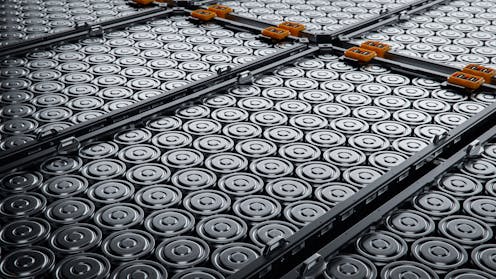
Around the world, more and more electric vehicles are hitting the road. Last year, more than 17 million battery-electric and hybrid vehicles were sold. Early forecasts suggest this year’s figure might reach 20 million. Nearly 20% of all cars sold today are electric.
But as more motorists go electric, it creates a new challenge – what to do with the giant batteries when they reach the end of their lives. That’s 12 to 15 years on average, though real-world data suggests it may be up to 40% longer. The average EV battery weighs about 450 kilograms.
By 2030, around 30,000 tonnes of EV batteries are expected to need disposal or recycling in Australia. By 2040, the figure is projected to be 360,000 tonnes and 1.6 million tonnes by 2050.
Is this a problem? Not necessarily. When a battery reaches the end of its life in a vehicle, it’s still got plenty of juice. Together, they could power smaller vehicles, houses or, when daisy-chained, even whole towns.
For this to work, though, we need better information. How healthy are these batteries? What are they made of? Have they ever been in an accident? At present, answers to these questions are hard to come by. That has to change.

Huge potential, challenging reality
Old EV batteries have huge potential. But it’s not going to be easy to realise this.
That’s because it’s hard to get accurate data on battery performance, how fast it’s degrading and the battery’s current state of health – how much capacity it has now versus how much it had when new.
Unfortunately, vehicle manufacturers often make it difficult to get access to this crucial information. And once a battery pack is removed, we can’t get access to its specific data.
This comes with real risks. If a battery has a fault or has been severely degraded, it could catch fire when opened or if used for an unsuitable role. Without data, recyclers are flying blind.
Reusing EV batteries will only be economically viable if there’s sufficient confidence in estimates of remaining capacity and performance.
Without solid data, investors and companies may hesitate to engage in the repurposing market due to the financial risks involved.
Extracting minerals from a battery
EV batteries are full of critical minerals such as nickel, cobalt, lithium and manganese. Nearly everything in an EV battery can be recycled – up to 95%.
Here, too, it’s not as easy as it should be. Manufacturers design batteries focusing on performance and safety with recyclability often an afterthought.
Battery packs are often sealed shut for safety, making it difficult to disassemble their thousands of individual cells. Dismantling these type of EV batteries is extremely labour-intensive and time-consuming. Some will have to be crushed and the minerals extracted afterwards.
EV batteries have widely differing chemistries, such as lithium iron phosphate and nickel manganese cobalt. But this vital information is often not included on the label.

Better ways of assessing battery health
Used EV batteries fall into three groups based on their state of health:
High (80% or more of original capacity): These batteries can be refurbished for reuse in similar applications, such as electric cars, mopeds, bicycles and golf carts. Some can be resized to suit smaller vehicles.
Medium (60-80%): These batteries can be repurposed for entirely different applications, such as stationary power storage or uninterruptible power supplies.
Low (below 60%): These batteries undergo shredding and refining processes to recover valuable minerals which can be used to make new batteries.
Researchers have recently succeeded in estimating the health of used EV batteries even without access to the battery’s data. But access to usage and performance data would still give better estimates.
What’s at stake?
An EV battery is a remarkable thing. But they rely on long supply chains and contain critical minerals, and their manufacture can cause pollution and carbon emissions.
Ideally, an EV battery would be exhausted before we recycle it. Repurposing these batteries will help reduce how many new batteries are needed.
If old batteries are stockpiled or improperly discarded, it leads to fire risk and potential contamination of soil and water.
Right now, it’s hard for companies and individuals to access each battery’s performance data. This means it’s much harder and more expensive to assess its health and remaining useful life. As a result, more batteries are being discarded or sent for recycling too early.
Recycling EV batteries is a well-defined process. But it’s energy-intensive and requires significant chemical treatments.
What needs to change?
At present, many battery manufacturers are wary of sharing battery performance data, due to concerns over intellectual property and other legal issues. This will have to change if society is to get the fullest use out of these complex energy storage devices. But these changes are unlikely to come from industry.
In 2021, California introduced laws requiring manufacturers to give recyclers access to data and battery state of health. Likewise, the European Union will require all EV batteries to come with a digital passport from January 2027, giving access to data on the battery’s health, chemistry and records of potentially harmful events such as accidents or charging at extreme temperatures.
Australia should follow suit – before we have a mountain of EV batteries and no way to reuse them.


