

Ways of Seeing at 50: an icy blast of a book about male voyeurism, art, capitalism and so much more
- Written by The Conversation
I still remember the shock when I first saw John Berger’s television series, Ways of Seeing, in 1972. In the years before Australia had colour television BBC art programs were often screened at the Art Gallery of NSW. (Previously the same venue had shown Kenneth Clark’s Civilisation).
Ways of Seeing was like a blast of icy water – Berger stripped away the gloss to expose the capitalist ideology behind polite narratives, such as Clark’s, tracing the rise of western culture.

 Poor quality, black and white illustrations …
Author provided
The corroding influence of money is perhaps Berger’s strongest argument. The price placed on art even influences which works are more likely to be valued in reproduction.
In the 1960s, for instance, photographic prints of Leonardo Da Vinci’s magnificent cartoon, The Virgin and Child with St Anne and the infant St John the Baptist, became the most popular sales item in the UK’s National Gallery bookshop, writes Berger. This was not because of beauty, the artist’s mastery of line, or the relationship between the figures – but because an American wanted to buy the original for £2.5 million. Art is placed in the service of Mammon.
Both the film and the book show, without comment, newspaper cuttings that include photographs of a great painting. There was no need to name the work as Titian’s Death of Actaeon, as it was so recently infamous.
In 1971 the painting had been sold to the J. Paul Getty Museum in the USA for the then record price of £1,763,000. The UK’s Reviewing Committee on the Export of Works of Art then gave one year for a British buyer to match the price. Eventually the money was raised by a combination of government funds, a philanthropic trust and an appeal to the general public.
This process, which saw the work enter the National Gallery, meant that for many years it was hard to separate Titian’s painting from the money paid.
 Titian’s The Death of Actaeon (circa 1559 and 1575).
Wikimedia Commons
Read more:
Art for trying times: Titian’s The Death of Actaeon and the capriciousness of fate
Berger claimed that greed is at the very core of the western tradition of oil painting – this is the medium that before photography could effectively imitate reality. It thus became a device for celebrating conspicuous consumption.
It is therefore not surprising that oil paintings, more than any other form of art, remain the subject of speculative investment today. The ability to create an illusion of abundance makes oil paintings especially attractive to those who wished to possess stuff.
Berger’s argument is aimed directly at British art historian Kenneth Clark, whose book Landscape into Art (1949) praised Gainsborough’s Mr and Mrs Andrews for the way the landscape was “painted with such love and mastery”.
Berger saw the painting differently:
among the pleasures their portrait gave to Mr and Mrs Andrews, was the pleasure of seeing themselves depicted as landowners and this pleasure was enhanced by the ability of oil paint to render their land in all its substantiality.
 Thomas Gainsborough, Mr and Mrs Andrews, circa 1750.
Wikimedia Commons
‘Men look at women’
The chapter of Ways of Seeing that most affected women art historians and curators of my generation was that in which Berger examines the western tradition as it panders to male voyeurism by depicting naked women as passive objects of desire.
“Men look at women,” he writes. “Women watch themselves being looked at.”
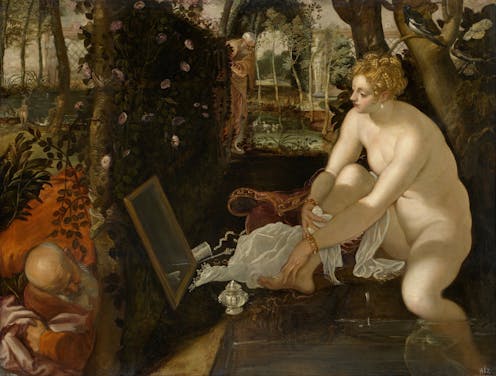
While Renaissance artists enjoyed painting classical nudes, they were especially fond of religious subjects with supposedly moral overtones. Tintoretto’s Susannah and the Elders (now renamed Susanna Bathing) was a perennial favourite. “We join the Elders,” wrote Berger, “to spy on Susannah taking her bath. She looks back at us looking at her.”
Whether the image is painted as a work of art, or reproduced as a soft-porn photograph, Berger argues the intent is the same:
Women are depicted in a quite different way from men – not because the feminine is different from the masculine – but because the ‘ideal’ spectator is always assumed to be male and the image of the woman is designed to flatter him.
Read more:
Explainer: what does the 'male gaze' mean, and what about a female gaze?
As with his critique of the landscape tradition, Berger takes direct aim at Clark whose 1956 book, The Nude, was devoted to the subject. For Clark, while naked bodies are without clothes, the nude is “a form of art”.
Berger sees it differently:
To be naked is to be oneself. To be nude is be seen naked by others and yet not recognised for oneself.
In the television series, Berger discusses the problems of this treatment of women’s bodies with five women, none of whom are identified as individuals. (They are, however, named at the end of the program: Anya Bostock, Eva Figes, Jane Kenrick, Barbara Niven and Carola Moon.) Their input is not acknowledged in the book.
The most articulate speaker is easily recognised as Bostock, a formidable intellect, a professional translator and a leading figure in second wave feminism. Known at that time as Anya Berger, she was John’s partner from 1958 until about 1974.
Life and influences
Ways of Seeing is more than an art historical attack on the propertied classes. At times, Berger is capable of capturing the very essence of the artist’s intention. When he discusses a late self-portrait by Rembrandt he writes:
All has gone except a sense of the question of existence, of existence as a question.
Still, as a critic, Berger can also be mocking. For instance he is dismissive of the eminent art historian, Seymour Slive’s description of the figures in Frans Hals’ late painting, Regentesses of the Old Men’s Alms house.
 Frans Hals’ Regentesses of the Old Men’s Alms House, Haarlem (1664).
Wikimedia Commons
Slive described the figures as “linked by a firm rhythmical arrangement and the subdued diagonal pattern formed by their heads and hands”. This formalist analysis, suggests Berger, is meaningless. Instead he sees the painting as a personal response:
The pauper has painted the people who administer the charity on which he depends. Hals was the first portraitist to paint the new characters and expressions created by capitalism.
Berger’s refreshing approach to art came in part from his initial education as a painter rather than as an art historian. He later became an art critic for The New Statesman.
 John Berger pictured in 2011.
Internaz/flickr, CC BY-NC-SA
Born in London in 1926, Berger may have spoken with the reassuring polished accent of the English upper class, but his family were ethnically Jewish immigrants from Italy. Given the cultural insularity of the English, it is understandable that he inclined towards Europe, and from the early 1960s lived in Geneva, and then France.
Berger’s eloquent visual argument on the reproduction of images effectively paraphrased the German philosopher Walter Benjamin, whose key essay, The Work of Art in the Age of Mechanical Reproduction, was written in 1935 but translated into English in 1969.
Berger’s other sources include the contemporary philosophers of the New Left, as well as older European philosophers whose work was not readily accessible in English.
Jonathan Conlin’s article, Lost in Transmission? John Berger and the Origins of Ways of Seeing (1972), analyses Berger’s archive in the British Library, showing both the breadth and depth of his reading. Conlin especially notes Berger’s early access to the writing of the Italian Marxist Antonio Gramsci, whose theory of cultural hegemony detailed connections between power and culture.
Berger was more than an art critic. His first novel, A Painter of Our Time (1958), was withdrawn from circulation by Secker & Warburg after political pressure. In 1974 Berger married Beverly Bancroft and they moved to Quincy in the French alps. Their life, that of their friends and a contemplation of the future for their son, became the subject of his script for the classic film, Jonah Who Will Be 25 in the Year 2000.
 Books by Berger.
Steve Bowbrick/flickr, CC BY
In an essay written in his old age Berger reflected on the long-term real impact of art:
I can’t tell you what art does and how it does it, but I know that often art has judged the judges, pleaded revenge to the innocent and shown to the future what the past suffered, so that it has never been forgotten.
I know too that the powerful fear art, whatever its form, when it does this, and that amongst the people such art sometimes runs like a rumour and a legend because it makes sense of what life’s brutalities cannot, a sense that unites us, for it is inseparable from a justice at last.
Of course, Berger did not see Ways of Seeing as the final work in how art may be seen and debated. His final sentence in the book is:
To be continued by the reader …


